Tecnologico de Monterrey, Escuela de Ingeniería y Ciencias. Ave. Eugenio Garza Sada 2501, Monterrey 64849, N.L., Mexico.
Biosensors (Basel). 2019 Jan 18;9(1):15. doi: 10.3390/bios9010015.
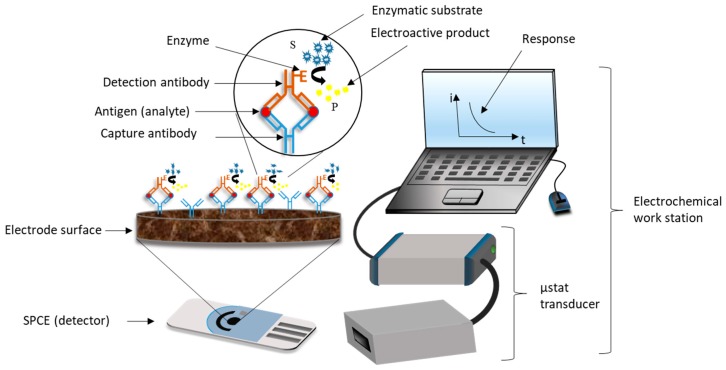
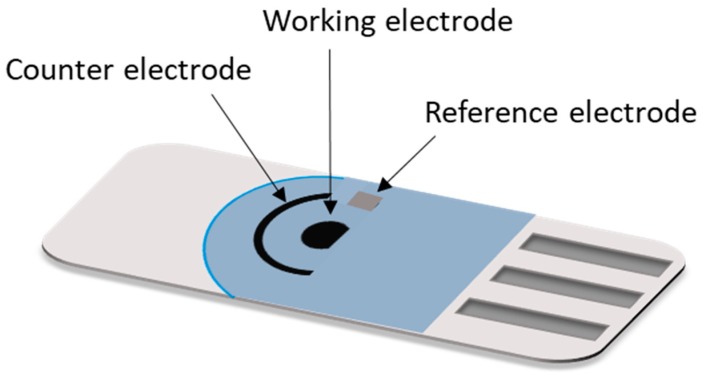
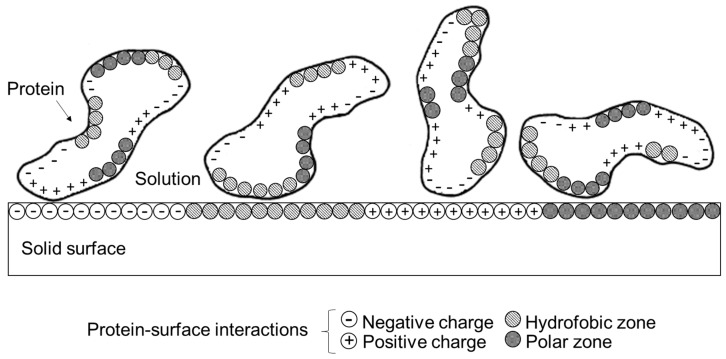
Electrochemical immunosensors, EIs, are systems that combine the analytical power of electrochemical techniques and the high selectivity and specificity of antibodies in a solid phase immunoassay for target analyte. In EIs, the most used transducer platforms are screen printed electrodes, SPEs. Some characteristics of EIs are their low cost, portability for point of care testing (POCT) applications, high specificity and selectivity to the target molecule, low sample and reagent consumption and easy to use. Despite all these attractive features, still exist one to cover and it is the enhancement of the sensitivity of the EIs. In this review, an approach to understand how this can be achieved is presented. First, it is necessary to comprise thoroughly all the complex phenomena that happen simultaneously in the protein-surface interface when adsorption of the protein occurs. Physicochemical properties of the protein and the surface as well as the adsorption phenomena influence the sensitivity of the EIs. From this point, some strategies to suppress non-specific binding, NSB, of proteins onto electrode surfaces in order to improve the sensitivity of EIs are mentioned.
电化学免疫传感器(EIs)是将电化学技术的分析能力与固相免疫分析中抗体的高选择性和特异性相结合的系统,用于目标分析物。在 EIs 中,最常用的换能器平台是丝网印刷电极(SPEs)。EIs 的一些特点是成本低、适用于即时检测(POCT)应用的便携性、对目标分子具有高特异性和选择性、低样品和试剂消耗以及易于使用。尽管具有所有这些吸引人的特点,但仍然存在一个需要克服的问题,那就是提高 EIs 的灵敏度。在这篇综述中,提出了一种理解如何实现这一目标的方法。首先,有必要彻底了解蛋白质吸附时在蛋白质-表面界面上同时发生的所有复杂现象。蛋白质和表面的物理化学性质以及吸附现象都会影响 EIs 的灵敏度。从这一点出发,提到了一些策略来抑制蛋白质在电极表面上的非特异性结合(NSB),以提高 EIs 的灵敏度。