Shemyakin and Ovchinnikov Institute of Bioorganic Chemistry, Russian Academy of Sciences, ul. Miklukho-Maklaya, Moscow 117997, Russia.
Center for Childhood Cancer and Blood Disorders, The Research Institute, Nationwide Children's Hospital, Columbus, OH 43205, USA.
Int J Mol Sci. 2019 Jan 21;20(2):443. doi: 10.3390/ijms20020443.
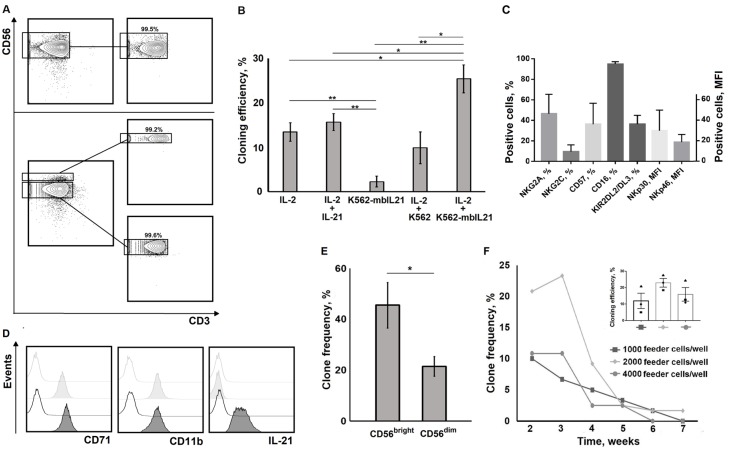
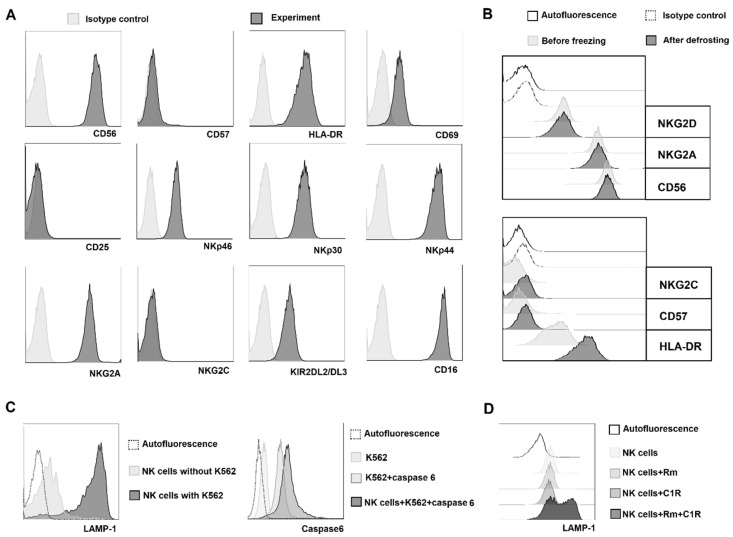
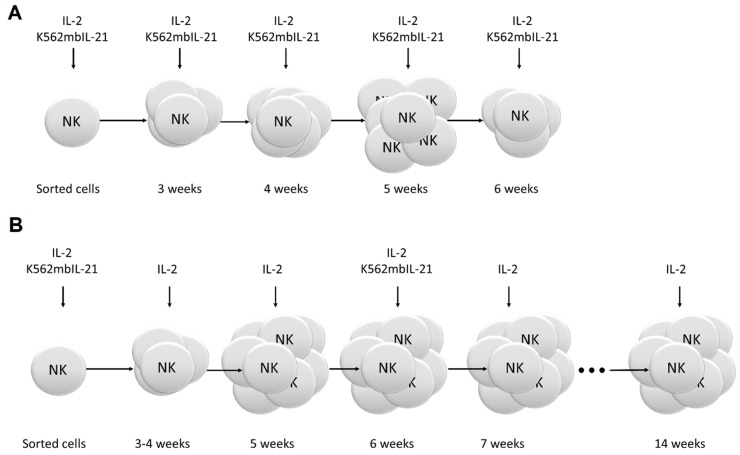
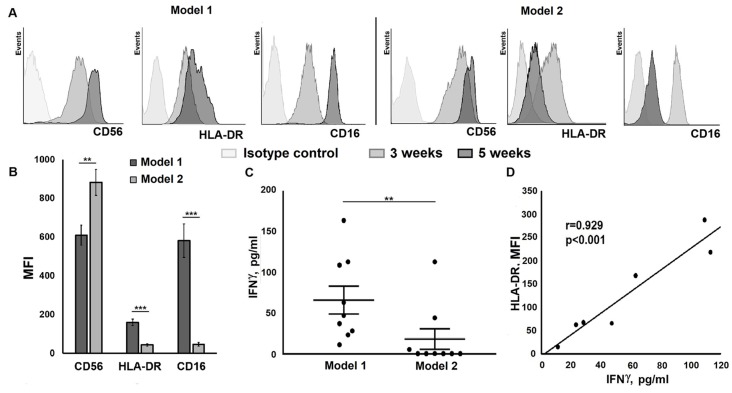
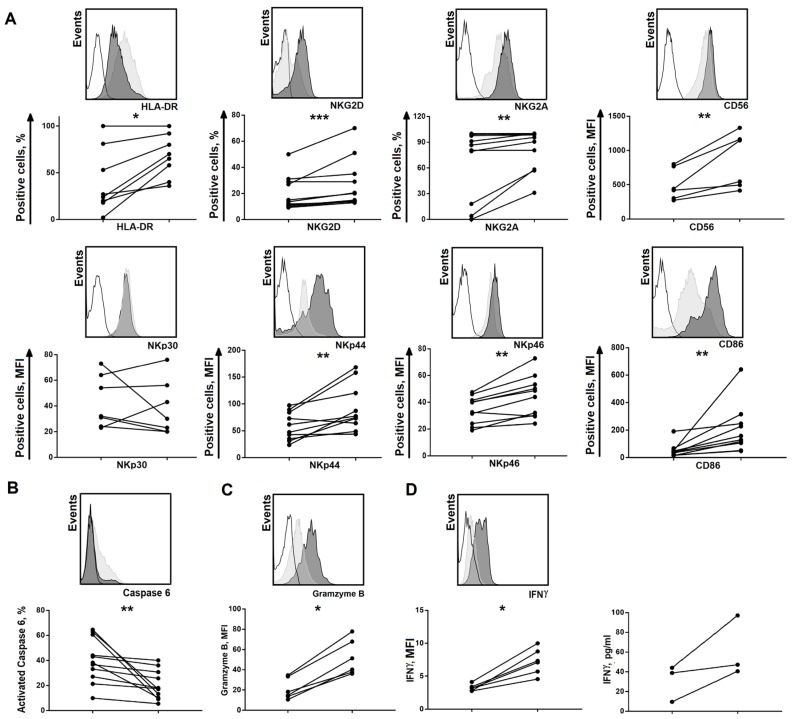
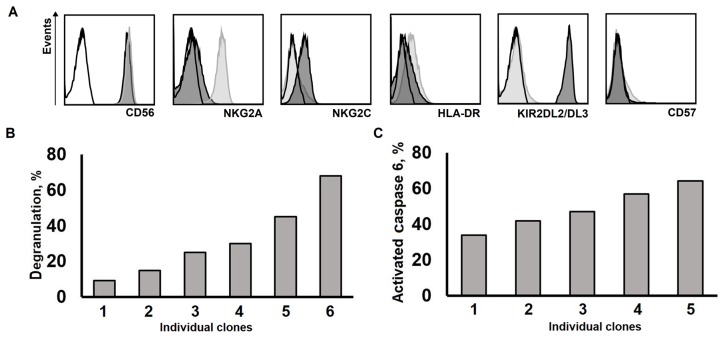
A pattern of natural killer cell (NK cell) heterogeneity determines proliferative and functional responses to activating stimuli in individuals. Obtaining the progeny of a single cell by cloning the original population is one of the ways to study NK cell heterogeneity. In this work, we sorted single cells into a plate and stimulated them via interleukin (IL)-2 and gene-modified K562 feeder cells that expressed membrane-bound IL-21 (K562-mbIL21), which led to a generation of phenotypically confirmed and functionally active NK cell clones. Next, we applied two models of clone cultivation, which differently affected their phenotype, lifespan, and functional activity. The first model, which included weekly restimulation of clones with K562-mbIL21 and IL-2, resulted in the generation of relatively short-lived (5⁻7 weeks) clones of highly activated NK cells. Levels of human leukocyte antigen class II molecule-DR isotype (HLA-DR) expression in the expanded NK cells correlated strongly with interferon-γ (IFN-γ) production. The second model, in which NK cells were restimulated weekly with IL-2 alone and once on the sixth week with K562-mbIL21 and IL-2, produced long-lived clones (8⁻14 weeks) that expanded up to 10⁷ cells with a lower ability to produce IFN-γ. Our method is applicable for studying variability in phenotype, proliferative, and functional activity of certain NK cell progeny in response to the stimulation, which may help in selecting NK cells best suited for clinical use.
自然杀伤细胞(NK 细胞)异质性的模式决定了个体对激活刺激的增殖和功能反应。通过克隆原始群体获得单个细胞的后代是研究 NK 细胞异质性的方法之一。在这项工作中,我们将单个细胞分拣到平板中,并通过白细胞介素(IL)-2 和基因修饰的表达膜结合 IL-21 的 K562 饲养细胞(K562-mbIL21)刺激它们,这导致表型确认和功能活性 NK 细胞克隆的产生。接下来,我们应用了两种克隆培养模型,它们对表型、寿命和功能活性有不同的影响。第一种模型包括每周用 K562-mbIL21 和 IL-2 对克隆进行再刺激,导致相对短暂寿命(5-7 周)的高度激活 NK 细胞克隆的产生。扩展的 NK 细胞中人白细胞抗原 II 类分子-DR 同种型(HLA-DR)的表达水平与干扰素-γ(IFN-γ)的产生强烈相关。第二种模型中,NK 细胞每周用 IL-2 单独再刺激,第 6 周用 K562-mbIL21 和 IL-2 再刺激一次,产生了寿命较长(8-14 周)的克隆,可扩展到 107 个细胞,IFN-γ的产生能力较低。我们的方法适用于研究特定 NK 细胞后代在刺激下的表型、增殖和功能活性的变异性,这可能有助于选择最适合临床应用的 NK 细胞。