Christopoulos Petros, Dietz Steffen, Kirchner Martina, Volckmar Anna-Lena, Endris Volker, Neumann Olaf, Ogrodnik Simon, Heussel Claus-Peter, Herth Felix J, Eichhorn Martin, Meister Michael, Budczies Jan, Allgäuer Michael, Leichsenring Jonas, Zemojtel Tomasz, Bischoff Helge, Schirmacher Peter, Thomas Michael, Sültmann Holger, Stenzinger Albrecht
Department of Thoracic Oncology, Heidelberg University Hospital, Heidelberg 69126, Germany.
Translational Lung Research Center Heidelberg (TLRC-H), Member of the German Center for Lung Research (DZL), Heidelberg 69120, Germany.
Cancers (Basel). 2019 Jan 21;11(1):124. doi: 10.3390/cancers11010124.
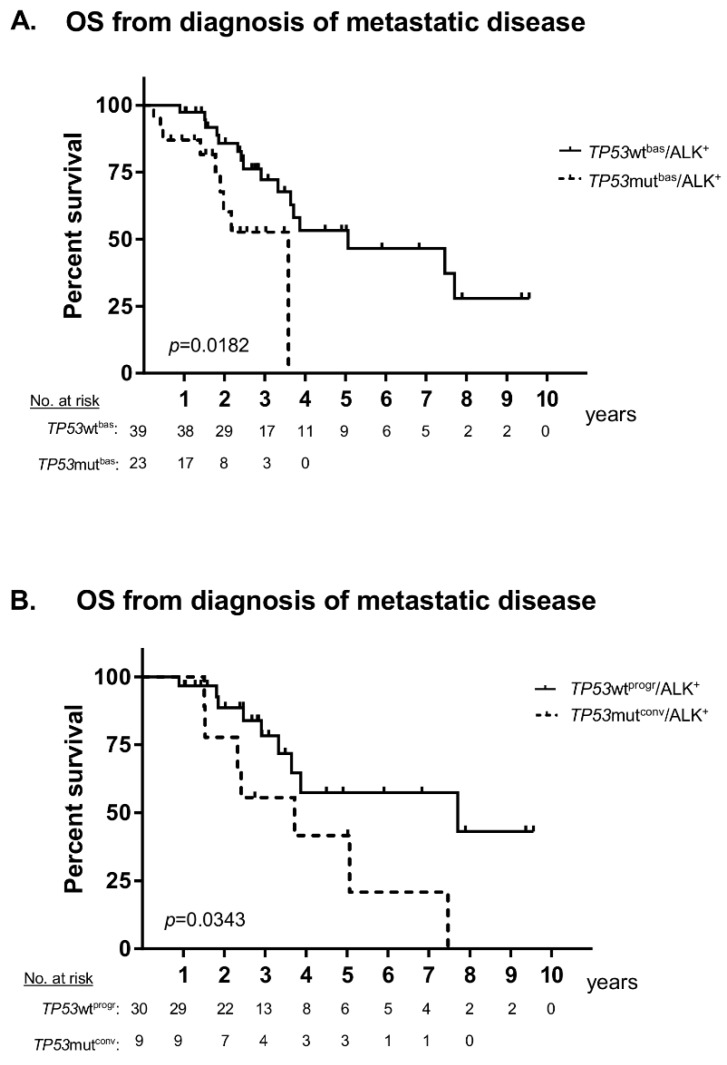
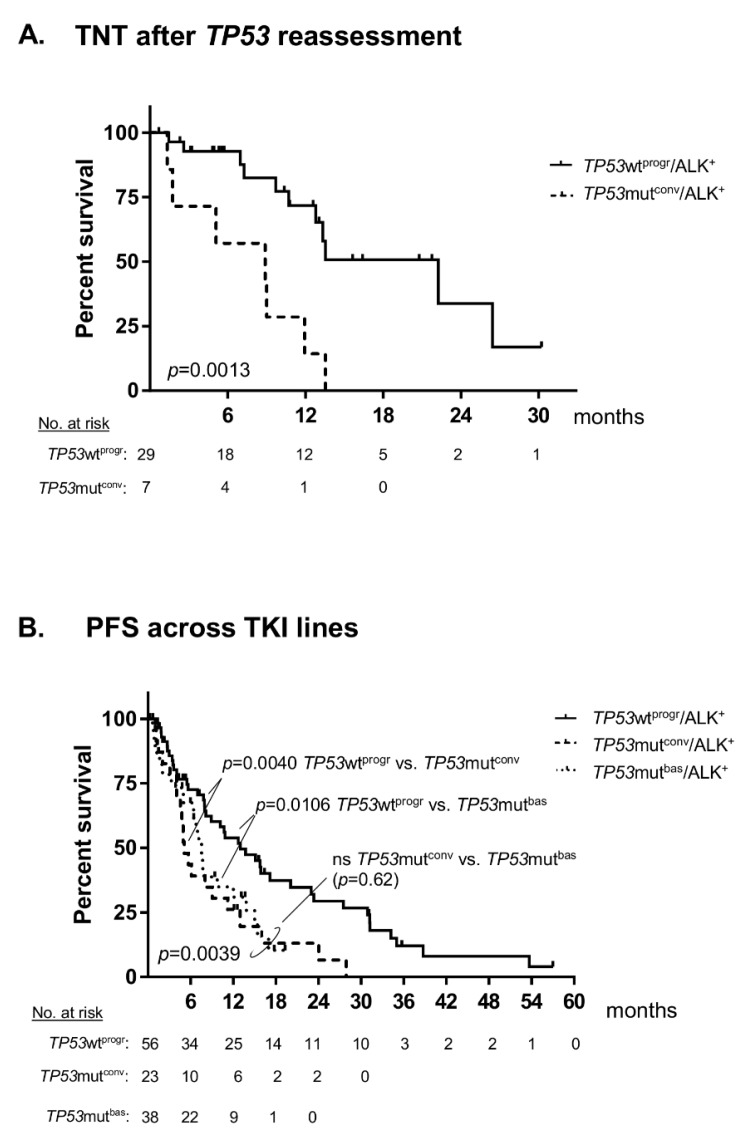
Anaplastic lymphoma kinase (ALK) sequencing can identify resistance mechanisms and guide next-line therapy in ALK+ non-small-cell lung cancer (NSCLC), but the clinical significance of other rebiopsy findings remains unclear. We analysed all stage-IV ALK+ NSCLC patients with longitudinally assessable TP53 status treated in our institutions (n = 62). Patients with TP53 mutations at baseline (TP53mutbas, n = 23) had worse overall survival (OS) than patients with initially wild-type tumours (TP53wtbas, n = 39, 44 vs. 62 months in median, p = 0.018). Within the generally favourable TP53wtbas group, detection of TP53 mutations at progression defined a "converted" subgroup (TP53mutconv, n = 9) with inferior OS, similar to that of TP53mutbas and shorter than that of patients remaining TP53 wild-type (TP53wtprogr, 45 vs. 94 months, p = 0.043). Progression-free survival (PFS) under treatment with tyrosine kinase inhibitors (TKI) for TP53mutconv was comparable to that of TP53mutbas and also shorter than that of TP53wtprogr cases (5 and 8 vs. 13 months, p = 0.0039). Fewer TP53wtprogr than TP53mutbas or TP53mutconv cases presented with metastatic disease at diagnosis (67% vs. 91% or 100%, p < 0.05). Thus, acquisition of TP53 mutations at progression is associated with more aggressive disease, shorter TKI responses and inferior OS in ALK+ NSCLC, comparable to primary TP53 mutated cases.
间变性淋巴瘤激酶(ALK)测序可识别ALK阳性非小细胞肺癌(NSCLC)的耐药机制并指导二线治疗,但其他再次活检结果的临床意义仍不明确。我们分析了在我们机构接受治疗的所有具有纵向可评估TP53状态的IV期ALK阳性NSCLC患者(n = 62)。基线时存在TP53突变的患者(TP53mutbas,n = 23)的总生存期(OS)比初始肿瘤为野生型的患者(TP53wtbas,n = 39,中位生存期分别为44个月和62个月,p = 0.018)更差。在总体预后较好的TP53wtbas组中,疾病进展时检测到TP53突变定义了一个“转化”亚组(TP53mutconv,n = 9),其OS较差,与TP53mutbas组相似且短于仍为TP53野生型的患者(TP53wtprogr,45个月对94个月,p = 0.043)。TP53mutconv患者接受酪氨酸激酶抑制剂(TKI)治疗的无进展生存期(PFS)与TP53mutbas组相当,也短于TP53wtprogr病例(分别为5个月、8个月对13个月,p = 0.0039)。TP53wtprogr病例在诊断时出现转移性疾病的比例低于TP53mutbas或TP53mutconv病例(67%对91%或100%,p < 0.05)。因此,疾病进展时获得TP53突变与ALK阳性NSCLC中更具侵袭性的疾病、更短的TKI反应及更差OS相关,与原发性TP53突变病例相当。