Novo Nordisk Foundation Center for Basic Metabolic Research, Faculty of Health and Medical Sciences, University of Copenhagen, Copenhagen, 2200, Denmark.
Department of Environmental Medicine and Public Health, The Icahn School of Medicine at Mount Sinai, New York, 10029, NY, USA.
Nat Commun. 2019 Jan 22;10(1):376. doi: 10.1038/s41467-018-08008-w.
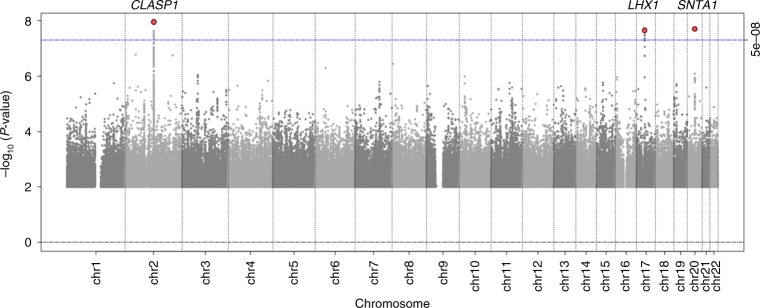
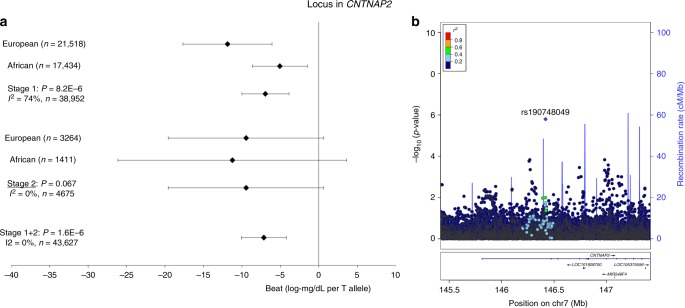
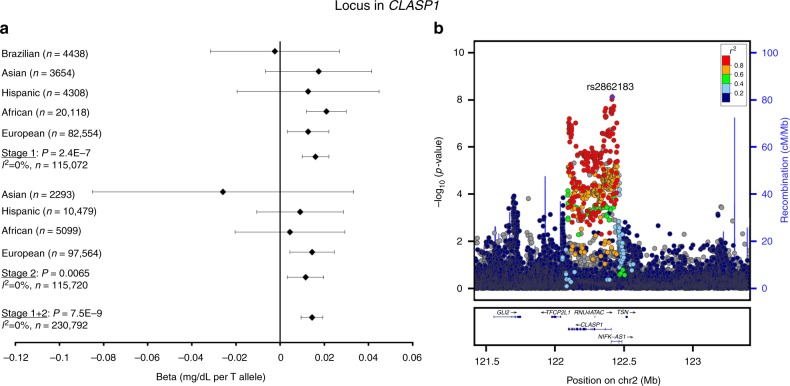
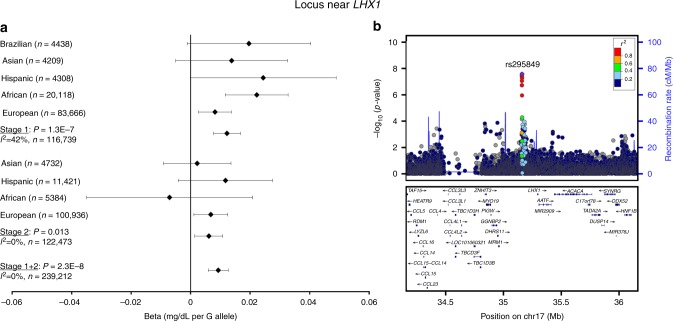
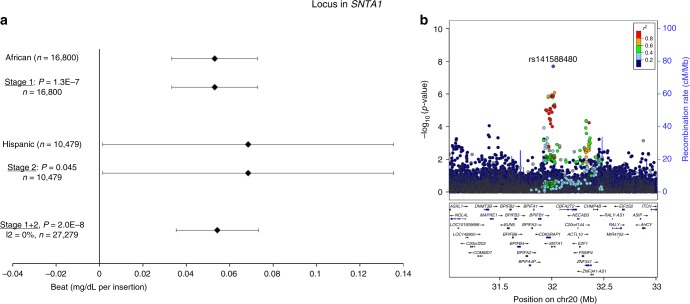
Many genetic loci affect circulating lipid levels, but it remains unknown whether lifestyle factors, such as physical activity, modify these genetic effects. To identify lipid loci interacting with physical activity, we performed genome-wide analyses of circulating HDL cholesterol, LDL cholesterol, and triglyceride levels in up to 120,979 individuals of European, African, Asian, Hispanic, and Brazilian ancestry, with follow-up of suggestive associations in an additional 131,012 individuals. We find four loci, in/near CLASP1, LHX1, SNTA1, and CNTNAP2, that are associated with circulating lipid levels through interaction with physical activity; higher levels of physical activity enhance the HDL cholesterol-increasing effects of the CLASP1, LHX1, and SNTA1 loci and attenuate the LDL cholesterol-increasing effect of the CNTNAP2 locus. The CLASP1, LHX1, and SNTA1 regions harbor genes linked to muscle function and lipid metabolism. Our results elucidate the role of physical activity interactions in the genetic contribution to blood lipid levels.
许多遗传基因座影响循环脂质水平,但目前尚不清楚生活方式因素(如体育活动)是否会改变这些遗传效应。为了确定与体育活动相互作用的脂质基因座,我们对欧洲、非洲、亚洲、西班牙裔和巴西血统的多达 120979 人的循环高密度脂蛋白胆固醇、低密度脂蛋白胆固醇和甘油三酯水平进行了全基因组分析,并在另外 131012 人的随访中对提示性关联进行了分析。我们发现了四个基因座,位于/附近 CLASP1、LHX1、SNTA1 和 CNTNAP2,这些基因座通过与体育活动的相互作用与循环脂质水平相关;较高水平的体育活动增强了 CLASP1、LHX1 和 SNTA1 基因座对高密度脂蛋白胆固醇的升高作用,并减弱了 CNTNAP2 基因座对低密度脂蛋白胆固醇的升高作用。CLASP1、LHX1 和 SNTA1 区域包含与肌肉功能和脂质代谢相关的基因。我们的研究结果阐明了体育活动相互作用在血液脂质水平遗传贡献中的作用。