Center for Nanoscale Materials, Argonne National Laboratory, Argonne, IL, 60439, USA.
Department of Mechanical Engineering, University of Louisville, Louisville, KY, 40292, USA.
Nat Commun. 2019 Jan 22;10(1):379. doi: 10.1038/s41467-018-08222-6.
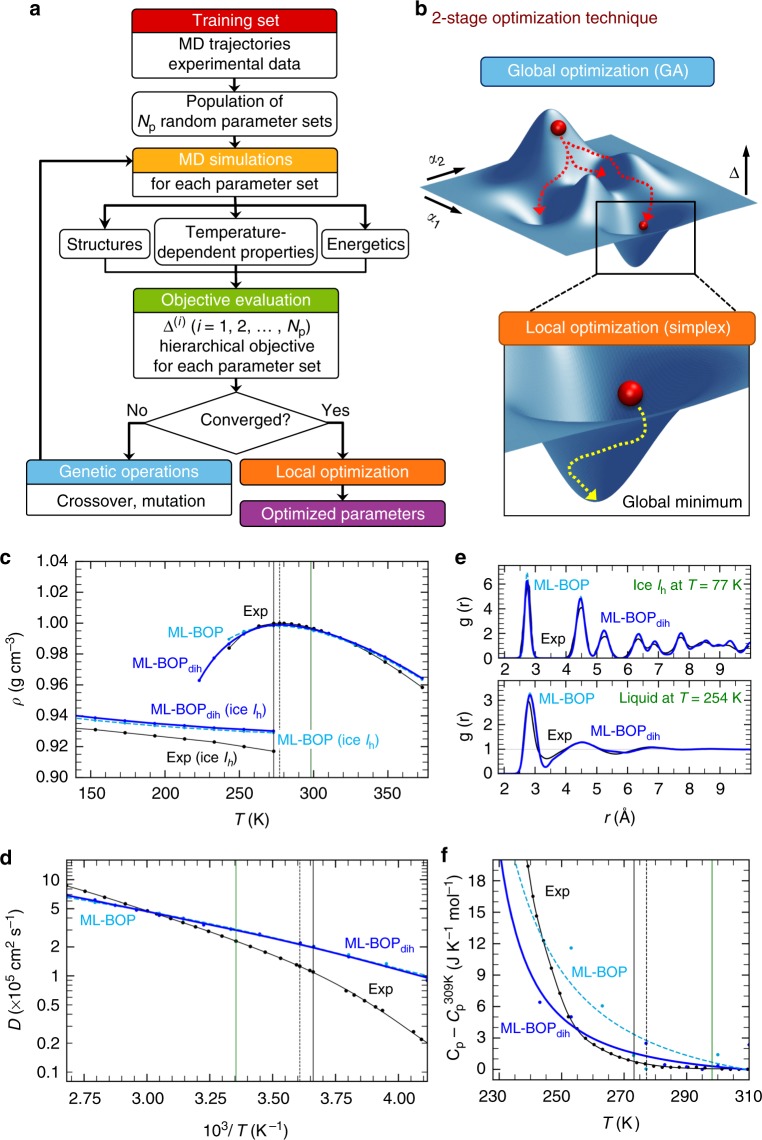
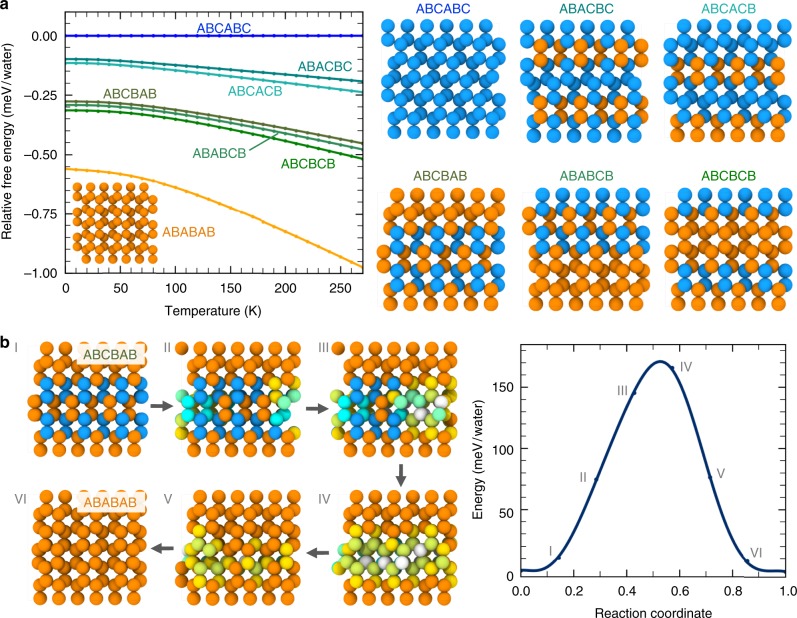
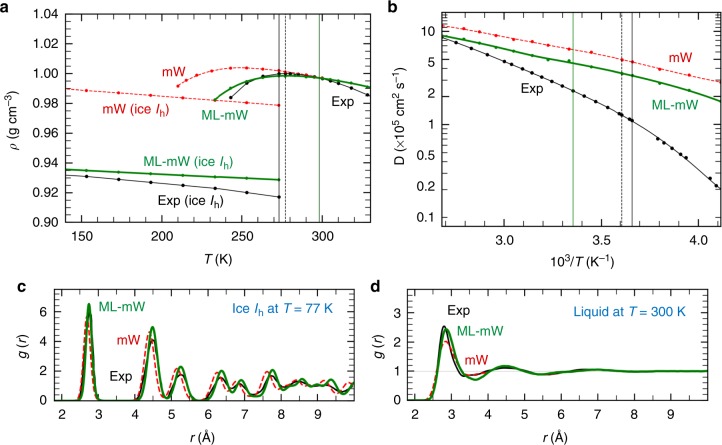
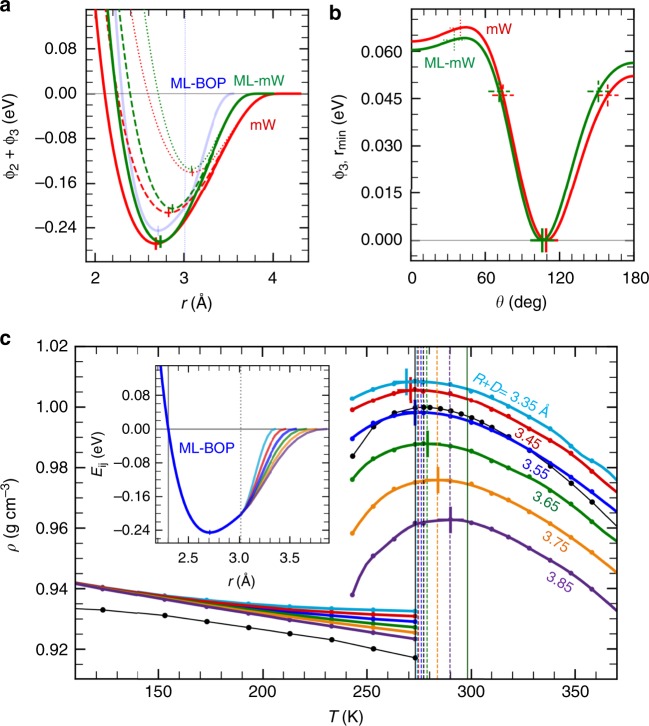
An accurate and computationally efficient molecular level description of mesoscopic behavior of ice-water systems remains a major challenge. Here, we introduce a set of machine-learned coarse-grained (CG) models (ML-BOP, ML-BOP, and ML-mW) that accurately describe the structure and thermodynamic anomalies of both water and ice at mesoscopic scales, all at two orders of magnitude cheaper computational cost than existing atomistic models. In a significant departure from conventional force-field fitting, we use a multilevel evolutionary strategy that trains CG models against not just energetics from first-principles and experiments but also temperature-dependent properties inferred from on-the-fly molecular dynamics (~ 10's of milliseconds of overall trajectories). Our ML BOP models predict both the correct experimental melting point of ice and the temperature of maximum density of liquid water that remained elusive to-date. Our ML workflow navigates efficiently through the high-dimensional parameter space to even improve upon existing high-quality CG models (e.g. mW model).
准确且高效地描述冰-水体系的介观行为仍然是一个重大挑战。在这里,我们引入了一组基于机器学习的粗粒化(CG)模型(ML-BOP、ML-BOP 和 ML-mW),这些模型可以在介观尺度上准确描述水和冰的结构和热力学异常,其计算成本比现有的原子模型低两个数量级。与传统的力场拟合方法有显著不同的是,我们使用了一种多层次的进化策略,不仅针对第一性原理和实验的能量,还针对从分子动力学(~ 10 毫秒的总轨迹)即时推断出的温度相关性质来训练 CG 模型。我们的 ML-BOP 模型不仅预测了冰的正确实验熔点,还预测了液体水的最大密度温度,这是迄今为止难以捉摸的。我们的 ML 工作流程能够高效地遍历高维参数空间,甚至可以改进现有的高质量 CG 模型(例如 mW 模型)。