Berbert Taisa Rocha Navasconi, de Mello Tatiane França Perles, Wolf Nassif Priscila, Mota Camila Alves, Silveira Aline Verzignassi, Duarte Giovana Chiqueto, Demarchi Izabel Galhardo, Aristides Sandra Mara Alessi, Lonardoni Maria Valdrinez Campana, Vieira Teixeira Jorge Juarez, Silveira Thaís Gomes Verziganassi
Graduate Program in Health Sciences, State University Maringá, Avenida Colombo, 5790 Jardim Universitário, 87020-900, Maringá, PR, Brazil.
Graduate Program in Bioscience and Physiopathology, State University Maringá, Avenida Colombo, 5790 Jardim Universitário, 87020-900 Maringá, PR, Brazil.
Dermatol Res Pract. 2018 Dec 24;2018:9014726. doi: 10.1155/2018/9014726. eCollection 2018.
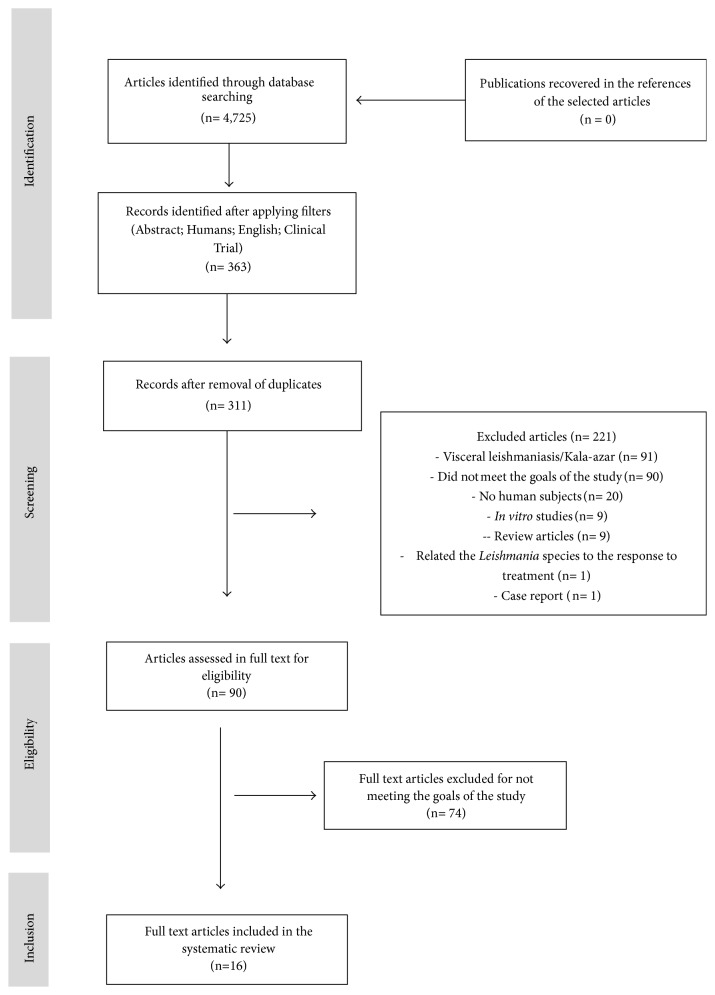
The first choice drugs for the treatment of cutaneous and mucocutaneous leishmaniasis are pentavalent antimonials, sodium stibogluconate, or meglumine antimoniate. However, the treatment with these drugs is expensive, can cause serious adverse effects, and is not always effective. The combination of two drugs by different routes or the combination of an alternative therapy with systemic therapy can increase the efficacy and decrease the collateral effects caused by the reference drugs. In this systematic review we investigated publications that described a combination of nonconventional treatment for cutaneous and mucocutaneous with pentavalent antimonials. A literature review was performed in the databases Web of Knowledge and PubMed in the period from 01 of December 2004 to 01 of June 2017, according to Prisma statement. Only clinical trials involving the treatment for cutaneous or mucocutaneous leishmaniasis, in English, and with available abstract were added. Other types of publications, such as reviews, case reports, comments to the editor, letters, interviews, guidelines, and errata, were excluded. Sixteen articles were selected and the pentavalent antimonials were administered in combination with pentoxifylline, granulocyte macrophage colony-stimulating factor, imiquimod, intralesional sodium stibogluconate, ketoconazole, silver-containing polyester dressing, lyophilized LEISH-F1 protein, cryotherapy, topical honey, and omeprazole. In general, the combined therapy resulted in high rates of clinical cure and when relapse or recurrence was reported, it was higher in the groups treated with pentavalent antimonials alone. The majority of the articles included in this review showed that cure rate ranged from 70 to 100% in patients treated with the combinations. Serious adverse effects were not observed in patients treated with drugs combination. The combination of other drugs or treatment modalities with pentavalent antimonials has proved to be effective for cutaneous and mucocutaneous leishmaniasis and for most seemed to be safe. However, new randomized, controlled, and multicentric clinical trials with more robust samples should be performed, especially the combination with immunomodulators.
治疗皮肤和黏膜皮肤利什曼病的首选药物是五价锑剂,如葡萄糖酸锑钠或葡甲胺锑酸盐。然而,使用这些药物进行治疗费用高昂,会导致严重的不良反应,且并非总是有效。通过不同途径联合使用两种药物,或替代疗法与全身治疗相结合,可提高疗效并减少参考药物引起的副作用。在本系统评价中,我们调查了描述非传统疗法与五价锑剂联合治疗皮肤和黏膜皮肤利什曼病的出版物。根据Prisma声明,于2004年12月1日至2017年6月1日期间在Web of Knowledge和PubMed数据库中进行了文献综述。仅纳入了涉及皮肤或黏膜皮肤利什曼病治疗、英文撰写且有可用摘要的临床试验。其他类型的出版物,如综述、病例报告、给编辑的评论、信件、访谈、指南和勘误表等均被排除。共筛选出16篇文章,其中五价锑剂与己酮可可碱、粒细胞巨噬细胞集落刺激因子、咪喹莫特、皮损内注射葡萄糖酸锑钠、酮康唑、含银聚酯敷料、冻干的LEISH - F1蛋白、冷冻疗法、局部用蜂蜜和奥美拉唑联合使用。总体而言,联合治疗的临床治愈率较高,当报告有复发或再发情况时,单独使用五价锑剂治疗的组复发率更高。本综述纳入的大多数文章表明,联合治疗的患者治愈率在70%至100%之间。联合用药治疗的患者未观察到严重不良反应。其他药物或治疗方式与五价锑剂联合使用已被证明对皮肤和黏膜皮肤利什曼病有效,且大多数似乎是安全的。然而,应开展样本量更大、更有力的新的随机、对照和多中心临床试验,尤其是与免疫调节剂联合使用的试验。