Cvetanovich Gregory L, Fillingham Yale A, O'Brien Michael, Forsythe Brian, Cole Brian J, Verma Nikhil N, Romeo Anthony A, Nicholson Gregory P
Department of Orthopaedic Surgery, Rush University Medical Center, Chicago, IL, USA.
JSES Open Access. 2018 Feb 6;2(1):23-27. doi: 10.1016/j.jses.2018.01.002. eCollection 2018 Mar.
Tranexamic acid (TXA) is an antifibrinolytic that has been shown to decrease blood loss and transfusion rates after hip and knee arthroplasty, with only limited evidence to support its use in shoulder arthroplasty. This study was conducted to determine whether intravenous (IV) TXA is more effective than placebo in reducing blood loss after primary total shoulder arthroplasty (TSA).
In this prospective, double-blind, placebo-controlled, randomized clinical trial, patients undergoing primary anatomic and reverse TSA were randomized to receive 1 g of intravenous TXA or a placebo of an equivalent volume of intravenous normal saline administered 10 minutes before the incision. The primary outcome measurement was calculated postoperative blood loss. Secondary outcomes included transfusion rates, weight of hemoglobin loss, hospital length of stay, and thromboembolic events.
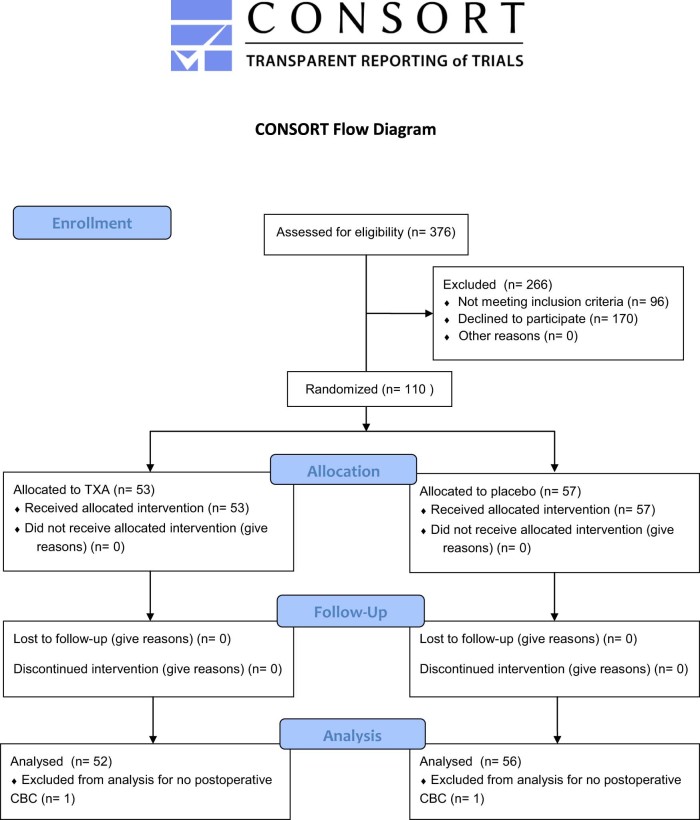
The study enrolled 110 patients, 2 of whom were excluded because they did not have a postoperative hemoglobin measurement, and the remaining 108 patients (52 for TXA, 56 for placebo) were analyzed. There were no significant differences between TXA and placebo groups in preoperative characteristics. For the primary outcome, the TXA group had significantly lower postoperative blood loss of 1100.9 ± 367.4 mL compared with 1274.5 ± 460.0 mL for the placebo group ( = .03). For secondary outcomes, TXA had lower weight of hemoglobin loss compared with placebo (152.2 ± 57.3 g vs. 178.0 ± 65.8 g; = .03). No patients in the TXA or placebo groups required a transfusion.
Intravenous TXA reduced blood loss after primary TSA compared with placebo.
氨甲环酸(TXA)是一种抗纤维蛋白溶解剂,已被证明可减少髋关节和膝关节置换术后的失血量及输血率,但仅有有限证据支持其在肩关节置换术中的应用。本研究旨在确定静脉注射氨甲环酸在减少初次全肩关节置换术(TSA)后失血量方面是否比安慰剂更有效。
在这项前瞻性、双盲、安慰剂对照、随机临床试验中,接受初次解剖型和反向TSA的患者被随机分为两组,一组在切口前10分钟接受1克静脉注射氨甲环酸,另一组接受等量静脉生理盐水安慰剂。主要结局指标为术后失血量。次要结局包括输血率、血红蛋白丢失量、住院时间和血栓栓塞事件。
该研究共纳入110例患者,其中2例因未进行术后血红蛋白测量而被排除,其余108例患者(氨甲环酸组52例,安慰剂组56例)进行了分析。氨甲环酸组和安慰剂组术前特征无显著差异。对于主要结局,氨甲环酸组术后失血量显著低于安慰剂组,分别为1100.9±367.4毫升和1274.5±460.0毫升(P = 0.03)。对于次要结局,氨甲环酸组血红蛋白丢失量低于安慰剂组(152.2±57.3克 vs. 178.0±65.8克;P = 0.03)。氨甲环酸组和安慰剂组均无患者需要输血。
与安慰剂相比,静脉注射氨甲环酸减少了初次TSA后的失血量。