Amgen Inc., Thousand Oaks, CA, USA.
Denver Nephrology Research Division, Denver, CO, USA.
Clin Pharmacol Drug Dev. 2019 Apr;8(3):281-289. doi: 10.1002/cpdd.650. Epub 2019 Jan 24.
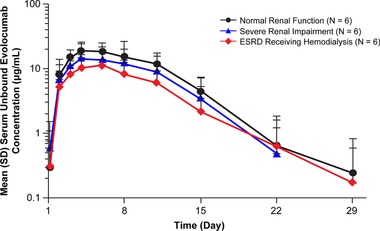
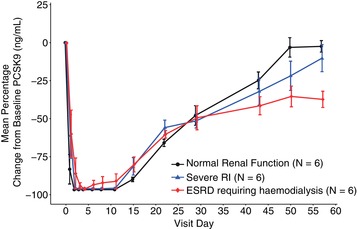
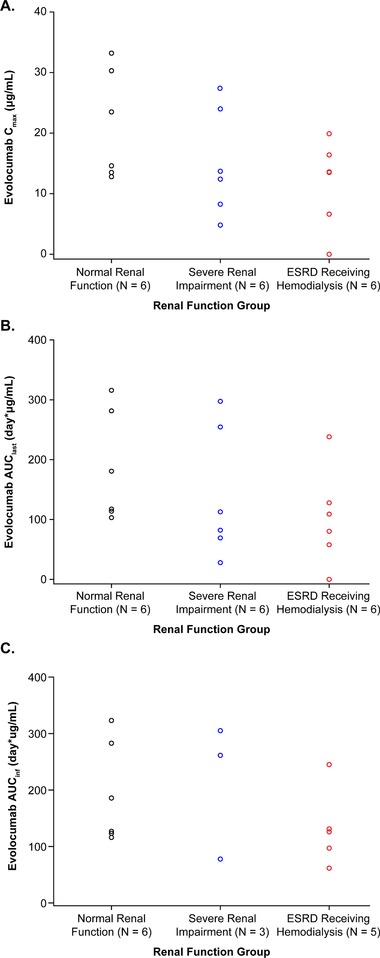
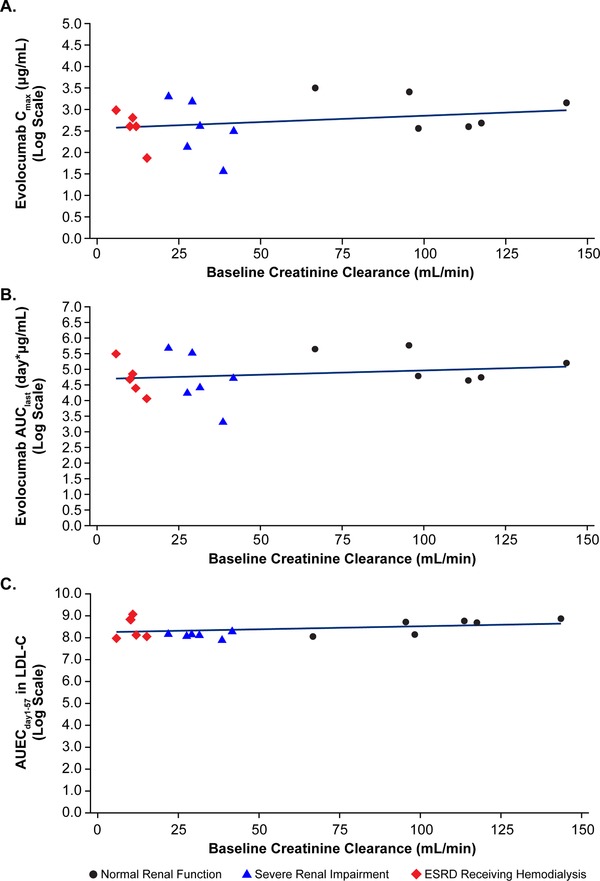
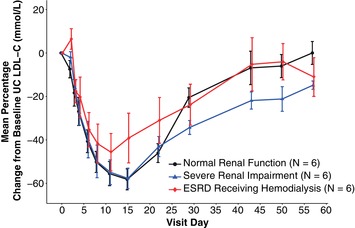
We evaluated the pharmacokinetics, pharmacodynamics, and safety of evolocumab, a fully human monoclonal antibody against proprotein convertase subtilisin kexin type 9 (PCSK9), in an open-label, parallel-design study in participants with normal renal function (n = 6), severe renal impairment (RI; n = 6), or end-stage renal disease (ESRD) receiving hemodialysis (n = 6) who received a single 140-mg dose of evolocumab. The effects of evolocumab treatment on low-density lipoprotein cholesterol (LDL-C) lowering and unbound PCSK9 concentrations were similar in the normal renal function group and the renally impaired groups. Geometric mean C and AUC values in the severe RI and ESRD hemodialysis groups compared with the normal renal function group were lower but within 37% of the normal renal function group (Jonckheere-Terpstra trend test; C , P = .23; AUC , P = .22) and within 26% after adjusting for body weight (mean body weight was approximately 9% higher in the renally impaired groups compared with the normal renal function group). No correlations were observed between exposure and baseline creatinine clearance. No adverse event was determined by the investigators to be related to evolocumab, and there were no trends indicative of clinically important effects on laboratory variables or vital signs. Overall, there were no meaningful differences in evolocumab exposure, as assessed by C and AUC , in patients with severe RI and ESRD hemodialysis compared with patients with normal renal function, and LDL-C-lowering effects were similar across groups. These results support the use of evolocumab without dose adjustment in patients who have severe RI or ESRD.
我们评估了依洛尤单抗(一种针对前蛋白转化酶枯草溶菌素 9(PCSK9)的全人单克隆抗体)的药代动力学、药效学和安全性,在一项开放性、平行设计的研究中,参与者肾功能正常(n=6)、严重肾功能不全(RI;n=6)或接受血液透析的终末期肾病(ESRD;n=6)患者单次接受 140mg 依洛尤单抗治疗。依洛尤单抗治疗对低密度脂蛋白胆固醇(LDL-C)降低和未结合 PCSK9 浓度的影响在肾功能正常组和肾功能不全组相似。严重 RI 和 ESRD 血液透析组与肾功能正常组相比,几何均数 C 和 AUC 值较低,但在肾功能正常组的 37%以内(Jonckheere-Terpstra 趋势检验;C,P=0.23;AUC,P=0.22),并且在调整体重后为 26%(与肾功能正常组相比,肾功能不全组的平均体重约高 9%)。未观察到暴露量与基线肌酐清除率之间存在相关性。研究者未确定任何不良事件与依洛尤单抗有关,也没有表明对实验室变量或生命体征有临床意义影响的趋势。总体而言,与肾功能正常患者相比,严重 RI 和 ESRD 血液透析患者的依洛尤单抗暴露量(通过 C 和 AUC 评估)无明显差异,各组的 LDL-C 降低效果相似。这些结果支持在严重 RI 或 ESRD 患者中无需调整剂量使用依洛尤单抗。