Department of Anesthesiology and Intensive Care Medicine, University Medical Center Rostock, Rostock, Germany.
Department of Neuroimmunology, Institute of Neurology, University College London, London, United Kingdom.
PLoS One. 2019 Jan 24;14(1):e0211184. doi: 10.1371/journal.pone.0211184. eCollection 2019.
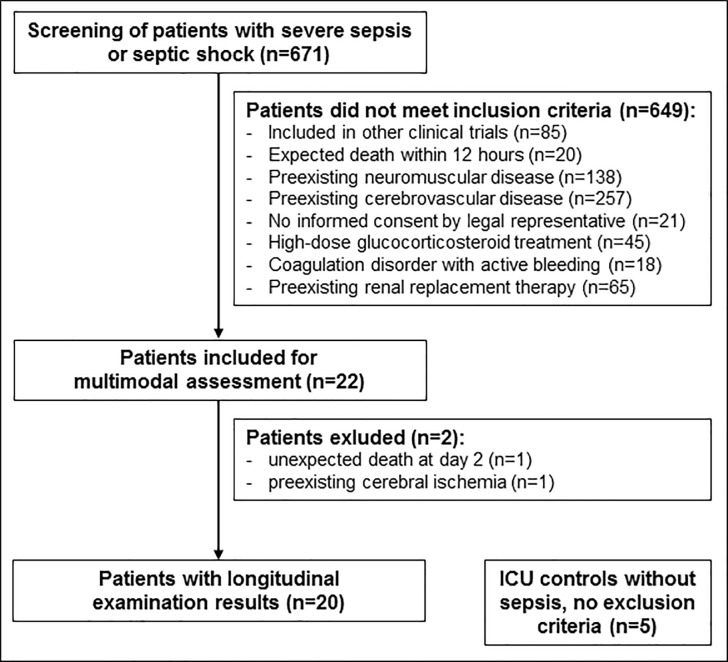
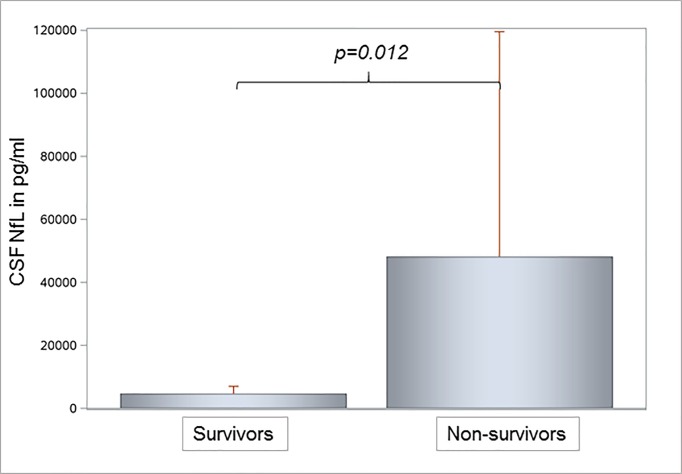
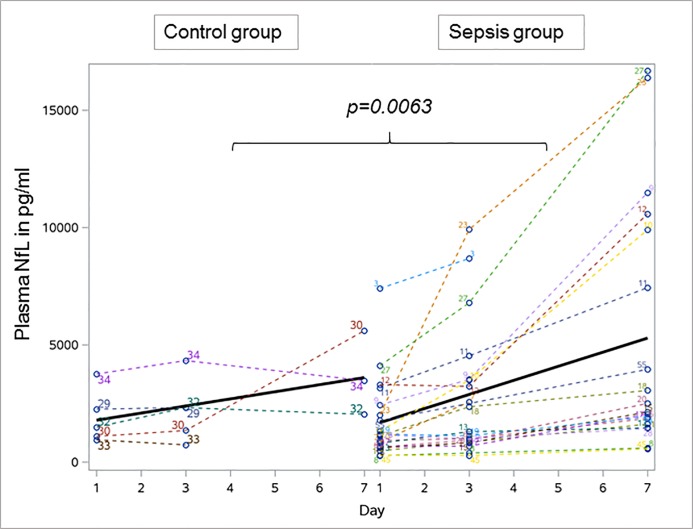
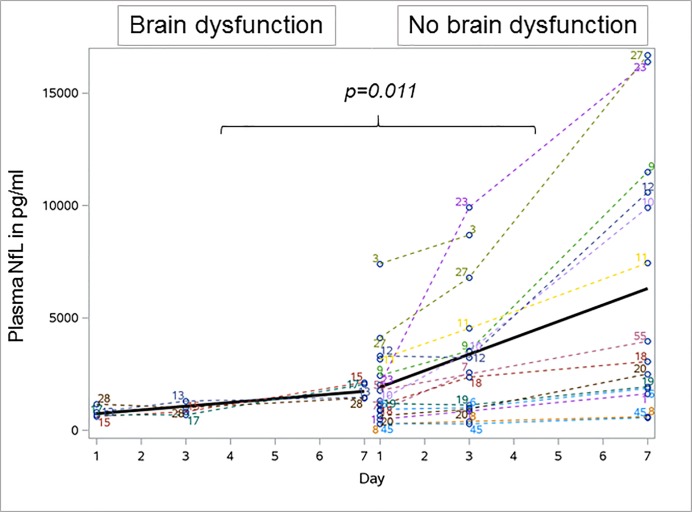
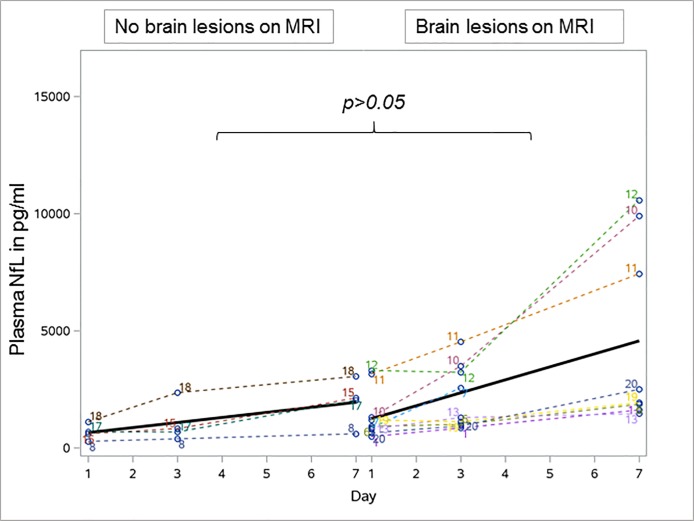
Sepsis-associated encephalopathy (SAE) contributes to mortality and neurocognitive impairment of sepsis patients. Neurofilament (Nf) light (NfL) and heavy (NfH) chain levels as biomarkers for neuroaxonal injury were not evaluated in cerebrospinal fluid (CSF) and plasma of patients with sepsis-associated encephalopathy (SAE) before. We conducted a prospective, pilot observational study including 20 patients with septic shock and five patients without sepsis serving as controls. The assessment of SAE comprised a neuropsychiatric examination, electroencephalography (EEG), magnetic resonance imaging (MRI) and delirium screening methods including the confusion assessment method for the ICU (CAM-ICU) and the intensive care delirium screening checklist (ICDSC). CSF Nf measurements in sepsis patients and longitudinal plasma Nf measurements in all participants were performed on days 1, 3 and 7 after study inclusion. Plasma NfL levels increased in sepsis patients over time (p = 0.0063) and remained stable in patients without sepsis. Plasma NfL values were significantly higher in patients with SAE (p = 0.011), significantly correlated with the severity of SAE represented by ICDSC values (R = 0.534, p = 0.022) and correlated with a poorer functional outcome after 100 days (R = -0.535, p = 0.0003). High levels of CSF Nf were measured in SAE patients. CSF NfL levels were higher in non-survivors (p = 0.012) compared with survivors and correlated with days until death (R = -0.932, p<0.0001) and functional outcome after 100 days (R = -0.749, p<0.0001). The present study showed for the first time that Nf levels provide complementary prognostic information in SAE patients indicating a higher chance of death and poorer functional/cognitive outcome in survivors.
脓毒症相关性脑病 (SAE) 可导致脓毒症患者的死亡率和神经认知障碍升高。此前,并未在患有 SAE 的患者的脑脊液 (CSF) 和血浆中评估神经丝轻链 (NfL) 和重链 (NfH) 水平作为神经轴突损伤的生物标志物。我们进行了一项前瞻性、试点观察性研究,纳入了 20 名脓毒性休克患者和 5 名无脓毒症的患者作为对照。SAE 的评估包括神经精神病学检查、脑电图 (EEG)、磁共振成像 (MRI) 和谵妄筛查方法,包括 ICU 意识模糊评估法 (CAM-ICU) 和重症监护谵妄筛查检查表 (ICDSC)。在研究纳入后的第 1、3 和 7 天,对脓毒症患者的 CSF Nf 测量和所有参与者的纵向血浆 Nf 测量。脓毒症患者的血浆 NfL 水平随时间增加(p = 0.0063),而无脓毒症患者的血浆 NfL 水平保持稳定。SAE 患者的血浆 NfL 值明显更高(p = 0.011),与 ICDSC 值代表的 SAE 严重程度显著相关(R = 0.534,p = 0.022),并与 100 天后的功能结局较差相关(R = -0.535,p = 0.0003)。SAE 患者中检测到高水平的 CSF Nf。与幸存者相比,非幸存者的 CSF NfL 水平更高(p = 0.012),与死亡天数(R = -0.932,p<0.0001)和 100 天后的功能结局(R = -0.749,p<0.0001)相关。本研究首次表明,Nf 水平在 SAE 患者中提供了补充的预后信息,表明幸存者死亡的可能性更高,功能/认知结局更差。