Sonneville Romain, Azabou Eric, Bailly Pierre, Benghanem Sarah, De Almeida Cardoso Gilles, Claquin Pierre, Cortier David, Gaudemer Augustin, Hermann Bertrand, Jaquet Pierre, Lambrecq Virginie, Legouy Camille, Legriel Stéphane, Rambaud Thomas, Rohaut Benjamin, Sarton Benjamine, Silva Stein, Sharshar Tarek, Taccone Fabio Silvio, Vodovar Dominique, Weiss Nicolas, Cerf Charles
Médecine intensive reanimation, Hôpital Bichat - Claude Bernard, 46 Rue Henri Huchard, 75877, Paris Cedex, France.
Université Paris Cité, IAME, INSERM, UMR 1137, 75018, Paris, France.
Ann Intensive Care. 2025 Mar 21;15(1):37. doi: 10.1186/s13613-025-01436-0.
Acute encephalopathy in the ICU poses significant diagnostic, therapeutic, and prognostic challenges. Standardized expert guidelines on acute encephalopathy are needed to improve diagnostic methods, therapeutic decisions, and prognostication.
The experts conducted a review of the literature, analysed it according to the GRADE (Grading of Recommendation, Assessment, Development and Evaluation) methodology and made proposals for guidelines, which were rated by other experts. Only expert opinions with strong agreement were selected.
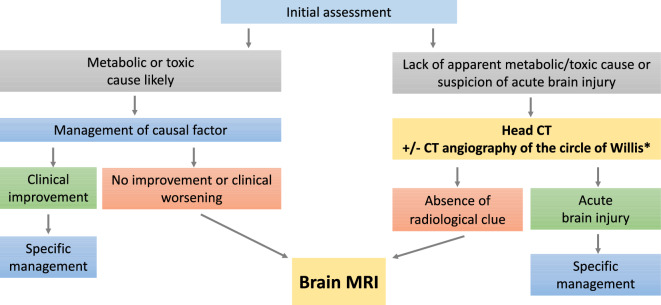
The synthesis of expert work and the application of the GRADE method resulted in 39 recommendations. Among the 39 formalized recommendations, 1 had a high level of evidence (GRADE 1 +) and 10 had a low level of evidence (GRADE 2 + or 2-). These recommendations describe indication for ICU admission, use of clinical scores and EEG for diagnosis, detection of complications, and prognostication. The remaining 28 recommendations were based on expert consensus. These recomandations describe common indications for blood and CSF studies, neuroimaging, use of neuromonitoring, and provide guidelines for management in the acute phase.
This expert consensus statement aims to provide a structured framework to enhance the consistency and quality of care for ICU patients presenting with acute encephalopathy. By integrating high-quality evidence with expert opinion, it offers a pragmatic approach to addressing the complex nature of acute encephalopathy in the ICU, promoting best practices in patient care and facilitating future research in the field.
重症监护病房(ICU)中的急性脑病带来了重大的诊断、治疗及预后挑战。需要关于急性脑病的标准化专家指南来改进诊断方法、治疗决策及预后评估。
专家们对文献进行了回顾,根据GRADE(推荐分级、评估、制定与评价)方法进行分析,并提出指南建议,由其他专家进行评级。仅选取了达成强烈共识的专家意见。
专家工作的综合及GRADE方法的应用产生了39条建议。在这39条正式建议中,1条证据等级高(GRADE 1 +),10条证据等级低(GRADE 2 +或2 -)。这些建议描述了ICU入院指征、用于诊断的临床评分及脑电图的使用、并发症的检测及预后评估。其余28条建议基于专家共识。这些建议描述了血液和脑脊液检查、神经影像学、神经监测使用的常见指征,并提供了急性期管理指南。
本专家共识声明旨在提供一个结构化框架,以提高对患有急性脑病的ICU患者护理的一致性和质量。通过将高质量证据与专家意见相结合,它为应对ICU中急性脑病的复杂性质提供了一种务实方法,促进患者护理的最佳实践,并推动该领域的未来研究。