Department of Pediatrics, University of Minnesota Medical School, Minneapolis, Minnesota, USA.
Center for Pediatric Obesity Medicine, University of Minnesota, Minneapolis, Minnesota, USA.
Obesity (Silver Spring). 2019 Feb;27(2):288-294. doi: 10.1002/oby.22369.
Treating pediatric severe obesity is challenging because of the complex biological, behavioral, and environmental factors that underpin the disease. The multifactorial etiology of obesity combined with the physiologic complexity of the energy regulatory system contributes to treatment variability. The goal of this secondary analysis of pooled data was to describe the degree of individual variation in response to various interventions among adolescents with severe obesity.
Data from three centers across the United States conducting either lifestyle (n = 53), pharmacotherapy (n = 40), or metabolic and bariatric surgery (n = 78) interventions were pooled. Inclusion criteria were severe obesity at baseline and at least one follow-up visit > 30 days after treatment start.
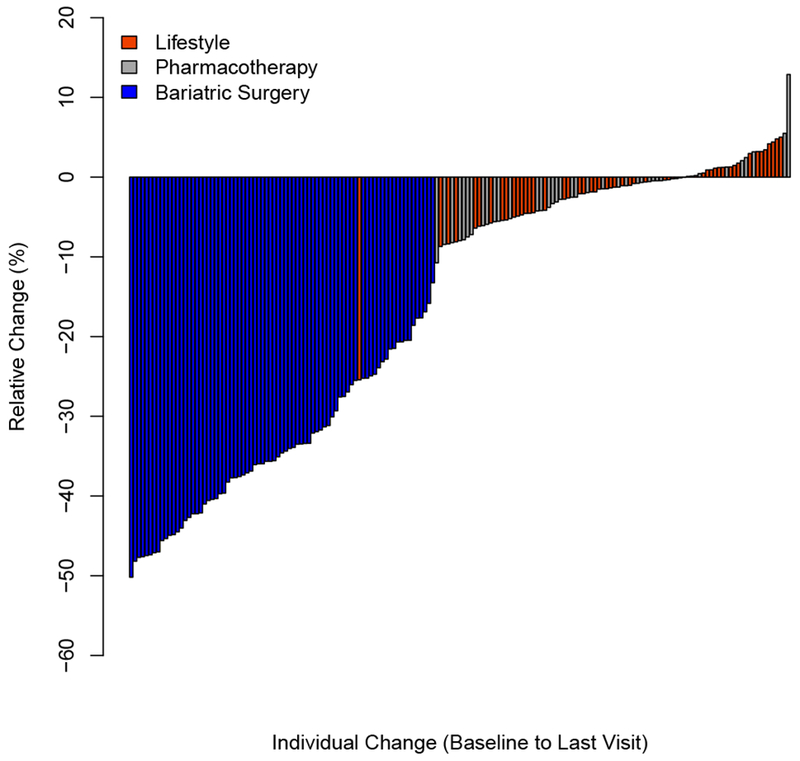
Change in BMI following intervention ranged from -50.2% to +12.9%, with each intervention (lifestyle [range: -25.4% to 5.0%], pharmacotherapy [range: -10.8% to 12.9%], and metabolic and bariatric surgery [range: -50.2% to -13.3%]) exhibiting wide individual variation in response. Changes in cardiometabolic risk factors demonstrated similarly high variability.
Adolescents with severe obesity demonstrated a high degree of heterogeneity in terms of BMI reduction and cardiometabolic risk factor response across treatment modalities. Reporting individual response data in trials and identifying factors driving variability in response will be vital for advancing precision medicine approaches to address obesity.
由于儿科重度肥胖症的发病机制涉及生物学、行为学和环境等多种复杂因素,因此其治疗颇具挑战。肥胖症的多因素病因以及能量调节系统的生理学复杂性导致治疗方案存在差异。本研究旨在对汇总数据进行二次分析,以描述在接受生活方式干预(n=53)、药物治疗(n=40)或代谢和减重手术(n=78)的重度肥胖青少年中,不同干预措施的个体反应差异程度。
汇总了来自美国三个中心的数据,这些中心分别开展生活方式(n=53)、药物治疗(n=40)或代谢和减重手术(n=78)干预。纳入标准为基线和治疗开始后至少 30 天随访时存在重度肥胖。
干预后 BMI 的变化范围为-50.2%至+12.9%,每种干预措施(生活方式[范围:-25.4%至 5.0%]、药物治疗[范围:-10.8%至 12.9%]和代谢和减重手术[范围:-50.2%至-13.3%])的个体反应差异均较大。心血管代谢风险因素的变化也表现出高度的可变性。
在不同治疗方式下,青少年的 BMI 降低和心血管代谢风险因素反应方面存在高度异质性。在临床试验中报告个体反应数据并确定导致反应差异的因素,对于推进精准医学方法解决肥胖问题至关重要。