Department of Pediatrics, University of Minnesota Medical School, Minneapolis, MN, USA.
Cincinnati Children's Hospital Medical Center, Cincinnati, OH, USA.
Int J Obes (Lond). 2018 Jan;42(1):102-107. doi: 10.1038/ijo.2017.193. Epub 2017 Aug 14.
BACKGROUND/OBJECTIVES: Bariatric surgery produces robust weight loss, however, factors associated with long-term weight-loss maintenance among adolescents undergoing Roux-en-Y gastric bypass surgery are unknown.
SUBJECTS/METHODS: Fifty adolescents (mean±s.d. age and body mass index (BMI)=17.1±1.7 years and 59±11 kg m) underwent Roux-en-Y gastric bypass surgery, had follow-up visits at 1 year and at a visit between 5 and 12 years following surgery (Follow-up of Adolescent Bariatric Surgery at 5 Plus years (FABS-5+) visit; mean±s.d. 8.1±1.6 years). A non-surgical comparison group (n=30; mean±s.d. age and BMI=15.3±1.7 years and BMI=52±8 kg m) was recruited to compare weight trajectories over time. Questionnaires (health-related and eating behaviors, health responsibility, impact of weight on quality of life (QOL), international physical activity questionnaire and dietary habits via surgery guidelines) were administered at the FABS-5+ visit. Post hoc, participants were split into two groups: long-term weight-loss maintainers (n=23; baseline BMI=58.2 kg m; 1-year BMI=35.8 kg m; FABS-5+ BMI=34.9 kg m) and re-gainers (n=27; baseline BMI=59.8 kg m; 1-year BMI=36.8 kg m; FABS-5+ BMI=48.0 kg m) to compare factors which might contribute to differences. Data were analyzed using generalized estimating equations adjusted for age, sex, baseline BMI, baseline diabetes status and length of follow-up.
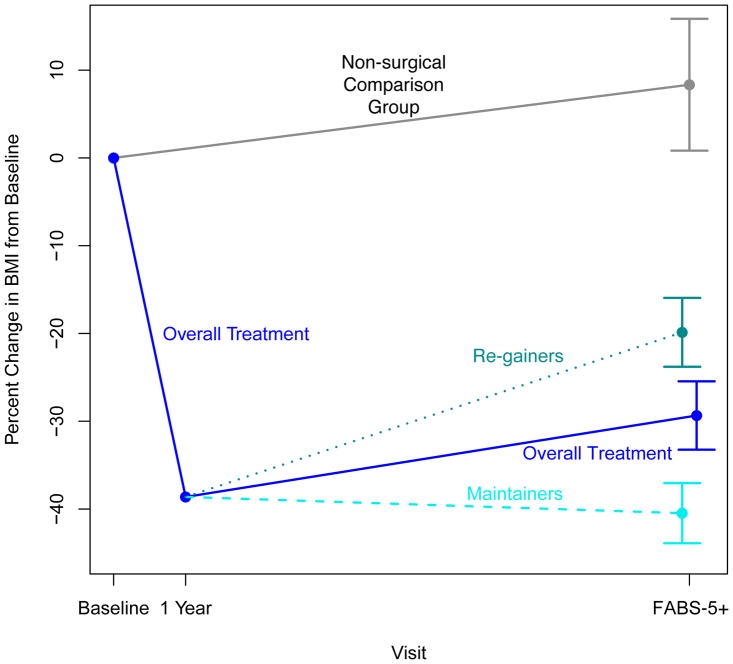
The BMI of the surgical group declined from baseline to 1 year (-38.5±6.9%), which, despite some regain, was largely maintained until FABS-5+ (-29.6±13.9% change). The BMI of the comparison group increased from baseline to the FABS-5+ visit (+10.3±20.6%). When the surgical group was split into maintainers and re-gainers, no differences in weight-related and eating behaviors, health responsibility, physical activity/inactivity, or dietary habits were observed between groups. However, at FABS-5+, maintainers had greater overall QOL scores than re-gainers (87.5±10.5 vs 65.4±20.2, P<0.001) and in each QOL sub-domain (P<0.01 all).
Long-term weight outcomes for those who underwent weight-loss surgery were superior to those who did not undergo surgical treatment. While no behavioral factors were identified as predictors of success in long-term weight-loss maintenance, greater QOL was strongly associated with maintenance of weight loss among adolescents who underwent Roux-en-Y gastric bypass surgery surgery.
背景/目的:减重手术可显著减轻体重,但尚不清楚接受 Roux-en-Y 胃旁路手术的青少年长期维持体重减轻的相关因素。
受试者/方法:50 名青少年(平均±标准差年龄和体重指数(BMI)=17.1±1.7 岁和 59±11kg/m)接受 Roux-en-Y 胃旁路手术,术后 1 年和术后 5 至 12 年(青少年减重手术 5 年以上随访(FABS-5+)访视)进行随访(平均±标准差年龄和 BMI=8.1±1.6 岁)。招募了一个非手术对照组(n=30;平均±标准差年龄和 BMI=15.3±1.7 岁和 BMI=52±8kg/m)以比较随时间推移的体重轨迹。在 FABS-5+访视时,通过手术指南,使用健康相关和饮食行为、健康责任、体重对生活质量(QOL)的影响、国际体力活动问卷和饮食习惯问卷进行评估。事后,将参与者分为两组:长期体重维持者(n=23;基线 BMI=58.2kg/m;1 年 BMI=35.8kg/m;FABS-5+ BMI=34.9kg/m)和再增重者(n=27;基线 BMI=59.8kg/m;1 年 BMI=36.8kg/m;FABS-5+ BMI=48.0kg/m)以比较可能导致差异的因素。使用广义估计方程,根据年龄、性别、基线 BMI、基线糖尿病状态和随访时间对数据进行调整。
手术组的 BMI 从基线下降到 1 年(-38.5±6.9%),尽管有一定程度的反弹,但直到 FABS-5+(-29.6±13.9%的变化)仍基本保持不变。对照组的 BMI 从基线增加到 FABS-5+访视(+10.3±20.6%)。当手术组分为维持者和再增重者时,两组在体重相关和饮食行为、健康责任、体力活动/不活动或饮食习惯方面无差异。然而,在 FABS-5+时,维持者的总体 QOL 评分高于再增重者(87.5±10.5 比 65.4±20.2,P<0.001),每个 QOL 亚域的评分也更高(P<0.01 均)。
接受减重手术者的长期体重结果优于未接受手术治疗者。虽然没有行为因素被确定为长期体重减轻维持的预测因素,但在接受 Roux-en-Y 胃旁路手术的青少年中,较高的生活质量与体重减轻的维持密切相关。