Department of Pediatrics, University of Minnesota Medical School, Minneapolis, Minnesota, USA.
Center for Pediatric Obesity Medicine, University of Minnesota Medical School, Minneapolis, Minnesota, USA.
Obesity (Silver Spring). 2019 Feb;27(2):272-279. doi: 10.1002/oby.22367.
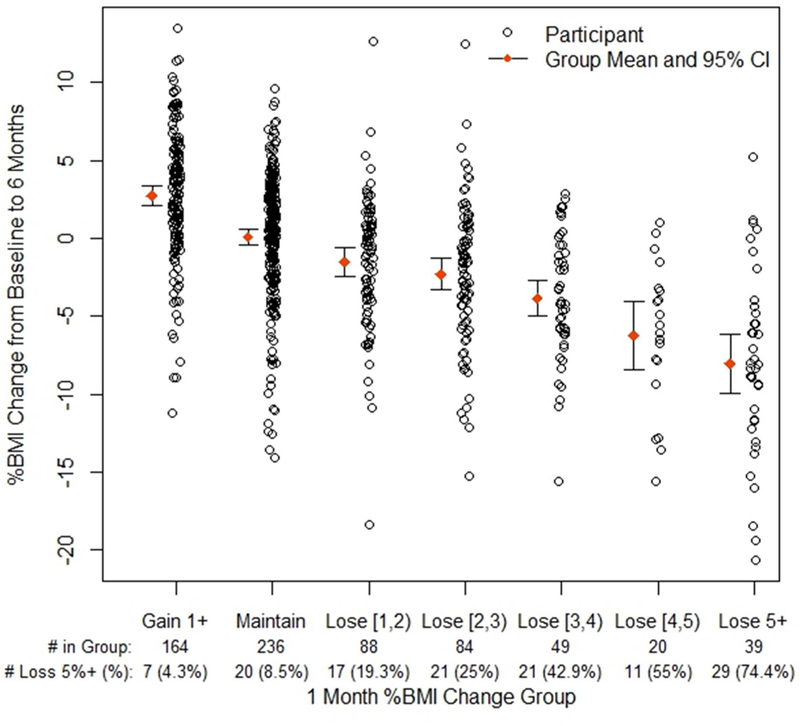
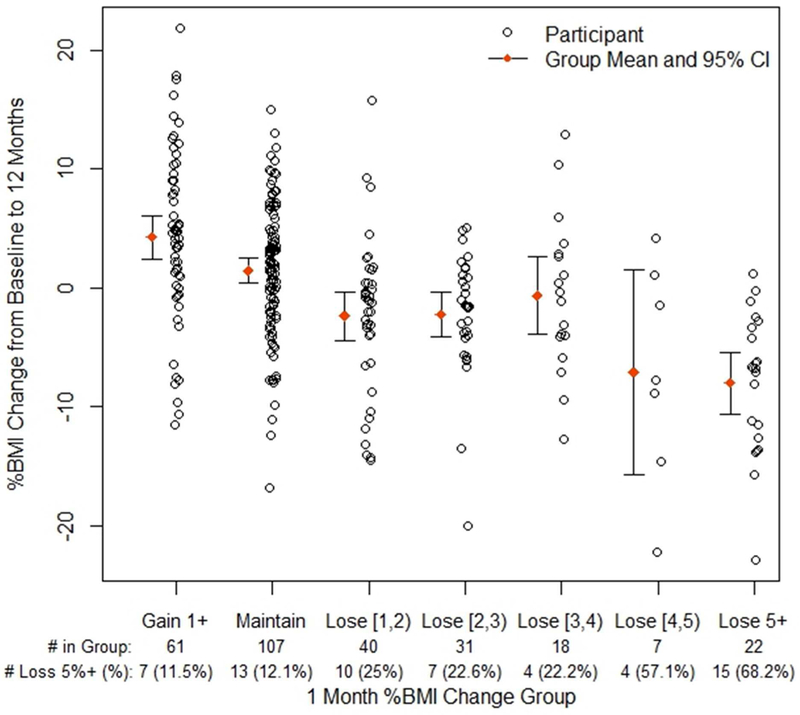
This study aimed to examine whether 1-month BMI improvement is predictive of superior 6- and 12-month BMI changes in a national sample of youth in pediatric weight management treatment.
Participants were 4- to 18-year-olds from the Pediatric Obesity Weight Evaluation Registry, a prospective study collecting data from 31 pediatric weight management programs across the United States. Response at 1 month was defined as ≥ 3% BMI reduction; success at 6 and 12 months was defined as ≥ 5% BMI reduction from baseline. Analyses used linear and logistic regression with robust variance estimation.
Primary analyses were completed with 687 participants (mean age 12.2 years). One-month responders demonstrated significant improvements in BMI compared with nonresponders at 6 months (BMI, -2.05 vs. 0.05; %BMI, -5.81 vs. 0.23; P < 0.001 for all) and 12 months (BMI, -1.87 vs. 0.30; %BMI, -5.04 vs. 1.06; P < 0.001 for all). The odds of success for 1-month responders were 9.64 (95% CI: 5.85-15.87; P < 0.001) times that of nonresponders at 6 months and 5.24 (95% CI: 2.49-11.02; P < 0.001) times that of nonresponders at 12 months.
In treatment-seeking youth with obesity, early BMI reduction was significantly associated with greater long-term BMI reduction. Nonresponders may benefit from early treatment redirection or intensification.
本研究旨在探讨在全国范围内接受儿科体重管理治疗的青少年中,1 个月 BMI 改善是否可预测更好的 6 个月和 12 个月 BMI 变化。
参与者为来自儿科肥胖体重评估登记处的 4 至 18 岁儿童,这是一项前瞻性研究,从美国 31 个儿科体重管理计划中收集数据。1 个月时的反应定义为 BMI 降低≥3%;6 个月和 12 个月时的成功定义为与基线相比 BMI 降低≥5%。分析采用线性和逻辑回归分析,使用稳健方差估计。
主要分析完成于 687 名参与者(平均年龄 12.2 岁)。与无应答者相比,1 个月时有应答者在 6 个月(BMI,-2.05 与 0.05;%BMI,-5.81 与 0.23;P<0.001)和 12 个月(BMI,-1.87 与 0.30;%BMI,-5.04 与 1.06;P<0.001)时 BMI 有显著改善。1 个月有应答者 6 个月时成功的可能性是非应答者的 9.64 倍(95%CI:5.85-15.87;P<0.001),12 个月时成功的可能性是非应答者的 5.24 倍(95%CI:2.49-11.02;P<0.001)。
在寻求治疗的肥胖青少年中,早期 BMI 降低与长期 BMI 降低显著相关。无应答者可能受益于早期治疗方向或强化治疗。