Southern California Permanente Medical Group, Kaiser Permanente Yorba Linda Medical Offices, 22550 Savi Ranch Parkway, Yorba Linda, CA, 92887, USA.
Department of Research & Evaluation, Kaiser Permanente Southern California, Pasadena, California, USA.
BMC Health Serv Res. 2022 Jan 2;22(1):12. doi: 10.1186/s12913-021-07361-9.
A 6-month pediatric weight loss program showed modest success, but the sustainability of this success after 12 months was unclear. The present study aims tomeasure the medium-term effectiveness of family-based weight management in pediatric primary care to reduce body weight in children living with obesity.
In a retrospective cohort study, children ages 3 to 17 years with obesity in Kaiser Permanente Orange County, California, who enrolled in a weight management program between April 2014 and December 2018 (FB-WMG, n = 341) were compared to children referred but not enrolled (Ref-CG, n = 317) and controls matched by sex, age, zip code and BMI (Area-CG, n = 801). The relative distance from the median BMI-for-age at months 0, 6, and 12 were expressed as difference-in-differences (DID) using multivariable linear regressions with robust standard error.
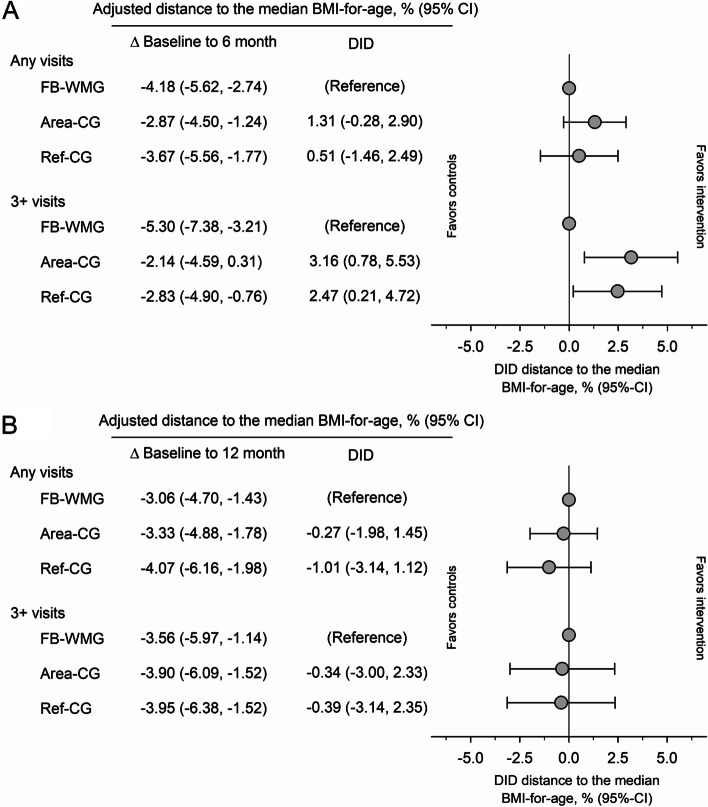
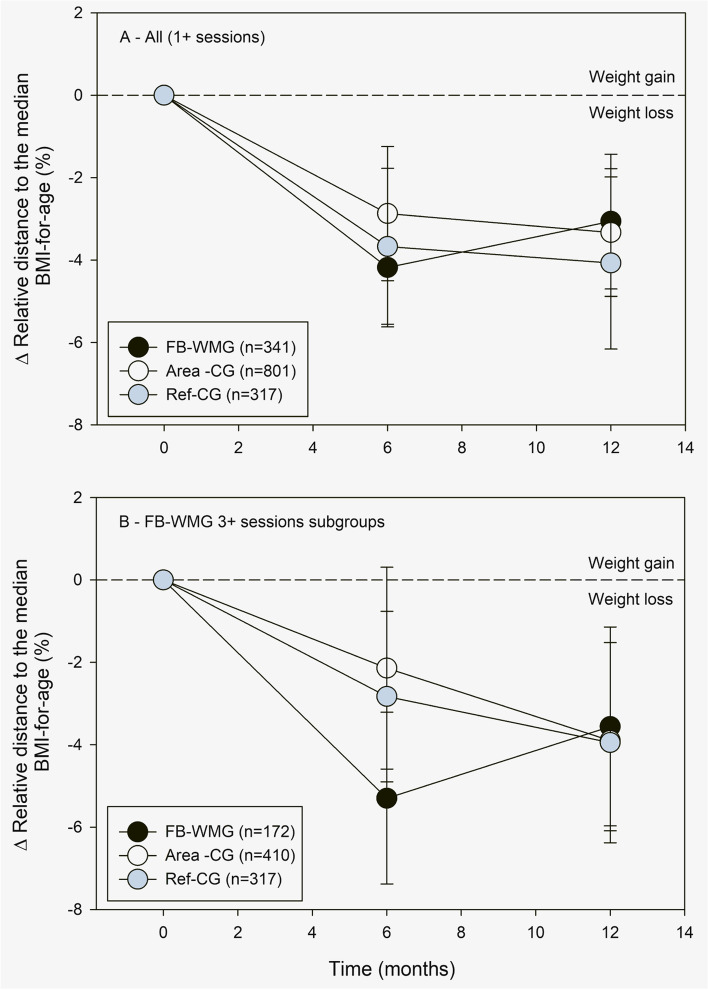
The baseline BMI-for-age was 98.6 (SD 1.08) percentile in FB-WMG, 98.2 (SD 1.22) percentile in Ref-CG, and 98.6 (1.13 in Area-CG). FB-WMG had a median of 3 visits (P25 1 visit, P75 5 visits) in the first 6 months. Despite a more considerable decrease in the relative distance to the median BMI-for-age in FB-WMG children with 3+ visits after 6 months, the success obtained was not sustained at 12 months (DID FB-WMG vs Area-CG -0.34, 95% CI - 3.00 to 2.33%, FB-WMG vs Ref-CG -0.39, 95% CI - 3.14 to 2.35%). At 12 months, there was no statistical significant difference between the three groups (FB-WWG, Ref-CG, Area-CG).
The initial success in weight management was not sustained in the absence of continued support for healthy lifestyle changes. Based on current evidence, continued support is necessary to maintain and promote success beyond a brief 6 month intervention. Long-term pediatric weight management programs are needed to promote continuing progress.
一项为期 6 个月的儿科减肥计划取得了一定成效,但在 12 个月后,这种成功的可持续性尚不清楚。本研究旨在评估家庭为基础的儿科初级保健体重管理在减少肥胖儿童体重方面的中期效果。
在一项回顾性队列研究中,比较了加利福尼亚州橙县 Kaiser Permanente 参加体重管理计划的肥胖儿童(FB-WMG,n=341)与未参加的转诊儿童(Ref-CG,n=317)和按性别、年龄、邮政编码和 BMI 匹配的对照组(Area-CG,n=801)。使用多变量线性回归模型和稳健标准差,以月 0、6 和 12 的 BMI 与年龄中位数的相对距离表示差异(DID)。
FB-WMG 的基线 BMI 为 98.6(SD 1.08)百分位数,Ref-CG 为 98.2(SD 1.22)百分位数,Area-CG 为 98.6(1.13)百分位数。FB-WMG 在最初的 6 个月内平均就诊 3 次(P25 就诊 1 次,P75 就诊 5 次)。尽管在 6 个月后就诊 3 次以上的 FB-WMG 儿童的 BMI 与年龄中位数的相对距离有更大程度的下降,但在 12 个月时这种效果并没有持续(FB-WMG 与 Area-CG 的 DID 为-0.34,95%CI 为-3.00 至 2.33%,FB-WMG 与 Ref-CG 的 DID 为-0.39,95%CI 为-3.14 至 2.35%)。在 12 个月时,三组之间没有统计学上的显著差异(FB-WWG、Ref-CG、Area-CG)。
在缺乏持续支持健康生活方式改变的情况下,体重管理的初步成功并没有持续。根据目前的证据,需要持续的支持,以维持和促进在短暂的 6 个月干预之外的成功。需要长期的儿科体重管理计划来促进持续的进展。