Møller Pål, Dominguez-Valentin Mev, Rødland Einar Andreas, Hovig Eivind
Department of Tumor Biology, Institute of Cancer Research, The Norwegian Radium Hospital, Part of Oslo University Hospital, Oslo 0424, Norway.
Center for Hereditary Tumors, HELIOS-Klinikum Wuppertal, University of Witten-Herdecke, Wuppertal 42283, Germany.
Cancers (Basel). 2019 Jan 23;11(2):132. doi: 10.3390/cancers11020132.
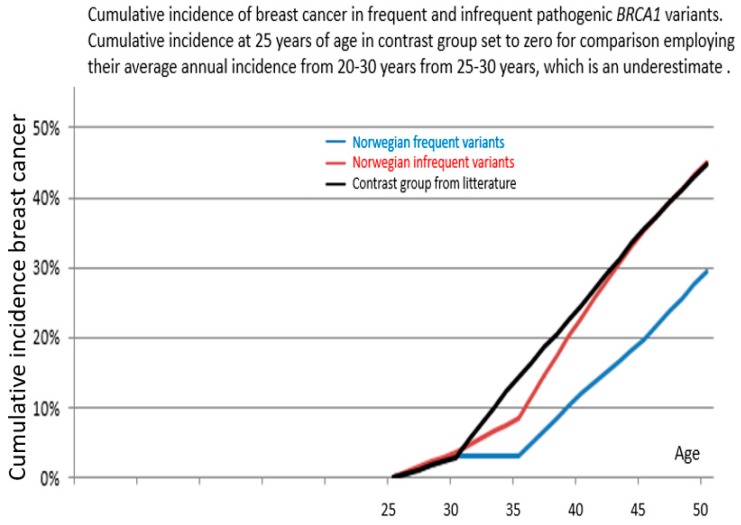
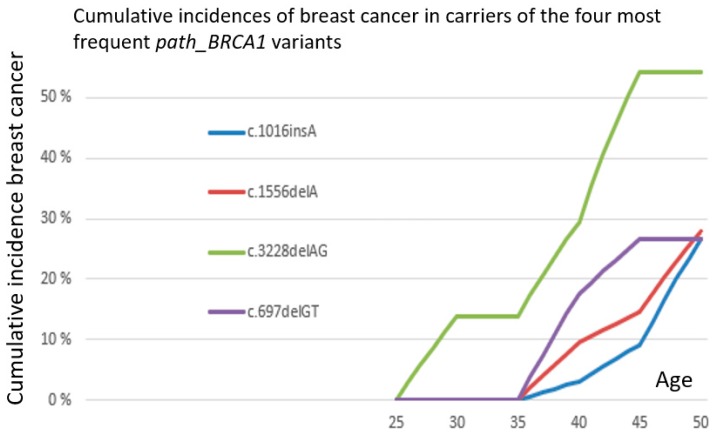
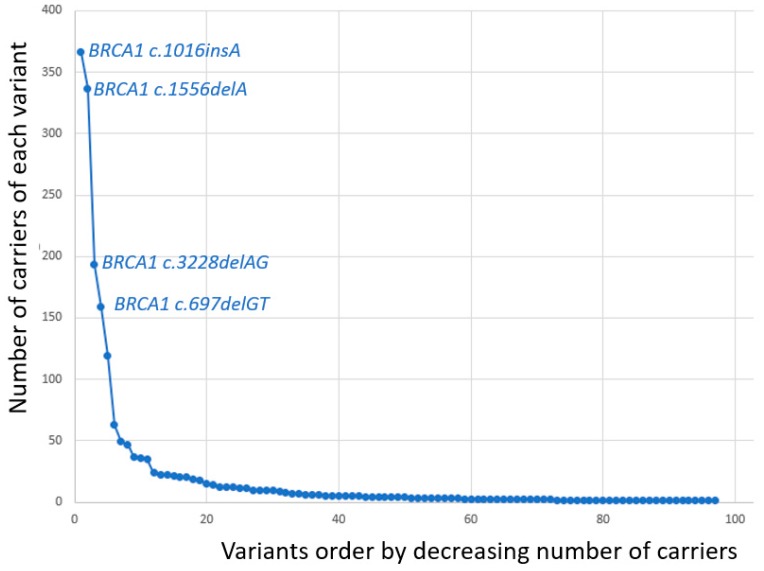
We have previously demonstrated that the Norwegian frequent pathogenic ) variants are caused by genetic drift and recurrent de-novo mutations. We here examined the penetrance of frequent variants in fertile ages as a surrogate marker for fitness. We conducted an observational prospective study of penetrance for cancer in Norwegian female carriers of frequent variants, and compared our observed results to penetrance of infrequent variants and to average penetrance of variants reported by others. The cumulative risk for breast cancer at 45 years in carriers of frequent variants was 20% (94% confidence interval 10⁻30%), compared to 35% (95% confidence interval 22⁻48%) in carriers of infrequent variants ( = 0.02), and to the 35% (confidence interval 32⁻39%) average for carriers reported by others ( = 0.0001). Carriers of the most frequent Norwegian variants had low incidence of cancer in fertile ages, indicating a low selective disadvantage. This, together with the variant locations being hotspots for de novo mutations and subject to genetic drift, as previously described, may have caused their high prevalence today. Besides being of theoretical interest to explain the phenomenon that a few variants are frequent, the later onset of breast cancer associated with the most frequent variants may be of interest for carriers who have to decide if and when to select prophylactic mastectomy.
我们之前已经证明,挪威常见的致病基因变异是由基因漂变和反复出现的新生突变引起的。我们在此研究了育龄期常见基因变异的外显率,将其作为适应性的替代指标。我们对挪威常见基因变异女性携带者的癌症外显率进行了一项观察性前瞻性研究,并将我们观察到的结果与罕见基因变异的外显率以及其他人报告的基因变异平均外显率进行了比较。常见基因变异携带者在45岁时患乳腺癌的累积风险为20%(94%置信区间为10⁻30%),相比之下,罕见基因变异携带者的这一风险为35%(95%置信区间为22⁻48%)(P = 0.02),而其他人报告的基因变异携带者的平均风险为35%(置信区间为32⁻39%)(P = 0.0001)。挪威最常见基因变异的携带者在育龄期患癌率较低,表明选择性劣势较低。如前所述,这一点连同变异位置是新生突变热点且易受基因漂变影响,可能导致了它们如今的高流行率。除了在理论上有助于解释少数基因变异为何常见这一现象外,与最常见基因变异相关的乳腺癌发病较晚这一情况,对于必须决定是否以及何时选择预防性乳房切除术的携带者来说可能具有重要意义。