Gaffney Ann, Bohman Björn, Quarrell Stephen R, Brown Philip H, Allen Geoff R
Tasmanian Institute of Agriculture, University of Tasmania, Churchill Ave, Hobart 7005, Australia.
School of Molecular Sciences, The University of Western Australia, 35 Stirling Hwy, Perth 6009, Australia.
Insects. 2019 Jan 23;10(2):34. doi: 10.3390/insects10020034.
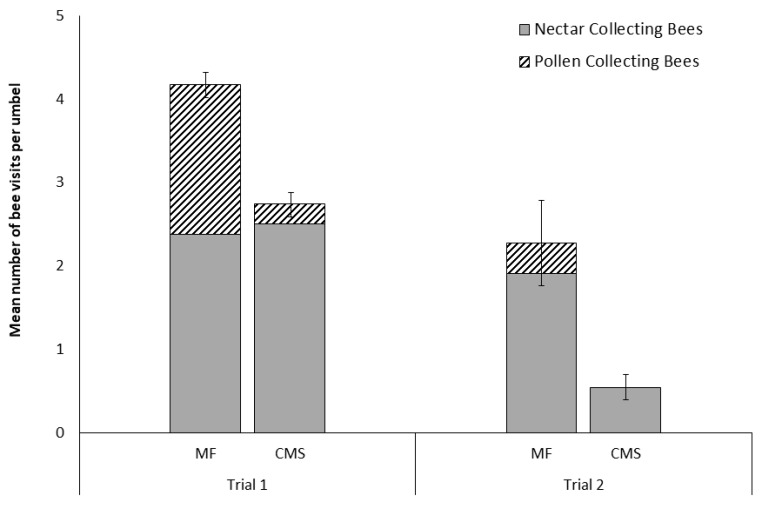
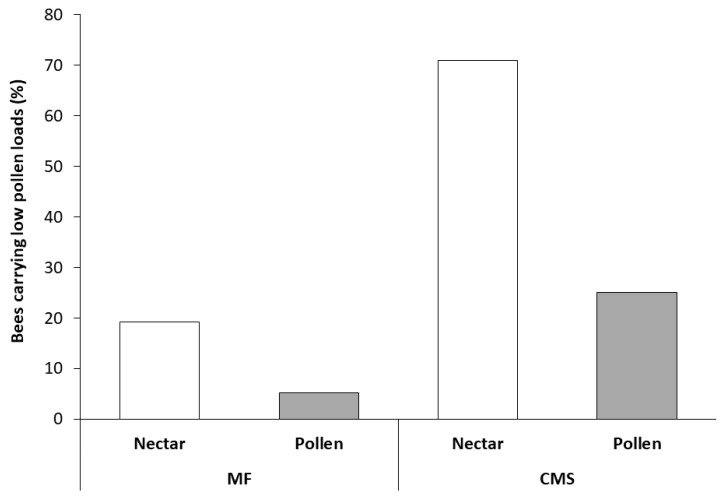
Pollination rates in hybrid carrot crops remain limited after introduction of honey bee hives. In this study, honey bee foraging behaviour was observed in commercial hybrid carrot seed crops. Significantly more visits were made to male-fertile (MF) rather than cytoplasmically male-sterile (CMS) flowers. Pollen was collected from bees returning to a hive, to determine daily variation in pollen loads collected and to what level the bees were foraging for carrot pollen. Honey bees visited a wide range of alternative pollen sources and made relatively few visits to carrot plants throughout the period of flowering. Visitation rates to other individual floral sources fluctuated but visitation to carrot was consistently low. The underlying rate of carrot pollen visits among collecting trips was modelled and estimated to be as low as 1.4%, a likely cause of the limited success implementing honey bee hives in carrot crops.
引入蜜蜂蜂箱后,杂交胡萝卜作物的授粉率仍然有限。在本研究中,观察了商业杂交胡萝卜种子作物中蜜蜂的觅食行为。蜜蜂对雄性可育(MF)花朵的访问显著多于细胞质雄性不育(CMS)花朵。从返回蜂巢的蜜蜂身上收集花粉,以确定所收集花粉负载的每日变化以及蜜蜂采集胡萝卜花粉的程度。在整个开花期,蜜蜂访问了多种替代花粉源,而对胡萝卜植株的访问相对较少。对其他单个花卉来源的访问率有所波动,但对胡萝卜的访问一直很低。对采集行程中访问胡萝卜花粉的潜在比率进行了建模,估计低至1.4%,这可能是在胡萝卜作物中实施蜜蜂蜂箱成功率有限的一个原因。