Shin Jason J, Popchak Adam J, Musahl Volker, Irrgang Jay J, Lin Albert
Division of Sports Medicine, Department of Orthopedic Surgery, University of Pittsburgh Medical Center, Pittsburgh, PA (Dr. Shin, Dr. Popchak, Dr. Musahl, Dr. Irrgang, Dr. Lin); and the Department of Surgery, College of Medicine, University of Saskatchewan, Saskatoon, Saskatchewan, Canada (Dr. Shin).
J Am Acad Orthop Surg Glob Res Rev. 2018 Dec 4;2(12):e093. doi: 10.5435/JAAOSGlobal-D-18-00093. eCollection 2018 Dec.
Shoulder arthroscopies are among the most frequently performed surgeries by orthopaedic surgeons. Little is known about complication rates among recently trained surgeons. The purpose of this study was to examine the type and frequency of complications of common arthroscopic shoulder procedures performed by candidates challenging the American Board of Orthopaedic Surgery: Part II, certification examination.
Data were obtained from the American Board of Orthopaedic Surgery database for orthopaedic surgeons who sat for the part II examination from 2012 to 2016. In total, 27,072 procedures were reviewed. The database was queried to determine the type and frequency of complications for patients who underwent shoulder arthroscopy, including arthroscopic rotator cuff repair, labrum repair, biceps tenodesis, and bony/soft tissue débridement procedures. Complications were classified as surgical, anesthetic, or medical. Factors affecting complication rates were investigated including surgeon's fellowship training, geographic location, and patients' age and sex.
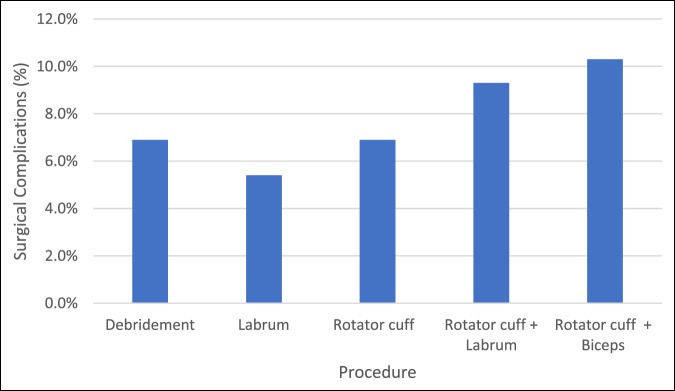
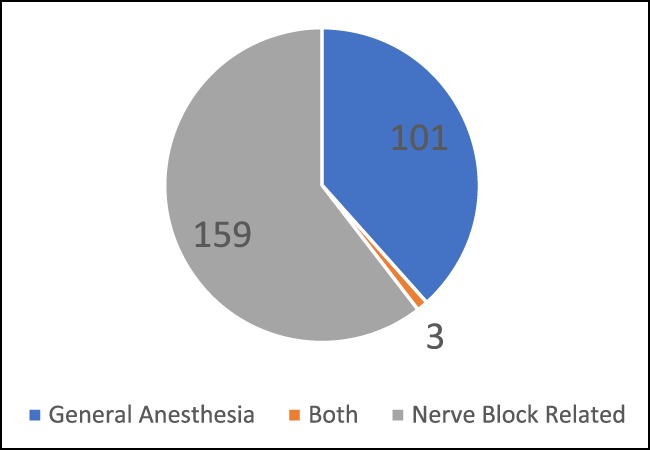
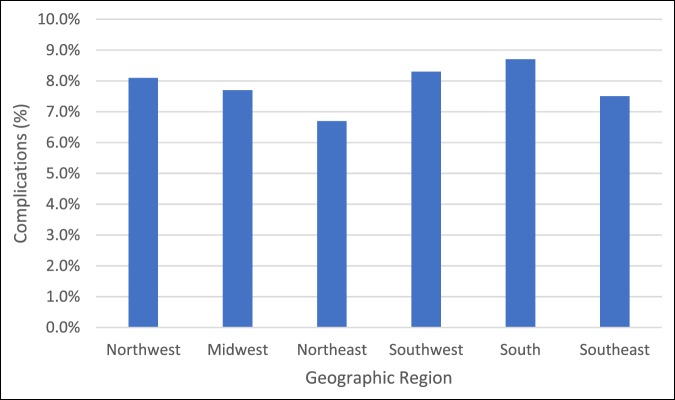
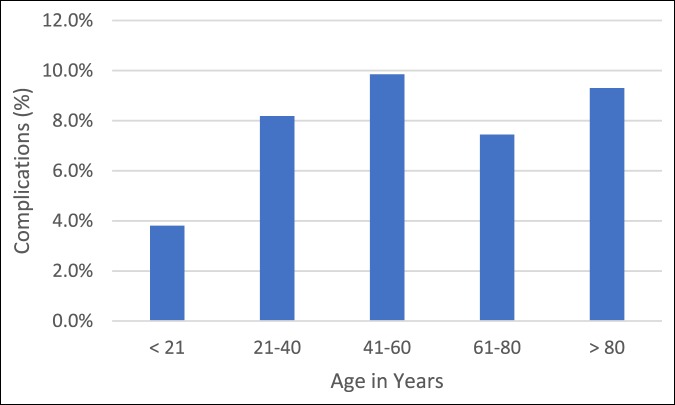
Patients with surgical complications (n = 2,133; 7.9%) were more common than anesthetic (n = 263; 1.0%) or medical (n = 607; 2.2%) complications. There was a significant variation in the surgical complication rate among different arthroscopic shoulder procedures, ranging from 5.4% for labral repair to 10.3% for rotator cuff repair and biceps tenodesis. Stiffness/arthrofibrosis was the most commonly recorded surgical complication (2.2%). Surgical complication rates were lowest in the Northeast region (6.7%; < 0.01) and in patients younger than 21 years (3.8%; < 0.01). Women had significantly higher rate of complications than men (8.4% versus 7.6%; = 0.02). Among anesthetic-related complications, 61.6% were related to regional nerve blocks. The overall revision surgery and readmission rates were 0.8% and 1.0%, respectively.
The overall self-reported surgical complication rate for arthroscopic shoulder procedures was 7.9%, which is higher than the rates reported in the literature. Although the rate of anesthetic complications is low (1.0%), adverse events related to nerve blocks made up most of the overall anesthetic related complications.
肩关节镜手术是骨科医生最常进行的手术之一。对于近期培训的外科医生的并发症发生率了解甚少。本研究的目的是检查参加美国骨科医师委员会第二部分认证考试的考生所进行的常见肩关节镜手术并发症的类型和发生率。
从美国骨科医师委员会数据库中获取2012年至2016年参加第二部分考试的骨科医生的数据。总共审查了27072例手术。查询该数据库以确定接受肩关节镜检查的患者的并发症类型和发生率,包括关节镜下肩袖修复、盂唇修复、肱二头肌固定术以及骨/软组织清创手术。并发症分为手术、麻醉或医疗类。研究了影响并发症发生率的因素,包括外科医生的专科培训、地理位置以及患者的年龄和性别。
手术并发症患者(n = 2133;7.9%)比麻醉并发症患者(n = 263;1.0%)或医疗并发症患者(n = 607;2.2%)更常见。不同肩关节镜手术的手术并发症发生率存在显著差异,从盂唇修复的5.4%到肩袖修复和肱二头肌固定术的10.3%不等。僵硬/关节纤维性变是最常记录的手术并发症(2.2%)。手术并发症发生率在东北地区最低(6.7%;P < 0.01),在21岁以下患者中最低(3.8%;P < 0.01)。女性的并发症发生率明显高于男性(8.4%对7.6%;P = 0.02)。在与麻醉相关的并发症中,61.6%与区域神经阻滞有关。总体翻修手术率和再入院率分别为0.8%和1.0%。
肩关节镜手术的总体自我报告手术并发症发生率为7.9%,高于文献报道的发生率。虽然麻醉并发症发生率较低(1.0%),但与神经阻滞相关的不良事件占总体麻醉相关并发症的大部分。