
伴有波动症状的帕金森病患者中单胺氧化酶-B 抑制剂奥匹卡朋的长期疗效:两项 III 期临床试验及其开放性扩展研究的汇总分析
Long-term efficacy of opicapone in fluctuating Parkinson's disease patients: a pooled analysis of data from two phase 3 clinical trials and their open-label extensions.
机构信息
Faculty of Medicine, Instituto de Medicina Molecular, University of Lisbon, Lisbon, Torres Vedras, Portugal.
CNS - Campus Neurológico Sénior, Torres Vedras, Portugal.
出版信息
Eur J Neurol. 2019 Jul;26(7):953-960. doi: 10.1111/ene.13914. Epub 2019 Mar 25.
BACKGROUND AND PURPOSE
The aim was to evaluate the efficacy of the catechol-O-methyltransferase inhibitor opicapone (25 and 50 mg) as adjunct therapy to levodopa in a pooled population of Parkinson's disease patients who participated in the pivotal double-blind trials of opicapone and their 1-year open-label extensions.
METHODS
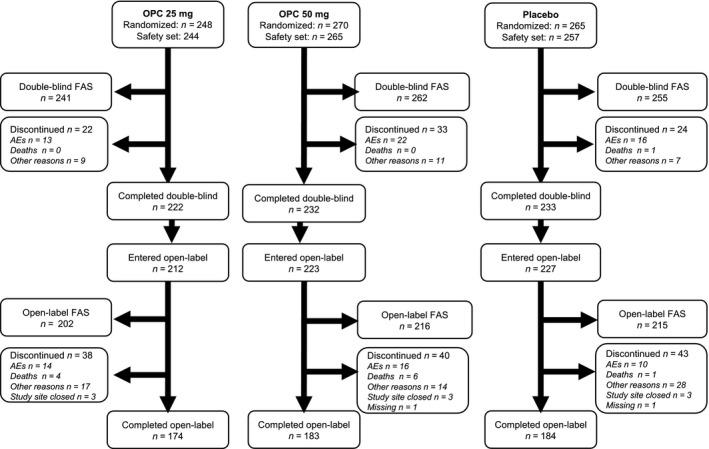
Data (placebo, opicapone 25 mg and opicapone 50 mg) from the BIPARK-1 and BIPARK-2 double-blind and open-label studies were combined. The studies had similar designs, eligibility criteria and assessment methods. The primary efficacy variable in both double-blind studies was the change from baseline in absolute OFF time based on patient diaries.
RESULTS
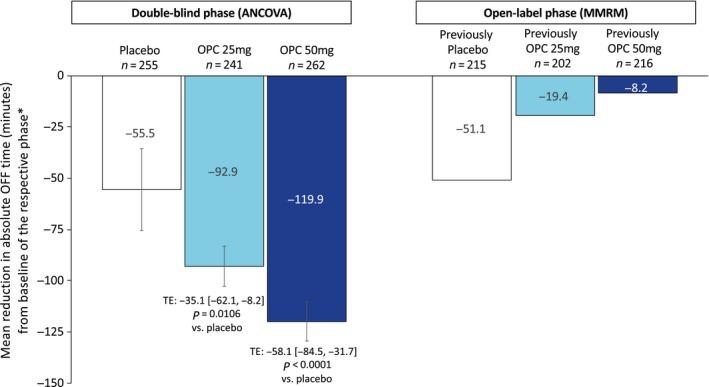
Double-blind treatment with opicapone (25 and 50 mg) significantly reduced absolute daily OFF time from a baseline of 6.1-6.6 h. The mean (and 95% confidence interval) treatment effect versus placebo was -35.1 (-62.1, -8.2) min (P = 0.0106) for the 25 mg dose and -58.1 (-84.5, -31.7) min (P < 0.0001) for the 50 mg dose. Reductions in OFF time were mirrored by significant increases in ON time without troublesome dyskinesia (P < 0.05 and P < 0.0001 for the 25 and 50 mg doses, respectively). No significant differences were observed for ON time with troublesome dyskinesia. Patient diary results from the open-label phase indicated a maintenance of effect for patients previously treated with opicapone 50 mg. The group previously treated with the 25 mg dose benefitted with further optimization of therapy during the open-label phase, whilst switching from placebo to opicapone led to significant reductions in OFF time and increased ON time.
CONCLUSIONS
Over at least 1 year of open-label therapy, opicapone consistently reduced OFF time and increased ON time without increasing the frequency of troublesome dyskinesia.
背景与目的
本研究旨在评估儿茶酚-O-甲基转移酶抑制剂(opicapone)作为左旋多巴辅助治疗在参加关键性双盲opicapone 试验和其 1 年开放标签扩展试验的帕金森病患者汇总人群中的疗效。
方法
对来自 BIPARK-1 和 BIPARK-2 双盲和开放标签研究的数据(安慰剂、opicapone 25 mg 和 opicapone 50 mg)进行合并。这些研究具有相似的设计、入选标准和评估方法。两项双盲研究的主要疗效变量均为根据患者日记记录的基线绝对关闭时间的变化。
结果
双盲治疗用 opicapone(25 mg 和 50 mg)可显著减少基线时 6.1-6.6 h 的绝对每日关闭时间。与安慰剂相比,25 mg 剂量的治疗效果为-35.1(-62.1,-8.2)min(P=0.0106),50 mg 剂量的治疗效果为-58.1(-84.5,-31.7)min(P<0.0001)。关闭时间的减少与无麻烦性运动障碍的开启时间的显著增加相吻合(25 和 50 mg 剂量分别为 P<0.05 和 P<0.0001)。有麻烦性运动障碍的开启时间无显著差异。开放标签阶段的患者日记结果表明,先前接受 opicapone 50 mg 治疗的患者疗效得到维持。先前接受 25 mg 剂量治疗的患者在开放标签阶段进一步优化治疗后受益,而从安慰剂转换为 opicapone 可显著减少关闭时间并增加开启时间。
结论
在至少 1 年的开放标签治疗中,opicapone 持续减少关闭时间并增加开启时间,而不增加麻烦性运动障碍的频率。

 Zotero 插件