Department of Neurology, University of Dresden, Dresden, Germany.
University College London, Reta Lila Weston Institute, London, UK.
Transl Neurodegener. 2020 Mar 4;9(1):9. doi: 10.1186/s40035-020-00187-1.
The efficacy and safety of opicapone, a once-daily catechol-O-methyltransferase inhibitor, have been established in two large randomized, placebo-controlled, multinational pivotal trials. Still, clinical evidence from routine practice is needed to complement the data from the pivotal trials.
OPTIPARK (NCT02847442) was a prospective, open-label, single-arm trial conducted in Germany and the UK under clinical practice conditions. Patients with Parkinson's disease and motor fluctuations were treated with opicapone 50 mg for 3 (Germany) or 6 (UK) months in addition to their current levodopa and other antiparkinsonian treatments. The primary endpoint was the Clinician's Global Impression of Change (CGI-C) after 3 months. Secondary assessments included Patient Global Impressions of Change (PGI-C), the Unified Parkinson's Disease Rating Scale (UPDRS), Parkinson's Disease Questionnaire (PDQ-8), and the Non-Motor Symptoms Scale (NMSS). Safety assessments included evaluation of treatment-emergent adverse events (TEAEs) and serious adverse events (SAEs).
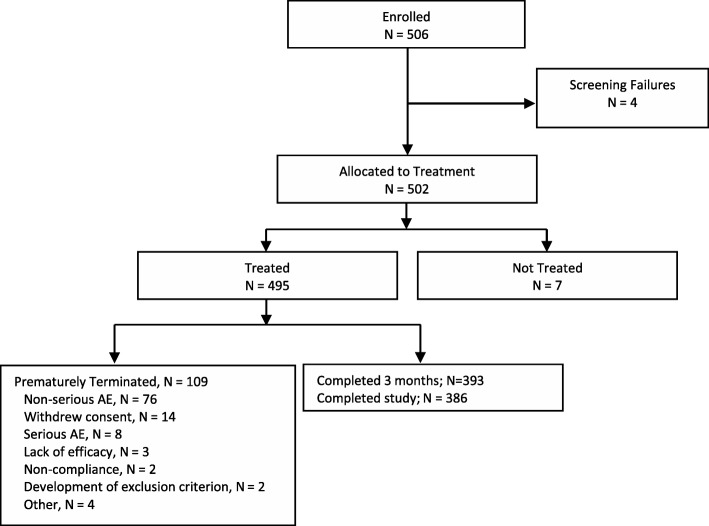
Of the 506 patients enrolled, 495 (97.8%) took at least one dose of opicapone. Of these, 393 (79.4%) patients completed 3 months of treatment. Overall, 71.3 and 76.9% of patients experienced any improvement on CGI-C and PGI-C after 3 months, respectively (full analysis set). At 6 months, for UK subgroup only (n = 95), 85.3% of patients were judged by investigators as improved since commencing treatment. UPDRS scores at 3 months showed statistically significant improvements in activities of daily living during OFF (mean ± SD change from baseline: - 3.0 ± 4.6, p < 0.0001) and motor scores during ON (- 4.6 ± 8.1, p < 0.0001). The mean ± SD improvements of - 3.4 ± 12.8 points for PDQ-8 and -6.8 ± 19.7 points for NMSS were statistically significant versus baseline (both p < 0.0001). Most of TEAEs (94.8% of events) were of mild or moderate intensity. TEAEs considered to be at least possibly related to opicapone were reported for 45.1% of patients, with dyskinesia (11.5%) and dry mouth (6.5%) being the most frequently reported. Serious TEAEs considered at least possibly related to opicapone were reported for 1.4% of patients.
Opicapone 50 mg was effective and generally well-tolerated in PD patients with motor fluctuations treated in clinical practice.
Registered in July 2016 at clinicaltrials.gov (NCT02847442).
每日一次的儿茶酚-O-甲基转移酶抑制剂奥匹卡朋的疗效和安全性已在两项大型随机、安慰剂对照、多中心关键试验中得到证实。尽管如此,仍需要来自常规实践的临床证据来补充关键试验的数据。
OPTIPARK(NCT02847442)是一项在德国和英国进行的前瞻性、开放标签、单臂试验,在临床实践条件下进行。患有帕金森病和运动波动的患者在当前的左旋多巴和其他抗帕金森病治疗基础上加用奥匹卡朋 50mg,治疗 3 个月(德国)或 6 个月(英国)。主要终点为治疗 3 个月后的临床医生整体印象变化(CGI-C)。次要评估包括患者整体印象变化(PGI-C)、统一帕金森病评定量表(UPDRS)、帕金森病问卷(PDQ-8)和非运动症状量表(NMSS)。安全性评估包括治疗出现的不良事件(TEAEs)和严重不良事件(SAEs)的评估。
在纳入的 506 例患者中,495 例(97.8%)至少服用了一次奥匹卡朋。其中,393 例(79.4%)患者完成了 3 个月的治疗。总体而言,分别有 71.3%和 76.9%的患者在治疗 3 个月后在 CGI-C 和 PGI-C 上有任何改善(全分析集)。6 个月时,仅在英国亚组(n=95)中,85.3%的患者被研究者判定为自开始治疗以来有所改善。3 个月时 UPDRS 评分显示日常生活活动期 OFF 时(平均基线变化±SD:-3.0±4.6,p<0.0001)和 ON 期运动评分(-4.6±8.1,p<0.0001)有统计学显著改善。PDQ-8 的平均±SD 改善为-3.4±12.8 分,NMSS 为-6.8±19.7 分,与基线相比均有统计学意义(均 p<0.0001)。大多数治疗出现的不良事件(94.8%的事件)为轻度或中度。报告了 45.1%的患者出现至少可能与奥匹卡朋有关的治疗出现的不良事件,最常报告的是运动障碍(11.5%)和口干(6.5%)。报告了 1.4%的患者出现至少可能与奥匹卡朋有关的严重治疗出现的不良事件。
奥匹卡朋 50mg 在临床实践中治疗有运动波动的帕金森病患者是有效且通常耐受良好的。
2016 年 7 月在 clinicaltrials.gov(NCT02847442)注册。