School of Earth and Space Sciences, Peking University, Beijing, China.
Key Laboratory of Economic Stratigraphy and Palaeogeography, Chinese Academy of Sciences (Nanjing Institute of Geology and Paleontology), Nanjing, China.
PLoS One. 2019 Jan 25;14(1):e0211069. doi: 10.1371/journal.pone.0211069. eCollection 2019.
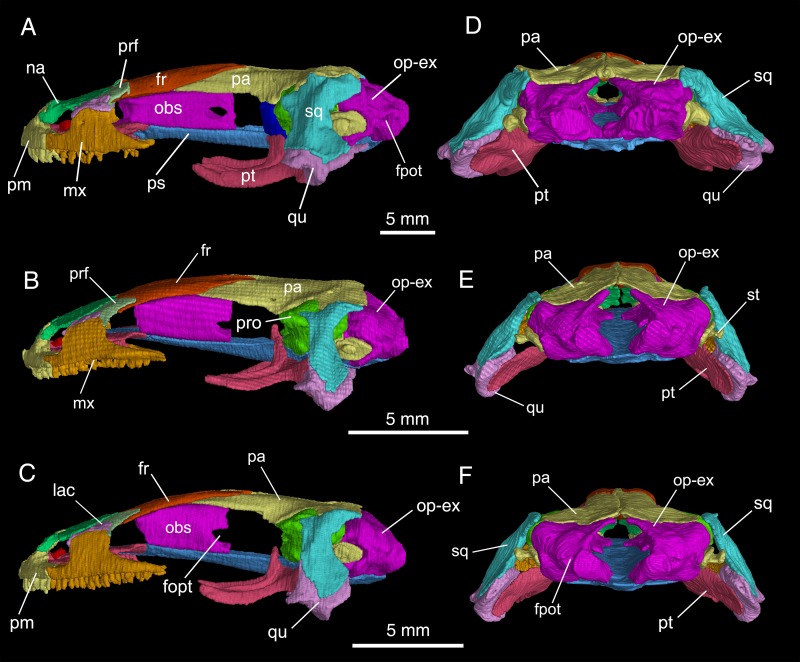
Batrachuperus yenyuanensis, commonly known as Yenyuan Stream Salamander, is a hynobiid species inhabiting high-altitude (2440-4025 m above sea level) mountain stream and pond environments along the eastern fringe of the Qinghai-Tibetan Plateau in western Sichuan Province, China. Although the species has been known for almost 70 years since its initial discovery in 1950, a thorough osteological description has never been provided. Our study provides a detailed account of the bony anatomy of this species, based on micro computed tomography scanning of multiple specimens collected from the type locality Shuangertang at Bailinshan, Yanyuan County, and several other localities in Sichuan Province. Our revised species diagnosis utilizes both bony and soft anatomical features. Comparative study of the specimens from the type locality in Yanyuan area with those from the nearby Xichang and Mianning areas confirms that they all pertain to Batrachuperus yenyuanensis, thereby removing doubt on the occurrence of the species in the latter areas. With this confirmation, the distribution of the species is extended from the type locality northwards some 180 km to the Mianning area, on both the west and east sides of the Yalong River, which is a major tributary of the upper Yangtze River. This distribution pattern indicates that the biogeographic origin and historical evolution of the species are closely associated with the orogeny of the Hengduan Mountains and formation of the Yalong River. Given the basalmost position of Batrachuperus yenyuanensis in relation to other congeneric species based on molecular studies, however, early expansion of the species distribution by dispersal is expected following the origin of the genus in early-middle Miocene in western Sichuan Province. Thus, the species may well have achieved its current distribution in western Sichuan before the drastic uplift of the Qinghai-Tibetan Plateau in Pliocene.
圆口螈,俗称盐源螈,是中国川西青藏高原东缘海拔 2440-4025 米高山溪流和池塘环境中的一个隐鳃鲵科物种。虽然该物种自 1950 年首次发现以来已经有近 70 年的历史,但从未进行过全面的骨骼描述。我们的研究基于对来自盐源县百灵山双儿塘等多个产地的多个标本进行的微计算机断层扫描,提供了该物种骨骼解剖结构的详细描述。我们对修订后的物种诊断利用了骨骼和软组织解剖特征。对来自盐源地区的模式产地标本与来自附近西昌和冕宁地区的标本进行比较研究,证实它们均属于圆口螈,从而消除了后者地区存在该物种的疑虑。通过这一确认,该物种的分布范围从模式产地向北延伸约 180 公里至冕宁地区,沿雅砻江两岸,雅砻江是长江上游的一条主要支流。这种分布模式表明,该物种的生物地理起源和历史进化与横断山脉的造山运动和雅砻江的形成密切相关。然而,根据分子研究,圆口螈在同属物种中处于最基础的位置,因此,在川西地区中-早中新世出现该属之后,物种的分布范围预计会通过扩散而早期扩张。因此,该物种在青藏高原在更新世剧烈抬升之前,可能已经在川西地区形成了其目前的分布范围。