Centers for Disease Control and Prevention, National Center for Immunization and Respiratory Diseases, Division of Bacterial Diseases, Atlanta, Georgia.
Centers for Disease Control and Prevention, National Center for Immunization and Respiratory Diseases, Division of Bacterial Diseases, Atlanta, Georgia.
Vaccine. 2019 Feb 14;37(8):1094-1100. doi: 10.1016/j.vaccine.2018.12.075. Epub 2019 Jan 23.
Vaccination of children with 13-valent pneumococcal conjugate vaccine (PCV13) led to declines in vaccine-type pneumococcal nasopharyngeal carriage among adults through indirect effects. In August 2014, PCV13 immunization of all U.S. adults ≥65 years of age was recommended. This study sought to define prevalence and serotype distribution of pneumococcal carriage among adults ≥65 years of age and to describe risk factors for colonization soon after introduction of PCV13 in adults.
A cross-sectional survey of non-institutionalized U.S. adults ≥65 years of age was conducted in four states in 2015-2016. Demographic information, risk factors for disease, PCV13 vaccination history, and nasopharyngeal (NP) and oropharyngeal (OP) swabs were collected. NP and OP swabs were processed separately and pneumococcal isolates were serotyped by Quellung reaction. Antimicrobial susceptibility of pneumococcal isolates was performed. NP swabs also underwent real-time PCR for pneumococcal detection and serotyping.
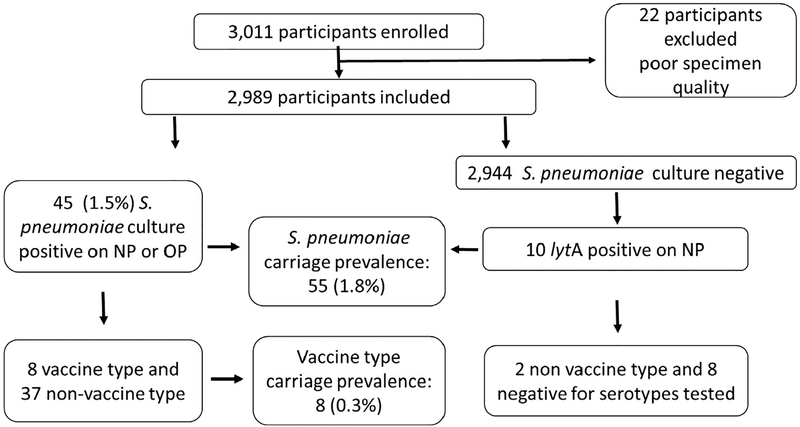
Of 2989 participants, 45.3% (1354/2989) had been vaccinated with PCV13. Fifty-five (1.8%) carried pneumococcus (45 identified by culture and 10 by real-time PCR only) and PCV13 serotypes were found in eight (0.3%) participants. Almost half (22/45) of pneumococcal isolates were not susceptible to at least one of the antibiotics tested. Vaccine-type carriage among vaccinated and unvaccinated individuals was similar (0.2% vs. 0.1%, respectively). Respiratory symptoms were associated with higher odds of pneumococcal colonization (adjusted OR: 2.1; 95% CI = 1.1-3.8).
Pneumococcal carriage among non-institutionalized adults ≥65 years of age was very low. Less than 0.5% of both vaccinated and unvaccinated individuals in our study carried vaccine-type serotypes. Over a decade of PCV vaccination of children likely led to indirect effects in adults. However, given the low vaccine-type carriage rates we observed in an already high PCV13 adult coverage setting, it is difficult to attribute our findings to the direct versus indirect effects of PCV13 on adult carriage.
儿童接种 13 价肺炎球菌结合疫苗(PCV13)导致成人疫苗型肺炎球菌鼻咽携带率下降,这是间接效应。2014 年 8 月,建议对所有 65 岁以上的美国成年人接种 PCV13 疫苗。本研究旨在定义 65 岁以上成年人中肺炎球菌携带的流行率和血清型分布,并描述 PCV13 在成年人中引入后不久定植的危险因素。
2015-2016 年,在四个州对 2989 名非住院的美国 65 岁以上成年人进行了横断面调查。收集了人口统计学信息、疾病危险因素、PCV13 疫苗接种史以及鼻咽(NP)和口咽(OP)拭子。NP 和 OP 拭子分别处理,肺炎球菌分离株通过 Quellung 反应进行血清型分型。对肺炎球菌分离株的药敏性进行了检测。NP 拭子还进行了实时 PCR 检测和血清型鉴定。
在 2989 名参与者中,45.3%(1354/2989)接种了 PCV13。55 名(1.8%)携带肺炎球菌(45 名通过培养确定,10 名仅通过实时 PCR 确定),8 名(0.3%)参与者携带 PCV13 血清型。近一半(22/45)的肺炎球菌分离株对至少一种测试的抗生素不敏感。接种疫苗和未接种疫苗的个体的疫苗型携带率相似(分别为 0.2%和 0.1%)。呼吸道症状与肺炎球菌定植的几率较高相关(调整后的 OR:2.1;95%CI=1.1-3.8)。
非住院 65 岁以上成年人的肺炎球菌携带率非常低。在我们的研究中,接种疫苗和未接种疫苗的个体中,疫苗型血清型的携带率均低于 0.5%。在儿童中接种 PCV 疫苗超过十年,可能导致成年人中出现间接效应。然而,鉴于我们在已经很高的 PCV13 成人覆盖率环境中观察到的低疫苗型携带率,很难将我们的发现归因于 PCV13 对成人携带的直接或间接影响。