1 Department of Internal Medicine III, Cardiology and Angiology University Hospital Schleswig-Holstein Kiel Germany.
2 Institute of Medical Informatics and Statistics Kiel University University Hospital Schleswig-Holstein Kiel Germany.
J Am Heart Assoc. 2019 Feb 5;8(3):e010876. doi: 10.1161/JAHA.118.010876.
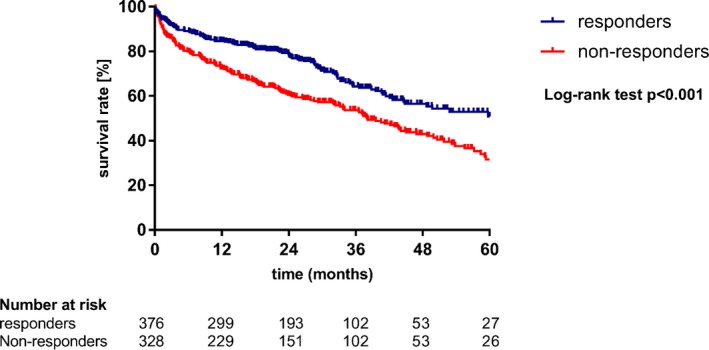
Background Cardiovascular biomarkers constitute promising tools for improved risk stratification and prediction of outcome in patients undergoing transcatheter aortic valve implantation. We examined the association of periprocedural changes of NT-proBNP (N-terminal pro-B-type natriuretic peptide) with survival after transcatheter aortic valve implantation. Methods and Results NT-proBNP levels were measured in 704 patients before transcatheter aortic valve implantation and at discharge. Patients were grouped as responders and nonresponders depending on an NT-proBNP-based ratio (postprocedural NT-proBNP at discharge/preprocedural NT-proBNP). Overall, 376 of 704 patients showed a postprocedural decrease in NT-proBNP levels (NT-proBNP ratio <1). Responders and nonresponders differed significantly regarding median preprocedural (2822 versus 1187 pg/mL, P<0.001) and postprocedural (1258 versus 3009 pg/mL, P<0.001) NT-proBNP levels. Patients in the nonresponder group showed higher prevalence of atrial fibrillation (47.0% versus 39.4%, P=0.042), arterial hypertension (94.2% versus 87.5%, P=0.002), renal impairment (77.4% versus 69.1%, P=0.013), and peripheral artery disease (24.4% versus 14.6%, P=0.001). In contrast, patients in the responder group had higher prevalence of moderately reduced left ventricular ejection fraction (17.3% versus 11.0%, P=0.017), lower calculated aortic valve area (0.7 versus 0.8 cm, P<0.001), and higher mean pressure gradient (41 versus 35 mm Hg, P<0.001). Median follow-up was 22.6 months. Kaplan-Meier analysis showed a highly significant survival benefit for the responder group compared with the nonresponder group (log-rank test, P<0.001). Conclusions A ratio based on periprocedural changes of NT-proBNP is a simple tool for better risk stratification and is associated with survival in patients after transcatheter aortic valve implantation.
背景 心血管生物标志物是改善经导管主动脉瓣植入术患者风险分层和预后预测的有前途的工具。我们研究了经导管主动脉瓣植入术前后 NT-proBNP(氨基末端 B 型利钠肽前体)的变化与生存的关系。
方法和结果 在 704 例经导管主动脉瓣植入术患者中测量了 NT-proBNP 水平,并在出院时进行了测量。根据基于 NT-proBNP 的比值(出院时的术后 NT-proBNP/术前 NT-proBNP)将患者分为反应者和非反应者。总体而言,704 例患者中有 376 例术后 NT-proBNP 水平下降(NT-proBNP 比值<1)。反应者和非反应者在术前中位数(2822 与 1187 pg/mL,P<0.001)和术后中位数(1258 与 3009 pg/mL,P<0.001)NT-proBNP 水平方面有显著差异。非反应者组患者心房颤动(47.0%与 39.4%,P=0.042)、动脉高血压(94.2%与 87.5%,P=0.002)、肾功能不全(77.4%与 69.1%,P=0.013)和外周动脉疾病(24.4%与 14.6%,P=0.001)的发生率更高。相比之下,反应者组患者中度左心室射血分数降低(17.3%与 11.0%,P=0.017)、计算出的主动脉瓣口面积较低(0.7 与 0.8 cm,P<0.001)和平均压力梯度较高(41 与 35 mm Hg,P<0.001)的发生率更高。中位随访时间为 22.6 个月。Kaplan-Meier 分析显示,与非反应者相比,反应者组的生存获益具有显著统计学意义(对数秩检验,P<0.001)。
结论 基于经导管主动脉瓣植入术前后 NT-proBNP 变化的比值是一种简单的风险分层工具,与经导管主动脉瓣植入术后患者的生存相关。