Zhang Yuzhong, Liu Zhou, Ji Bing, Liu Lijian, Wu Shaoxiong, Liu Xiaowu, Wang Silun, Wang Liya
Department of Radiology, The People's Hospital of Longhua, Shenzhen, China.
Graduate School, Medical College of Nanchang University, Nanchang, China.
Front Aging Neurosci. 2019 Jan 9;10:424. doi: 10.3389/fnagi.2018.00424. eCollection 2018.
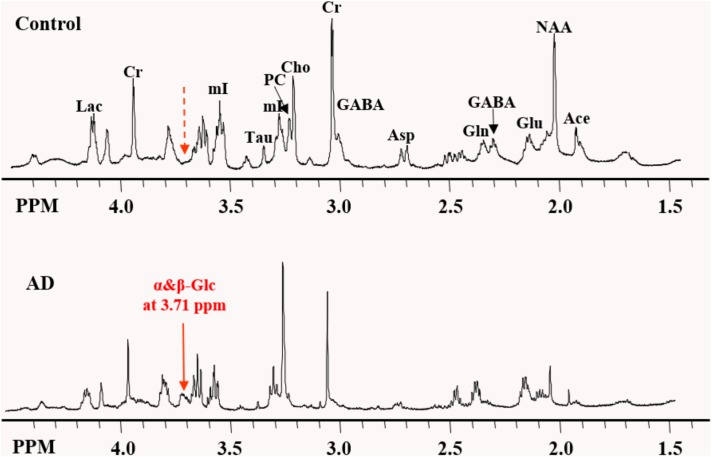
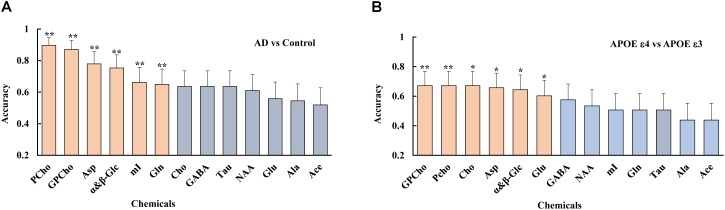
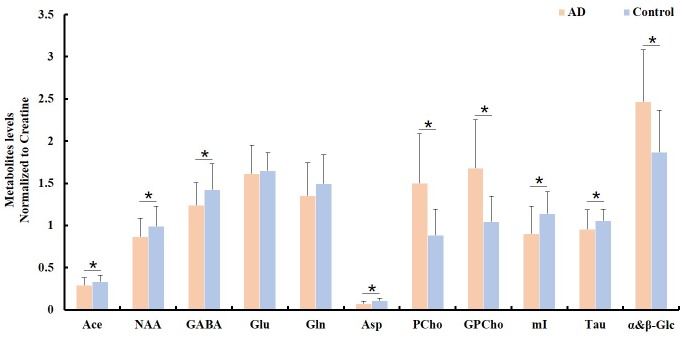
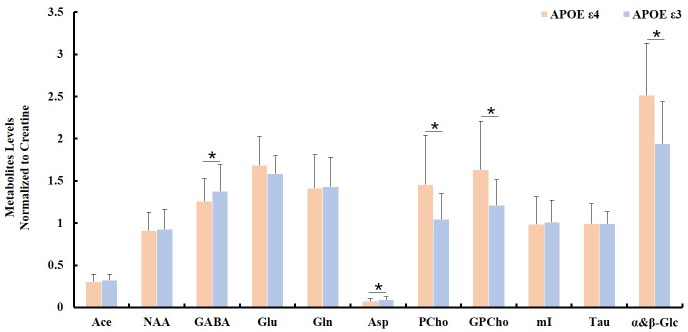
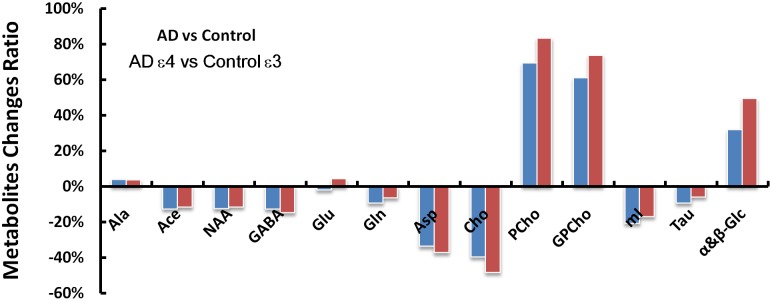
Investigation on neurochemical changes in the frontal cortex in individuals with Alzheimer's disease (AD) and different Apolipoprotein E (APOE) genotypes, using solid-state high-resolution NMR analysis, may lead to a better understanding of the neurochemistry associated with AD as well as new AD-specific metabolite biomarkers that might potentially improve the clinical diagnosis of AD. Intact tissue samples of the frontal cortex were obtained from 11 patients and 11 age-matched non-demented controls. Metabolite profiles in all samples were analyzed , using solid-state high-resolution magic angle spinning (HRMAS) 600 MHz H nuclear magnetic resonance (NMR). A logistic regression analysis was used to rank metabolites based on their level of contribution in differentiating the AD patient tissues and the controls, and different AD-associated APOE genotypes (APOE ε4 vs. APOE ε3). Tissue samples from the AD patients showed significantly lower NAA/Cr ( = 0.011), Ace/Cr ( = 0.027), GABA/Cr ( = 0.005), Asp/Cr ( < 0.0001), mI/Cr ( < 0.0001), and Tau/Cr ( = 0.021), and higher PCho/Cr ( < 0.0001), GPCho/Cr ( < 0.0001), and α&β-Glc/Cr ( < 0.0001) than the controls did. Specifically, a newly observed resonance at 3.71 ppm, referred to as α&β-Glc, was observed in 90.9% of the AD samples (10/11). Samples with APOE ε4 also exhibited higher PCho/Cr ( = 0.0002), GPCho/Cr ( = 0.0001), α&β-Glc/Cr ( < 0.0001), and lower Asp/Cr ( = 0.004) and GABA/Cr ( = 0.04) than the samples with APOE ε3 did. In the logistic regression analysis, PCho, GPCho, ASP, and α&β-Glc were found to be the most relevant metabolites for differentiating the AD patient tissues and the controls, and different APOE genotypes. HRMAS H NMR with high spectral resolution and sensitivity offers a powerful tool to gain quantitative information on AD associated neurochemical changes. There are important neurochemical differences in the frontal cortex between the AD patient tissues and the controls, and between those with different APOE genotypes. The resonance (α&β-Glc) found at 3.71 ppm in the AD patient tissues may be further investigated for its potential in the diagnosis and monitoring of AD.
利用固态高分辨率核磁共振分析,对患有阿尔茨海默病(AD)且具有不同载脂蛋白E(APOE)基因型的个体额叶皮质中的神经化学变化进行研究,可能有助于更好地理解与AD相关的神经化学,以及发现可能改善AD临床诊断的新型AD特异性代谢物生物标志物。从11例患者和11例年龄匹配的非痴呆对照中获取额叶皮质的完整组织样本。使用固态高分辨率魔角旋转(HRMAS)600 MHz氢核磁共振(NMR)分析所有样本中的代谢物谱。采用逻辑回归分析根据代谢物在区分AD患者组织与对照以及不同AD相关APOE基因型(APOE ε4与APOE ε3)中的贡献水平对其进行排名。AD患者的组织样本显示,与对照相比,NAA/Cr(P = 0.011)、Ace/Cr(P = 0.027)、GABA/Cr(P = 0.005)、Asp/Cr(P < 0.0001)、mI/Cr(P < 0.0001)和Tau/Cr(P = 0.021)显著降低,而PCho/Cr(P < 0.0001)、GPCho/Cr(P < 0.0001)和α&β-Glc/Cr(P < 0.0001)显著升高。具体而言,在90.9%的AD样本(10/11)中观察到在3.71 ppm处有一个新的共振峰,称为α&β-Glc。与APOE ε3样本相比,携带APOE ε4的样本还表现出更高的PCho/Cr(P = 0.0002)、GPCho/Cr(P = 0.0001)、α&β-Glc/Cr(P < 0.0001),以及更低的Asp/Cr(P = 0.004)和GABA/Cr(P = 0.04)。在逻辑回归分析中,发现PCho、GPCho、ASP和α&β-Glc是区分AD患者组织与对照以及不同APOE基因型的最相关代谢物。具有高光谱分辨率和灵敏度的HRMAS氢核磁共振为获取与AD相关的神经化学变化的定量信息提供了一个强大的工具。AD患者组织与对照之间以及不同APOE基因型之间的额叶皮质存在重要的神经化学差异。在AD患者组织中于3.71 ppm处发现的共振峰(α&β-Glc)在AD诊断和监测方面的潜力可能值得进一步研究。