College of Medicine, King Saud bin Abdulaziz University for Health Sciences, King Abdullah International Medical Research Center, Riyadh, Saudi Arabia; Intensive Care Department, Ministry of the National Guard - Health Affairs, Riyadh, Saudi Arabia.
Research Office, King Abdullah International Medical Research Center, King Saud bin Abdulaziz University for Health Sciences, Ministry of the National Guard - Health Affairs, Riyadh, Saudi Arabia.
Int J Infect Dis. 2019 Apr;81:184-190. doi: 10.1016/j.ijid.2019.01.041. Epub 2019 Jan 25.
Macrolides have been reported to be associated with improved outcomes in patients with viral pneumonia related to influenza and other viruses, possibly because of their immune-modulatory effects. Macrolides have frequently been used in patients with Middle East Respiratory Syndrome (MERS). This study investigated the association of macrolides with 90-day mortality and MERS coronavirus (CoV) RNA clearance in critically ill patients with MERS.
This retrospective analysis of a multicenter cohort database included 14 tertiary-care hospitals in five cities in Saudi Arabia. Multivariate logistic-regression analysis was used to determine the association of macrolide therapy with 90-day mortality, and the Cox-proportional hazard model to determine the association of macrolide therapy with MERS-CoV RNA clearance.
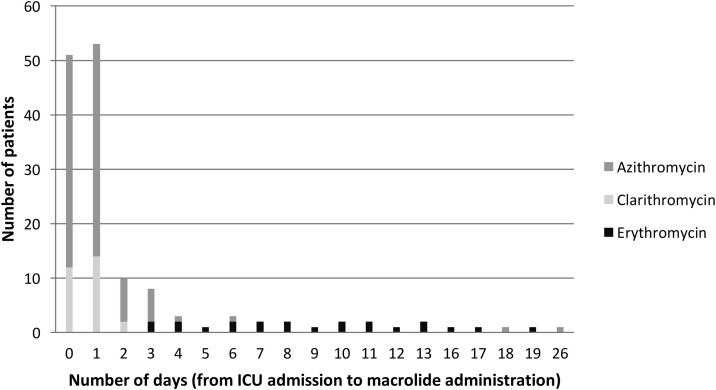
Of 349 critically ill MERS patients, 136 (39%) received macrolide therapy. Azithromycin was most commonly used (97/136; 71.3%). Macrolide therapy was commonly started before the patient arrived in the intensive care unit (ICU) (51/136; 37.5%), or on day1 in ICU (53/136; 39%). On admission to ICU, the baseline characteristics of patients who received and did not receive macrolides were similar, including demographic data and sequential organ failure assessment score. However, patients who received macrolides were more likely to be admitted with community-acquired MERS (P=0.02). Macrolide therapy was not independently associated with a significant difference in 90-day mortality (adjusted odds ratio [OR]: 0.84; 95% confidence interval [CI] :0.47-1.51; P=0.56) or MERS-CoV RNA clearance (adjusted HR: 0.88; 95% CI:0.47-1.64; P=0.68).
These findings indicate that macrolide therapy is not associated with a reduction in 90-day mortality or improvement in MERS-CoV RNA clearance.
有报道称,大环内酯类药物可能通过其免疫调节作用,改善流感和其他病毒引起的病毒性肺炎患者的预后。大环内酯类药物在中东呼吸综合征(MERS)患者中经常使用。本研究旨在调查大环内酯类药物与重症 MERS 患者 90 天死亡率和 MERS 冠状病毒(CoV)RNA 清除率之间的关系。
这是一项对沙特阿拉伯五个城市的 14 家三级护理医院的多中心队列数据库进行的回顾性分析。采用多变量逻辑回归分析确定大环内酯类药物治疗与 90 天死亡率之间的关系,采用 Cox 比例风险模型确定大环内酯类药物治疗与 MERS-CoV RNA 清除之间的关系。
在 349 例重症 MERS 患者中,有 136 例(39%)接受了大环内酯类药物治疗。阿奇霉素(97/136;71.3%)最常用。大环内酯类药物治疗通常在患者进入重症监护病房(ICU)之前(51/136;37.5%)或 ICU 第 1 天(53/136;39%)开始。入住 ICU 时,接受和未接受大环内酯类药物治疗的患者的基线特征相似,包括人口统计学数据和序贯器官衰竭评估评分。然而,接受大环内酯类药物治疗的患者更有可能因社区获得性 MERS 而入院(P=0.02)。大环内酯类药物治疗与 90 天死亡率(调整后的优势比[OR]:0.84;95%置信区间[CI]:0.47-1.51;P=0.56)或 MERS-CoV RNA 清除率(调整后的 HR:0.88;95%CI:0.47-1.64;P=0.68)之间无显著相关性。
这些发现表明,大环内酯类药物治疗与降低 90 天死亡率或改善 MERS-CoV RNA 清除率无关。