Senior Director of Capsid Development, Rare Disease Research Unit, Pfizer Inc., 7030 Kit Creek Road, Morrisville, NC 27560, USA.
Department of Genetics, Harvard Medical School, Boston, 02115, USA.
Viruses. 2019 Jan 25;11(2):102. doi: 10.3390/v11020102.
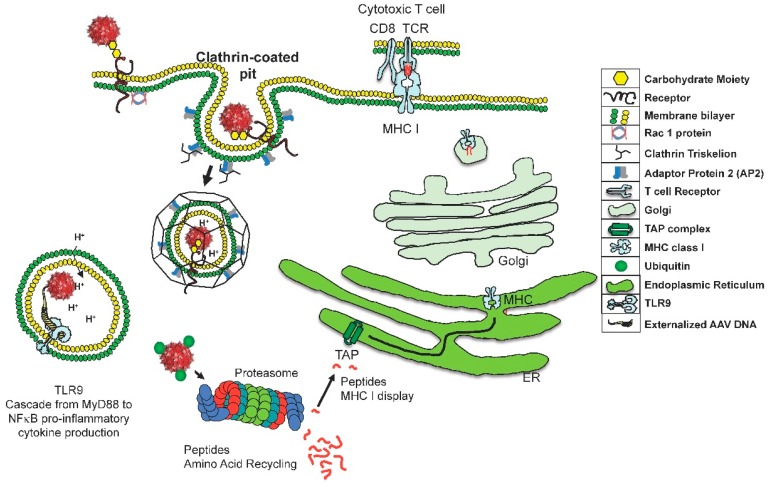
Decades ago, Friedmann and Roblin postulated several barriers to gene therapy, including tissue targeting, delivery across the blood⁻brain barrier (BBB), and host immune responses. These issues remain pertinent till today. Since then, several advances have been made in elucidating structures of adeno-associated virus (AAV) serotypes, antibody epitopes, and ways to modify antibody-binding sites. AAVs capsid has also been engineered to re-direct tissue tropism, reduce ubiquitination, and promote passage across the BBB. Furthermore, the use of high(er) dose recombinant AAV (rAAV) has been accompanied by a better understanding of immune responses in both experimental animals and early clinical trials, and novel work is being performed to modulate the immune response. While the immune responses to rAAV remains a major challenge in translating experimental drugs to approved medicine, and will likely require more than a single solution, we now better understand the hurdles to formulate and test experimental solutions to surmount them.
几十年前,Friedmann 和 Roblin 提出了基因治疗的几个障碍,包括组织靶向、穿过血脑屏障(BBB)的传递以及宿主免疫反应。这些问题直到今天仍然存在。从那时起,人们在阐明腺相关病毒(AAV)血清型、抗体表位的结构以及修饰抗体结合位点的方法方面取得了几项进展。AAV 衣壳也经过了工程改造,以重新定向组织嗜性、减少泛素化并促进穿过 BBB。此外,高(更高)剂量重组 AAV(rAAV)的使用伴随着对实验动物和早期临床试验中免疫反应的更好理解,并且正在进行新的工作来调节免疫反应。虽然 rAAV 的免疫反应仍然是将实验药物转化为批准药物的主要挑战,并且可能需要不止一种解决方案,但我们现在更了解制定和测试实验解决方案以克服这些障碍的困难。