Clinic of Nephrology and Rheumatology, University Medical Center Goettingen, 37075 Goettingen, Germany.
Clinic of Pediatrics and Adolescent Medicine, University Medical Center Goettingen, 37075 Goettingen, Germany.
Int J Mol Sci. 2019 Jan 26;20(3):519. doi: 10.3390/ijms20030519.
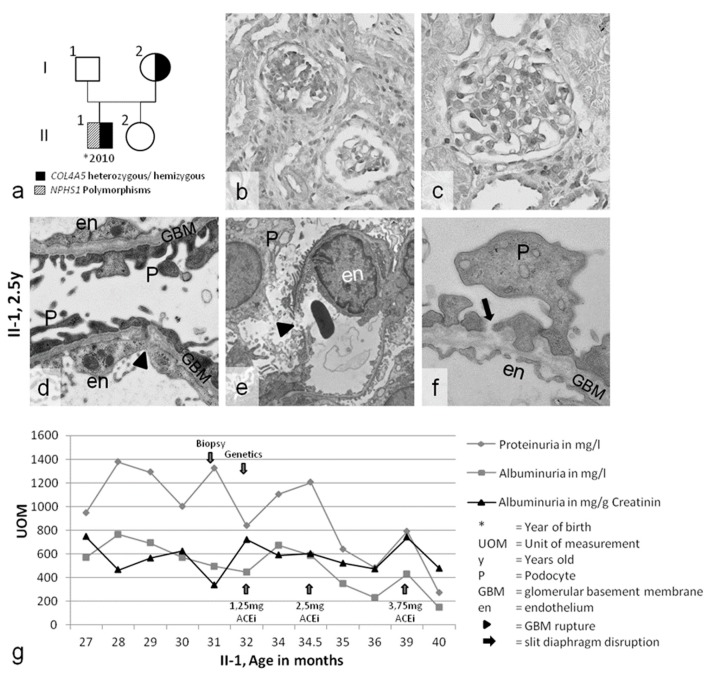
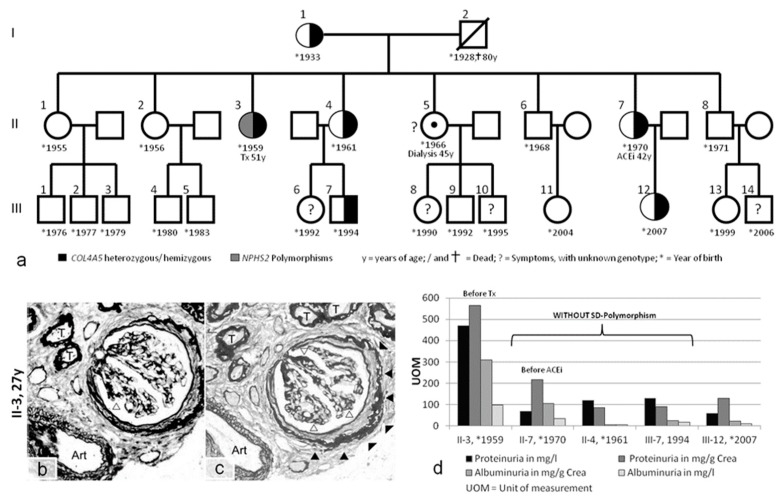
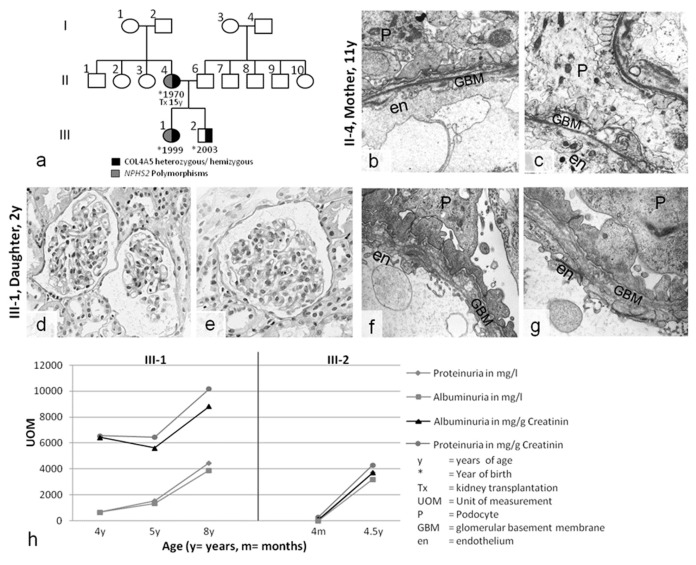
Kidney injury due to focal segmental glomerulosclerosis (FSGS) is the most common primary glomerular disorder causing end-stage renal disease. Homozygous mutations in either glomerular basement membrane or slit diaphragm genes cause early renal failure. Heterozygous carriers develop renal symptoms late, if at all. In contrast to mutations in slit diaphragm genes, hetero- or hemizygous mutations in the X-chromosomal Alport gene have not yet been recognized as a major cause of kidney injury by FSGS. We identified cases of FSGS that were unexpectedly diagnosed: In addition to mutations in the X-chromosomal type IV collagen gene, nephrin and podocin polymorphisms aggravated kidney damage, leading to FSGS with ruptures of the basement membrane in a toddler and early renal failure in heterozygous girls. The results of our case series study suggest a synergistic role for genes encoding basement membrane and slit diaphragm proteins as a cause of kidney injury due to FSGS. Our results demonstrate that the molecular genetics of different players in the glomerular filtration barrier can be used to evaluate causes of kidney injury. Given the high frequency of X-chromosomal carriers of Alport genes, the analysis of genes involved in the organization of podocyte architecture, the glomerular basement membrane, and the slit diaphragm will further improve our understanding of the pathogenesis of FSGS and guide prognosis of and therapy for hereditary glomerular kidney diseases.
由于局灶节段性肾小球硬化症(FSGS)导致的肾脏损伤是引起终末期肾病的最常见原发性肾小球疾病。肾小球基底膜或裂孔隔膜基因突变会导致早期肾衰竭。杂合子携带者即使有肾脏症状,也通常出现得较晚。与裂孔隔膜基因突变不同,X 染色体上的 Alport 基因的杂合或半合子突变尚未被认为是 FSGS 导致肾脏损伤的主要原因。我们发现了一些出乎意料被诊断为 FSGS 的病例:除了 X 染色体 IV 型胶原蛋白基因突变外,nephrin 和 podocin 多态性也加重了肾脏损伤,导致基底膜破裂的 FSGS 出现在幼儿身上,杂合子女孩则出现早期肾衰竭。我们的病例系列研究结果提示编码基底膜和裂孔隔膜蛋白的基因协同作用是 FSGS 导致肾脏损伤的原因。我们的结果表明,不同肾小球滤过屏障蛋白的分子遗传学可以用于评估肾脏损伤的原因。鉴于 Alport 基因的 X 染色体携带者频率较高,对参与足细胞结构、肾小球基底膜和裂孔隔膜组织的基因进行分析,将进一步提高我们对 FSGS 发病机制的认识,并指导遗传性肾小球肾病的预后和治疗。