Laboratory of Bacteriology, The Rockefeller University, New York, NY, USA.
Howard Hughes Medical Institute, The Rockefeller University, New York, NY, USA.
Nat Microbiol. 2019 Apr;4(4):656-662. doi: 10.1038/s41564-018-0353-x. Epub 2019 Jan 28.
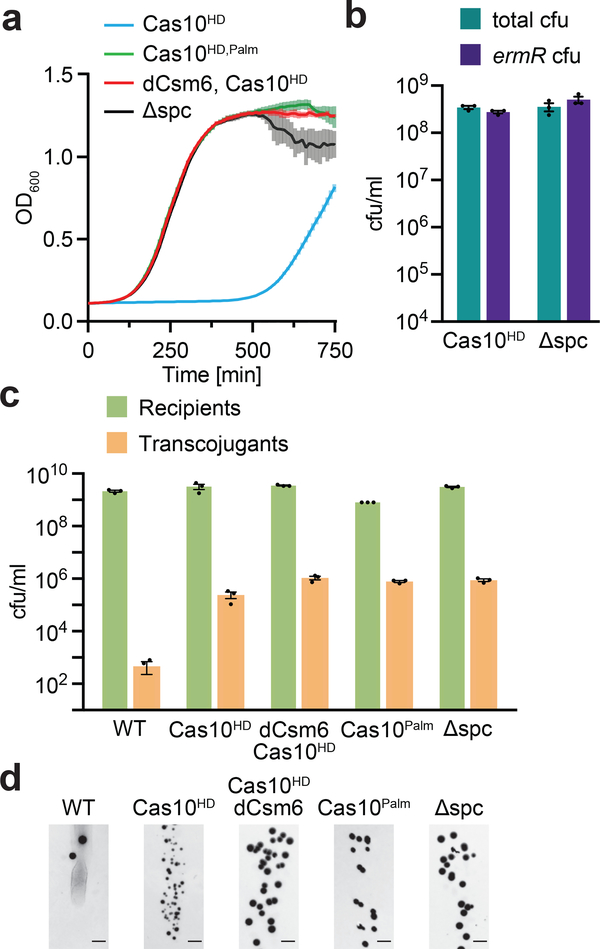
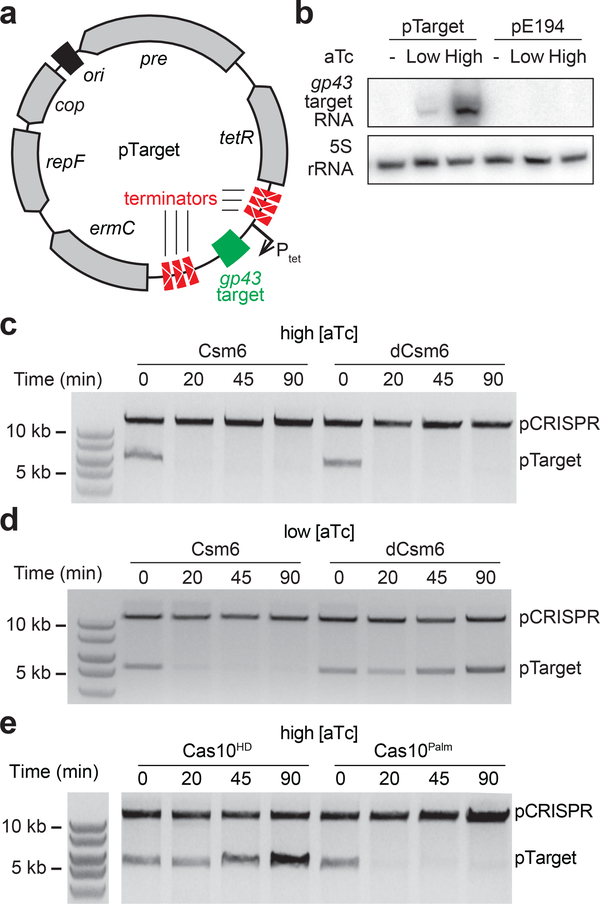
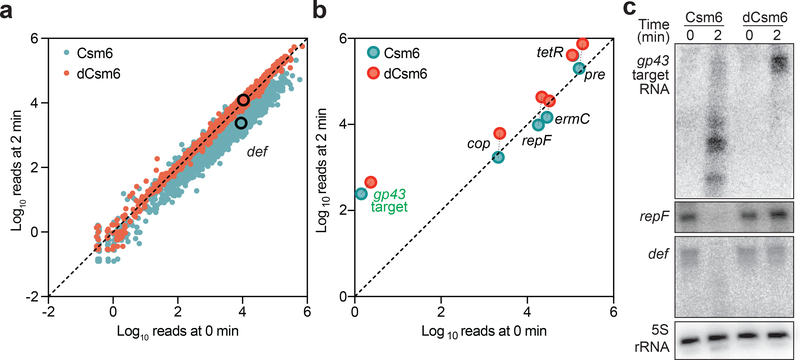
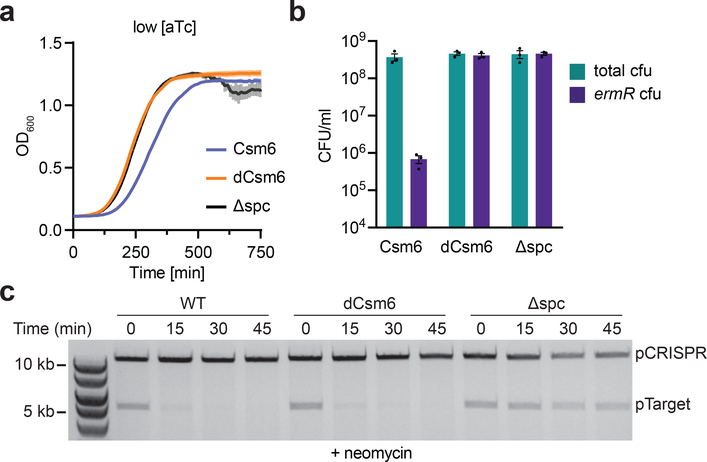
Type III-A CRISPR-Cas systems employ the Cas10-Csm complex to destroy bacteriophages and plasmids, using a guide RNA to locate complementary RNA molecules from the invader and trigger an immune response that eliminates the infecting DNA. In addition, these systems possess the non-specific RNase Csm6, which provides further protection for the host. While the role of Csm6 in immunity during phage infection has been determined, how this RNase is used against plasmids is unclear. Here, we show that Staphylococcus epidermidis Csm6 is required for immunity when transcription across the plasmid target is infrequent, leading to impaired target recognition and inefficient DNA degradation by the Cas10-Csm complex. In these conditions, Csm6 causes growth arrest in the host and prevents further plasmid replication through the indiscriminate degradation of host and plasmid transcripts. In contrast, when plasmid target sequences are efficiently transcribed, Csm6 is dispensable and DNA degradation by Cas10 is sufficient for anti-plasmid immunity. Csm6 therefore provides robustness to the type III-A CRISPR-Cas immune response against difficult targets for the Cas10-Csm complex.
III-A 型 CRISPR-Cas 系统利用 Cas10-Csm 复合物来破坏噬菌体和质粒,使用指导 RNA 来定位来自入侵者的互补 RNA 分子,并引发免疫反应,从而消除感染 DNA。此外,这些系统还具有非特异性 RNase Csm6,为宿主提供进一步的保护。虽然已经确定了 Csm6 在噬菌体感染期间免疫中的作用,但这种 RNase 如何针对质粒发挥作用尚不清楚。在这里,我们表明当质粒靶标上的转录不频繁时,表皮葡萄球菌 Csm6 对于免疫是必需的,这导致靶标识别受损,并且 Cas10-Csm 复合物的 DNA 降解效率降低。在这些条件下,Csm6 会导致宿主生长停滞,并通过非特异性降解宿主和质粒转录本来阻止进一步的质粒复制。相比之下,当质粒靶序列被有效地转录时,Csm6 是可有可无的,Cas10 的 DNA 降解足以产生抗质粒免疫。因此,Csm6 为 III-A 型 CRISPR-Cas 免疫反应提供了对 Cas10-Csm 复合物难以识别的靶标具有稳健性。