Forny-Germano Leticia, De Felice Fernanda G, Vieira Marcelo Nunes do Nascimento
Institute of Medical Biochemistry Leopoldo de Meis, Federal University of Rio de Janeiro, Rio de Janeiro, Brazil.
Centre for Neuroscience Studies, Department of Psychiatry, Queen's University, Kingston, ON, Canada.
Front Neurosci. 2019 Jan 14;12:1027. doi: 10.3389/fnins.2018.01027. eCollection 2018.
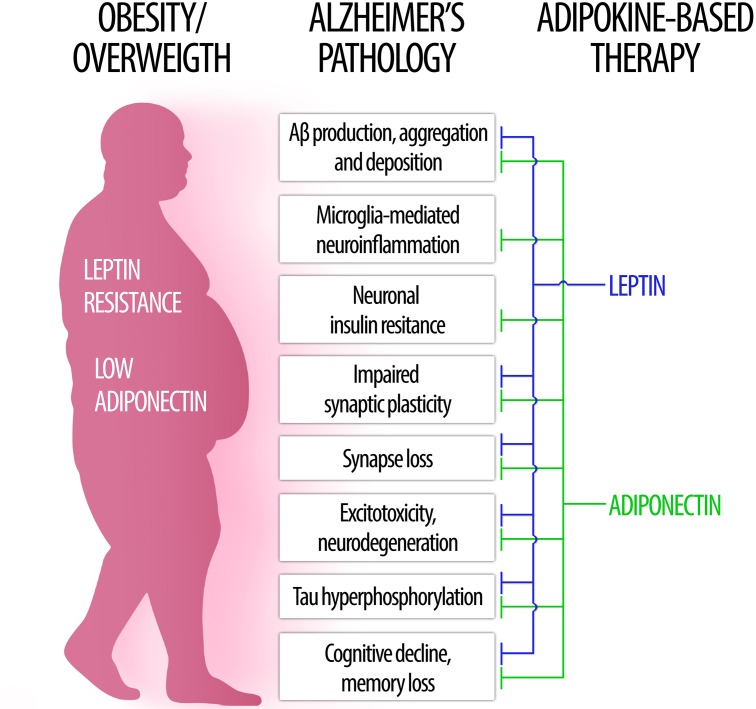
Cross-talk between adipose tissue and central nervous system (CNS) underlies the increased risk of obese people to develop brain diseases such as cognitive and mood disorders. Detailed mechanisms for how peripheral changes caused by adipose tissue accumulation in obesity impact the CNS to cause brain dysfunction are poorly understood. Adipokines are a large group of substances secreted by the white adipose tissue to regulate a wide range of homeostatic processes including, but not limited to, energy metabolism and immunity. Obesity is characterized by a generalized change in the levels of circulating adipokines due to abnormal accumulation and dysfunction of adipose tissue. Altered adipokine levels underlie complications of obesity as well as the increased risk for the development of obesity-related comorbidities such as type 2 diabetes, cardiovascular and neurodegenerative diseases. Here, we review the literature for the role of adipokines as key mediators of the communication between periphery and CNS in health and disease. We will focus on the actions of leptin and adiponectin, two of the most abundant and well studied adipokines, in the brain, with particular emphasis on how altered signaling of these adipokines in obesity may lead to cognitive dysfunction and augmented risk for Alzheimer's disease. A better understanding of adipokine biology in brain disorders may prove of major relevance to diagnostic, prevention and therapy.
脂肪组织与中枢神经系统(CNS)之间的相互作用是肥胖人群患脑部疾病(如认知和情绪障碍)风险增加的基础。肥胖时脂肪组织堆积引起的外周变化如何影响中枢神经系统导致脑功能障碍的详细机制尚不清楚。脂肪因子是由白色脂肪组织分泌的一大类物质,可调节广泛的稳态过程,包括但不限于能量代谢和免疫。肥胖的特征是由于脂肪组织异常堆积和功能障碍导致循环脂肪因子水平普遍变化。脂肪因子水平的改变是肥胖并发症以及肥胖相关合并症(如2型糖尿病、心血管疾病和神经退行性疾病)发生风险增加的基础。在这里,我们综述了关于脂肪因子作为健康和疾病中外周与中枢神经系统之间通讯关键介质作用的文献。我们将重点关注瘦素和脂联素这两种含量最丰富且研究最多的脂肪因子在大脑中的作用,特别强调肥胖时这些脂肪因子信号改变如何导致认知功能障碍和患阿尔茨海默病风险增加。更好地理解脑部疾病中的脂肪因子生物学可能对诊断、预防和治疗具有重要意义。