Ronga Irene, Garbarini Francesca, Neppi-Modona Marco, Fossataro Carlotta, Pyasik Maria, Bruno Valentina, Sarasso Pietro, Barra Giulia, Frigerio Marta, Chiotti Virginia Carola, Pia Lorenzo
SAMBA (SpAtial, Motor and Bodily Awareness) Research Group, Psychology Department, University of Turin, Turin, Italy.
Manibus Laboratory, Psychology Department, University of Turin, Turin, Italy.
Front Psychol. 2019 Jan 14;9:2726. doi: 10.3389/fpsyg.2018.02726. eCollection 2018.
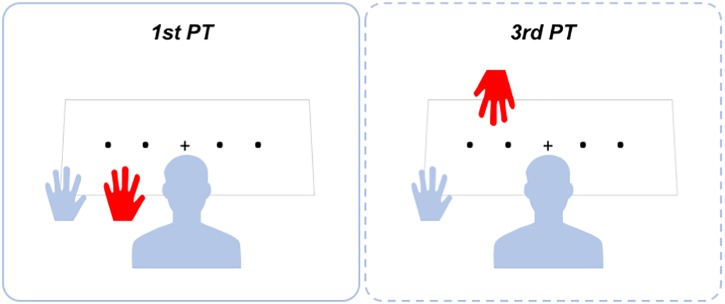
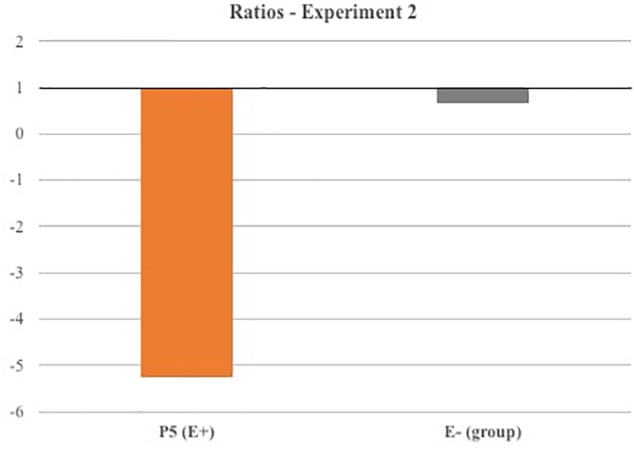
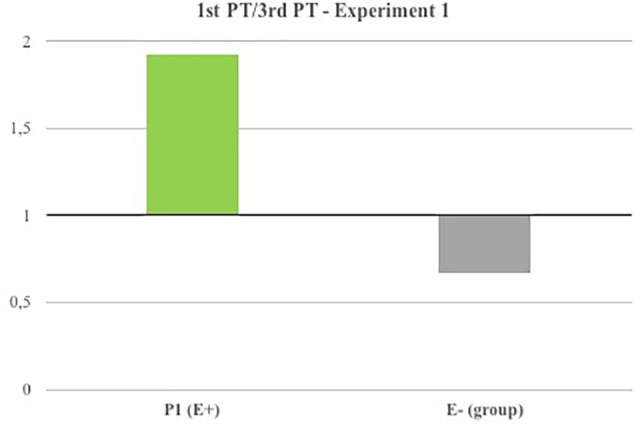
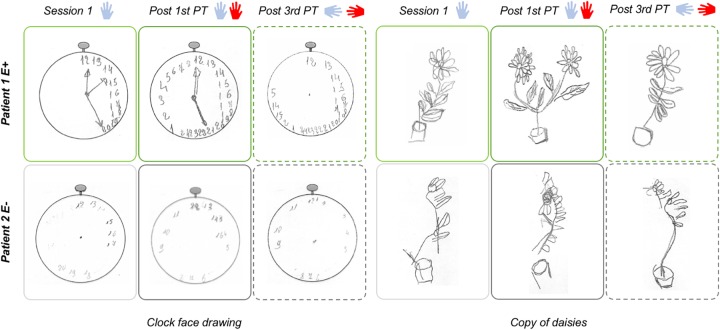
(E+) is a specific contralesional delusion of body ownership, observed following brain damage, in which patients embody someone else's arm and its movements within their own body schema whenever the contralesional 'alien' arm is presented in a body-congruent position (i.e., 1st person perspective and aligned with the patient's shoulder). This disorder is often associated with spatial neglect, a neurological syndrome in which patients are unaware of stimuli presented in the contralesional (often the left) space. Capitalizing on previous evidence demonstrating that prismatic adaptation of the ipsilesional arm to right-deviating prisms is effective in ameliorating neglect symptoms, here we investigated whether such amelioration also occurs in E+ patients with neglect when prismatic training is performed by the 'alien' embodied arm. Four left neglect patients (one with and three without pathological embodiment) underwent visuomotor prismatic training performed by an 'alien' arm. Specifically, while patients were wearing prismatic goggles shifting the visual field rightward, a co-experimenter's left arm presented in a body-congruent perspective was repeatedly moved toward visual targets by another examiner. In a control condition, the co-experimenter's arm was moved toward the targets from a body-incongruent position (i.e., 3rd person perspective). Neglect symptoms were assessed before and after training through paper-and-pencil tasks. In the E+ patient, neglect improved significantly more in 1st than in 3rd person perspective training, suggesting that prismatic adaptation of the 'alien' embodied arm is effective in modulating spatial representation. Conversely, for control E- patients (not embodying the 'alien' arm), we observed more limited improvements following training. These findings indicate that the 'alien' embodied arm is so deeply embedded in the patient body and motor schema that adaptation to prismatic lenses can affect multiple processing stages, from low level sensory-motor correspondences, to higher level body, motor and spatial maps, similarly as it occurs in normal subjects and neglect patients without pathological embodiment.
(肢体体现+)是一种在脑损伤后观察到的特定的对侧身体所有权妄想,即每当对侧“异己”手臂以身体一致的位置呈现时(即第一人称视角并与患者肩部对齐),患者会在自己的身体图式中体现出他人的手臂及其动作。这种障碍通常与空间忽视有关,空间忽视是一种神经综合征,患者对在对侧(通常是左侧)空间呈现的刺激没有意识。基于先前的证据表明,同侧手臂对向右偏移棱镜的棱镜适应在改善忽视症状方面是有效的,在此我们研究了在由“异己”体现手臂进行棱镜训练时,这种改善是否也会发生在伴有忽视的(肢体体现+)患者中。四名左侧忽视患者(一名有病理体现,三名无病理体现)接受了由“异己”手臂进行的视觉运动棱镜训练。具体而言,当患者佩戴使视野向右偏移的棱镜护目镜时,一名共同实验者以身体一致视角呈现的左臂由另一名检查者反复移向视觉目标。在对照条件下,共同实验者的手臂从身体不一致的位置(即第三人称视角)移向目标。在训练前后通过纸笔任务评估忽视症状。在(肢体体现+)患者中,第一人称视角训练比第三人称视角训练的忽视改善更为显著,这表明“异己”体现手臂的棱镜适应在调节空间表征方面是有效的。相反,对于对照的(肢体体现-)患者(不体现“异己”手臂),我们观察到训练后的改善较为有限。这些发现表明,“异己”体现手臂如此深入地嵌入患者身体和运动图式中,以至于对棱镜镜片的适应可以影响从低水平感觉运动对应到更高水平身体、运动和空间地图的多个处理阶段,这与正常受试者和无病理体现的忽视患者的情况类似。