
巴西低需冷量苹果种质资源库的遗传变异性
Genetic variability in a Brazilian apple germplasm collection with low chilling requirements.
作者信息
Mariano Livia Costa, Zchonski Felipe Liss, da Silva Clandio Medeiros, Da-Silva Paulo Roberto
机构信息
Plant Genetics and Molecular Biology Laboratory, Universidade Estadual do Centro-Oeste, UNICENTRO, Guarapuava, Paraná, Brazil.
Instituto Agronômico do Paraná, Londrina, Paraná, Brazil.
出版信息
PeerJ. 2019 Jan 21;6:e6265. doi: 10.7717/peerj.6265. eCollection 2019.
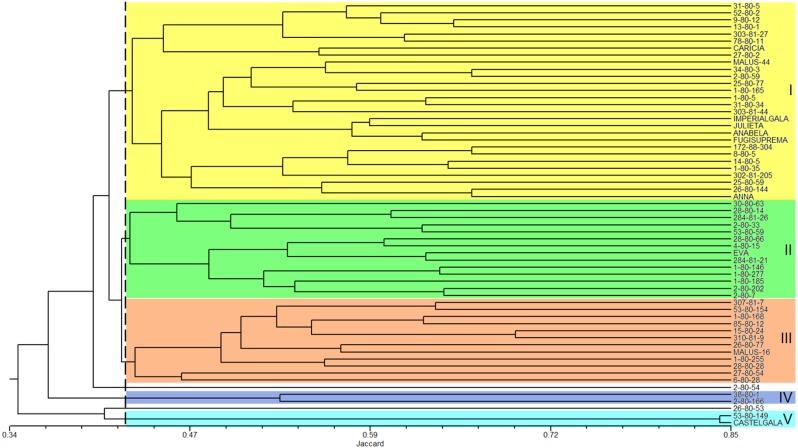
The apple ( Borkh) originally evolved to require temperatures below 7.2 °C for the induction of budding and flowering. In Brazil, breeders have overcome the climate barrier and developed the cultivars Anabela, Julieta, Carícia, and Eva, with low chilling requirements and good yield characteristics. These cultivars are grown in many warmer climate countries in South America, Africa, and the Middle East. The apple germplasm collection that originated these cultivars has several genotypes with pedigrees for a low chilling requirement. Knowledge of the variability and genetic relationships among these genotypes may be useful in the development of superior new cultivars. In this work, we first selected the best ISSR (inter-simple sequence repeat) primers for genetic studies in apple, and then we used the selected primers to evaluate the genetic variability of the apple germplasm collection at the Instituto Agronômico do Paraná. The evaluation of 42 ISSR primers in 10 apple genotypes allowed us to select the best nine primers based on the polymorphic information content (PIC) and resolving power (RP) indexes. The primer selection step was robust since the dendrogram obtained with the nine selected primers was the same as the one obtained using all 26 polymorphic primers. Primer selection using PIC and RP indexes allowed us to save about 60% of time and costs in the genetic variability study. The nine ISSR primers showed high levels of genetic variability in the 60 apple genotypes evaluated. The relevance of the primer selection step is discussed from the perspective of saving time and money in germplasm characterization. The high genetic variability and the genetic relationships among the genotypes are discussed from the perspective of the development of new apple cultivars, mainly aiming for a low chilling requirement that can better adapt to current climatic conditions or those that may arise with global warming.
苹果(Borkh)最初进化为需要7.2°C以下的温度来诱导萌芽和开花。在巴西,育种者克服了气候障碍,培育出了冷温需求量低且产量特性良好的品种阿纳贝拉、朱丽叶塔、卡里西亚和伊娃。这些品种在南美洲、非洲和中东的许多气候较温暖的国家种植。培育出这些品种的苹果种质资源库中有几种基因型具有低冷温需求的谱系。了解这些基因型之间的变异性和遗传关系可能有助于培育出更优良的新品种。在这项研究中,我们首先选择了用于苹果遗传研究的最佳ISSR(简单序列重复区间)引物,然后使用所选引物评估巴拉那州农业研究所苹果种质资源库的遗传变异性。对10个苹果基因型中的42个ISSR引物进行评估后,我们根据多态性信息含量(PIC)和分辨能力(RP)指标选择了最佳的9个引物。引物选择步骤是可靠的,因为用所选的9个引物得到的树状图与使用所有26个多态性引物得到的树状图相同。使用PIC和RP指标进行引物选择,使我们在遗传变异性研究中节省了约60%的时间和成本。这9个ISSR引物在评估的60个苹果基因型中显示出高水平的遗传变异性。从在种质特征鉴定中节省时间和金钱的角度讨论了引物选择步骤的相关性。从培育新苹果品种的角度讨论了基因型之间的高遗传变异性和遗传关系,主要目标是培育出冷温需求量低、能更好适应当前气候条件或全球变暖可能出现的气候条件的品种。




 Zotero 插件