Pan Zhaoxing, Granger Douglas A, Guérin Noémie A, Shoffner Amy, Gabriels Robin L
Department of Pediatrics, University of Colorado Anschutz Medical Campus, Aurora, CO, United States.
Children's Hospital Colorado, Aurora, CO, United States.
Front Vet Sci. 2019 Jan 14;5:312. doi: 10.3389/fvets.2018.00312. eCollection 2018.
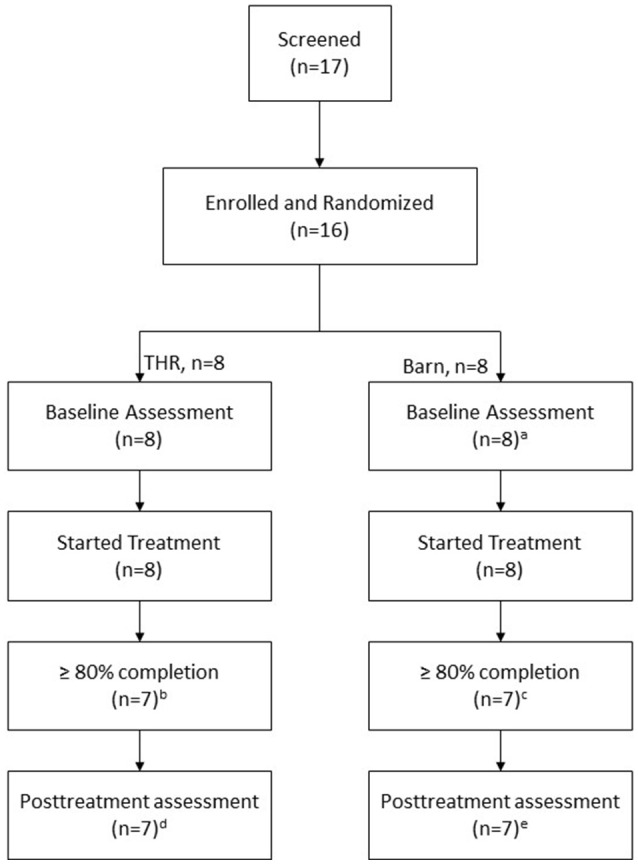
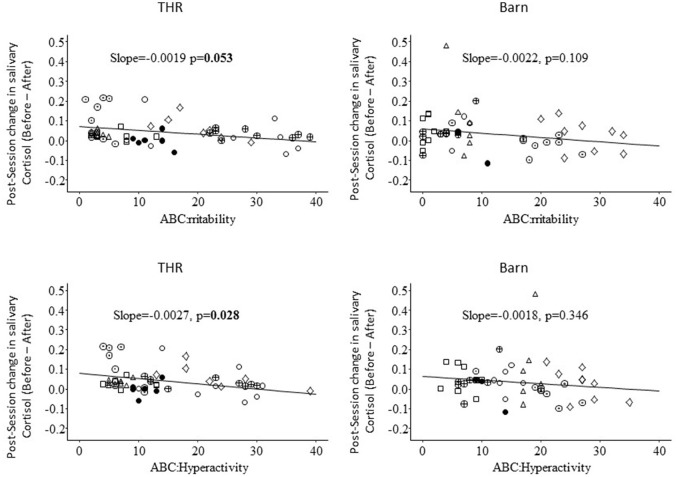
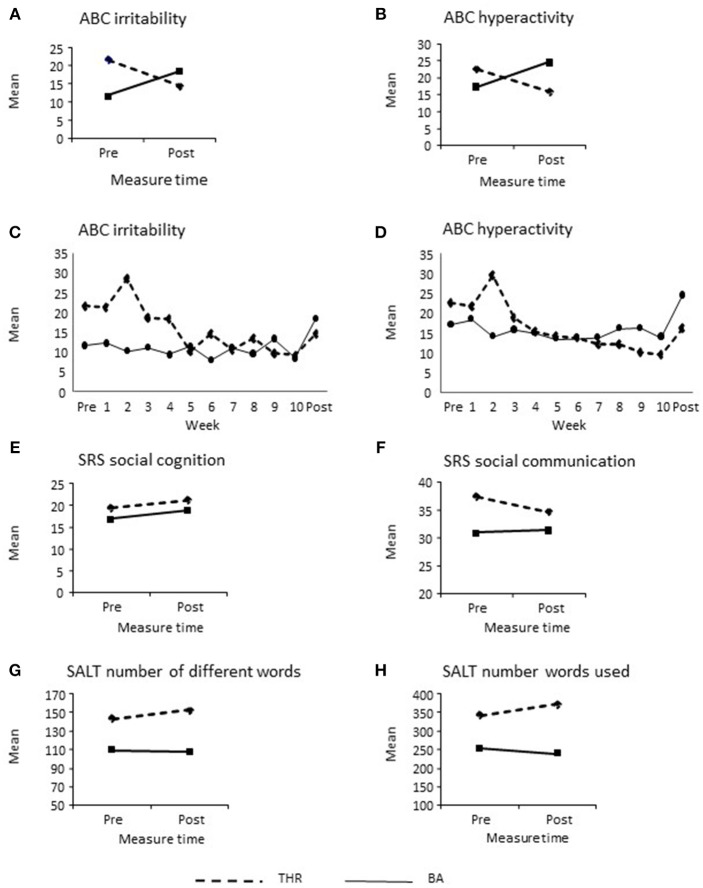
We aimed to determine whether results of our prior randomized control trial [RCT; NCT02301195, (1)] of Therapeutic Horseback Riding (THR) for children and adolescents with autism spectrum disorder (ASD) could be at a different riding center and if treatment effects also included differences in the expression of associations between problem behavior and the activity of the hypothalamic-pituitary-adrenal (HPA) axis. Participants with ASD ( = 16) ages 6-16 years were randomized by nonverbal intelligence quotient to either a 10-week THR group ( = 8) or no horse interaction barn activity (BA) control group ( = 8). Outcome measures were a standard speech-language sample and caregiver-report of aberrant and social behaviors. Participants' saliva was sampled weekly at a consistent afternoon time immediately pre- and 20 min' post-condition (later assayed for cortisol). Intent-to-treat analysis revealed that compared to controls, THR participants had significant improvements in hyperactivity, and social awareness, and significant improvements at the 0.1 significance level in irritability and social communication behaviors. There were no significant improvements in number of words or new words spoken during the standard language sample. Linear mixed effects model analysis indicated that greater weekly pre-lesson irritability levels were associated with smaller post-lesson reduction in salivary cortisol levels, and greater weekly pre-lesson hyperactivity levels were associated with smaller cortisol reduction in the THR group, but not in the BA control group. The findings represent a partial replication of prior results (1), extend prior observations to include THR effects on biobehavioral relationships and suggest that cortisol could be a target mediator for THR effects on irritability and hyperactivity behaviors in youth with ASD. Trial of Therapeutic Horseback Riding in Children and Adolescents with Autism Spectrum Disorder; http://clinicaltrials.gov, identifier: NCT02301195.
我们旨在确定先前针对患有自闭症谱系障碍(ASD)的儿童和青少年进行的治疗性骑马(THR)随机对照试验[RCT;NCT02301195,(1)]的结果在不同的骑马中心是否成立,以及治疗效果是否还包括问题行为与下丘脑-垂体-肾上腺(HPA)轴活动之间关联表达的差异。年龄在6至16岁的ASD参与者(n = 16)根据非言语智商被随机分为10周的THR组(n = 8)或无马匹互动的畜舍活动(BA)对照组(n = 8)。结果测量指标为标准的语言样本以及照料者报告的异常行为和社交行为。参与者的唾液样本在每周下午的同一时间,在每次治疗前和治疗后20分钟采集(随后检测皮质醇)。意向性分析显示,与对照组相比,THR参与者在多动和社交意识方面有显著改善,在易怒和社交沟通行为方面在0.1的显著性水平上有显著改善。在标准语言样本中说出的单词数量或新单词数量没有显著改善。线性混合效应模型分析表明,每周课前更高的易怒水平与课后唾液皮质醇水平的较小降低相关,每周课前更高的多动水平与THR组中皮质醇的较小降低相关,但在BA对照组中并非如此。这些发现部分重复了先前的结果(1),将先前观察结果扩展到包括THR对生物行为关系的影响,并表明皮质醇可能是THR对ASD青少年易怒和多动行为影响的目标介质。 自闭症谱系障碍儿童和青少年的治疗性骑马试验;http://clinicaltrials.gov,标识符:NCT02301195。