Center for Research in Biological Systems, University of California, San Diego, San Diego, United States.
Children's Medical Research Institute, University of Sydney, Westmead, Australia.
Elife. 2019 Jan 29;8:e41676. doi: 10.7554/eLife.41676.
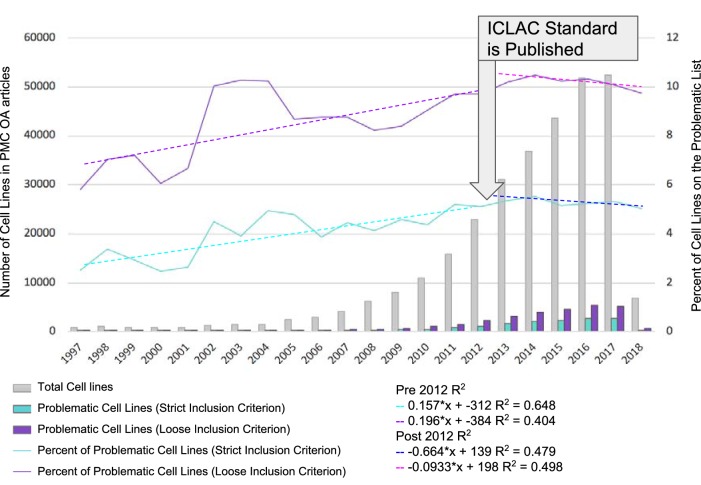
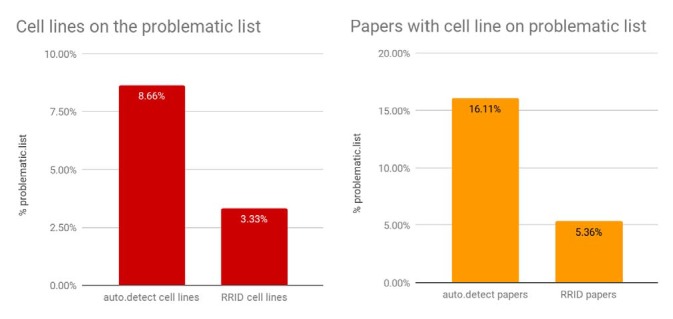
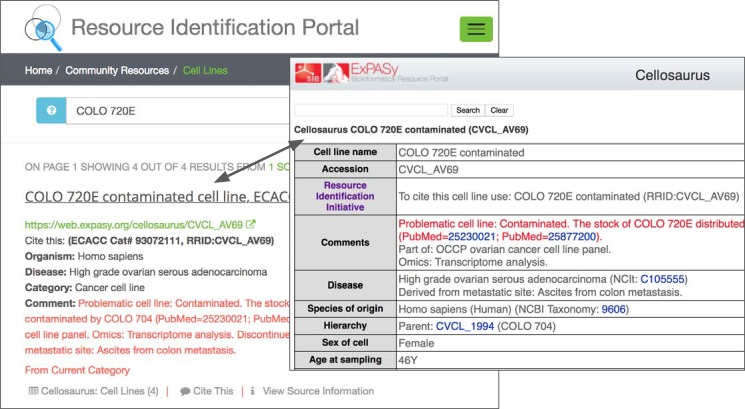
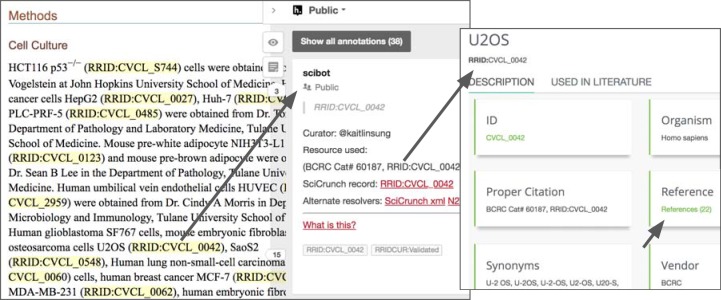
The use of misidentified and contaminated cell lines continues to be a problem in biomedical research. Research Resource Identifiers (RRIDs) should reduce the prevalence of misidentified and contaminated cell lines in the literature by alerting researchers to cell lines that are on the list of problematic cell lines, which is maintained by the International Cell Line Authentication Committee (ICLAC) and the Cellosaurus database. To test this assertion, we text-mined the methods sections of about two million papers in PubMed Central, identifying 305,161 unique cell-line names in 150,459 articles. We estimate that 8.6% of these cell lines were on the list of problematic cell lines, whereas only 3.3% of the cell lines in the 634 papers that included RRIDs were on the problematic list. This suggests that the use of RRIDs is associated with a lower reported use of problematic cell lines.
在生物医学研究中,误用和污染的细胞系仍然是一个问题。研究资源标识符(RRIDs)应该通过提醒研究人员注意国际细胞系认证委员会(ICLAC)和细胞库(Cellosaurus database)维护的有问题细胞系列表中的细胞系,来减少文献中误识别和污染的细胞系的流行率。为了验证这一说法,我们对 PubMed Central 中的大约 200 万篇论文的方法部分进行了文本挖掘,在 150459 篇文章中确定了 305161 个独特的细胞系名称。我们估计,这些细胞系中有 8.6%在有问题的细胞系列表中,而在包含 RRIDs 的 634 篇论文中的细胞系中,只有 3.3%在有问题的列表中。这表明 RRIDs 的使用与报告的有问题细胞系的使用呈负相关。