Bejerot Susanne, Hesselmark Eva, Mobarrez Fariborz, Wallén Håkan, Hietala Max Albert, Nybom Rolf, Wetterberg Lennart
Department of Clinical Neuroscience, Karolinska Institutet, SE-112 81, Stockholm, Sweden.
School of Medical Sciences, Örebro University, Örebro, Sweden.
J Med Case Rep. 2019 Jan 30;13(1):27. doi: 10.1186/s13256-018-1929-z.
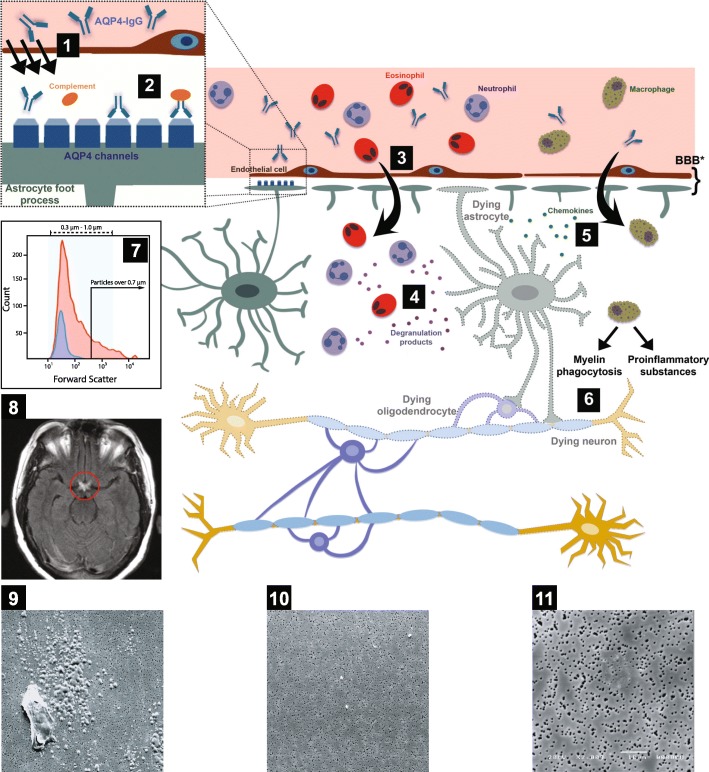
Neuromyelitis optica spectrum disorders are severe autoimmune inflammatory diseases of the central nervous system associated with the presence of immunoglobulin G antibodies against the water channel protein aquaporin-4. During exacerbation, specific aquaporin-4 immunoglobulin G may be produced intrathecally. We measured extracellular aquaporin-4 microparticles in the cerebrospinal fluid of a patient who later developed the typical symptoms and signs of a neuromyelitis optica spectrum disorder.
A 17-year-old South American girl developed acute severe motor and vocal tics and difficulties in walking, peripheral numbness, muscle pain, and bilateral headache. At age 22, she had a multitude of motor and psychiatric symptoms. Over the years, she fulfilled the diagnostic criteria for anorexia nervosa, depression, sleep disorder, obsessive-compulsive disorder, generalized anxiety disorder, panic disorder, agoraphobia, social anxiety disorder, development coordination disorder, attention-deficit/hyperactivity disorder, hypomania, pediatric autoimmune neuropsychiatric disorders associated with streptococcal infections, conversion disorder, psychosis, and schizotypal personality syndrome. At age 24, she was found to have elevated titers of aquaporin-4 antibodies in serum, suggestive of probable neuromyelitis optica. She subsequently developed visual impairment, and swollen optic nerves were verified by magnetic resonance imaging. She was thus treated with a chimeric monoclonal antibody targeted against the pan-B-cell marker CD20 (rituximab), and almost all symptoms, including the psychiatric symptoms, rapidly decreased. We found a significant increase of extracellular microparticles of aquaporin-4 in cerebrospinal fluid sampled from our patient when she was 22 years old, 2 years before the full clinical development of neuromyelitis optica.
Microparticles of aquaporin-4 represent subcellular arrangements that may influence the pathogenesis of neuromyelitis optica spectrum disorders and may serve as biomarkers for the underlying cellular disturbances. The increase of aquaporin-4 microparticles in cerebrospinal fluid may be used for early diagnostic purposes; for prevention; and for evaluation of effective treatment, long-term follow-up studies, and elucidating the pathophysiology in neuromyelitis optica spectrum disorders. Further studies of aquaporin-4 microparticles in cerebrospinal fluid of patients with neuromyelitis optica and similar neuropsychiatric disorders are thus called for.
视神经脊髓炎谱系障碍是中枢神经系统的严重自身免疫性炎症性疾病,与抗水通道蛋白4的免疫球蛋白G抗体的存在相关。在病情加重期间,鞘内可能产生特异性水通道蛋白4免疫球蛋白G。我们检测了一名后来出现视神经脊髓炎谱系障碍典型症状和体征的患者脑脊液中的细胞外水通道蛋白4微粒。
一名17岁的南美女孩出现急性严重运动性和发声性抽动,以及行走困难、周围麻木、肌肉疼痛和双侧头痛。22岁时,她出现了多种运动和精神症状。多年来,她符合神经性厌食症、抑郁症、睡眠障碍、强迫症、广泛性焦虑症、惊恐障碍、广场恐惧症、社交焦虑症、发育协调障碍、注意力缺陷/多动障碍、轻躁狂、与链球菌感染相关的儿童自身免疫性神经精神障碍、转换障碍、精神病和分裂样人格综合征的诊断标准。24岁时,她血清中的水通道蛋白4抗体滴度升高,提示可能患有视神经脊髓炎。随后她出现视力障碍,磁共振成像证实视神经肿胀。因此,她接受了针对泛B细胞标志物CD20的嵌合单克隆抗体(利妥昔单抗)治疗,几乎所有症状,包括精神症状,都迅速减轻。我们发现,在该患者22岁时,即视神经脊髓炎完全临床发作前2年采集的脑脊液中,水通道蛋白4的细胞外微粒显著增加。
水通道蛋白4微粒代表可能影响视神经脊髓炎谱系障碍发病机制的亚细胞结构,可作为潜在细胞紊乱的生物标志物。脑脊液中水通道蛋白4微粒的增加可用于早期诊断、预防以及评估有效治疗、长期随访研究和阐明视神经脊髓炎谱系障碍的病理生理学。因此,需要对视神经脊髓炎及类似神经精神疾病患者脑脊液中的水通道蛋白4微粒进行进一步研究。