Caruso Sarah, Poon Ivan K H
Department of Biochemistry and Genetics, La Trobe Institute for Molecular Science, La Trobe University, Melbourne, VIC, Australia.
Front Immunol. 2018 Jun 28;9:1486. doi: 10.3389/fimmu.2018.01486. eCollection 2018.
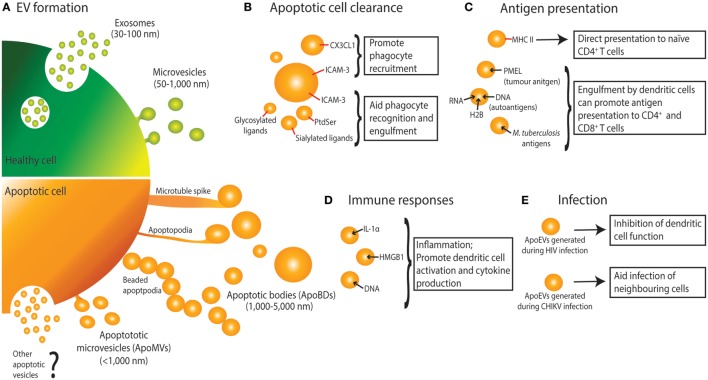
The many functions of extracellular vesicles (EVs) like exosomes and microvesicles released from healthy cells have been well characterized, particularly in relation to their roles in immune modulation. Apoptotic bodies, a major class of EV released as a product of apoptotic cell disassembly, and other types of EVs released from dying cells are also becoming recognized as key players in this emerging field. There is now increasing evidence to suggest that EVs produced during apoptosis have important immune regulatory roles, a concept relevant across different disease settings including autoimmunity, cancer, and infection. Therefore, this review focuses on how the formation of EVs during apoptosis could be a key mechanism of immune modulation by dying cells.
从健康细胞释放的细胞外囊泡(EVs),如外泌体和微囊泡,其多种功能已得到充分表征,尤其是它们在免疫调节中的作用。凋亡小体是凋亡细胞解体产物释放的一类主要的EV,从垂死细胞释放的其他类型的EV也逐渐被认为是这一新兴领域的关键参与者。现在有越来越多的证据表明,凋亡过程中产生的EV具有重要的免疫调节作用,这一概念在包括自身免疫、癌症和感染在内的不同疾病背景中都具有相关性。因此,本综述重点关注凋亡过程中EV的形成如何可能成为垂死细胞进行免疫调节的关键机制。