Luo Huan, Xie Shanshan, Ma Chao, Zhang Wenqiang, Tschöpe Carsten, Fa Xianen, Cheng Jingliang, Cao Jing
MR Department, The First Affiliated Hospital of Zhengzhou University, Zhengzhou, China.
Department of Ophthalmology, Campus Virchow, Charité - Universitätsmedizin Berlin, Berlin, Germany.
Front Neurol. 2019 Jan 15;9:1173. doi: 10.3389/fneur.2018.01173. eCollection 2018.
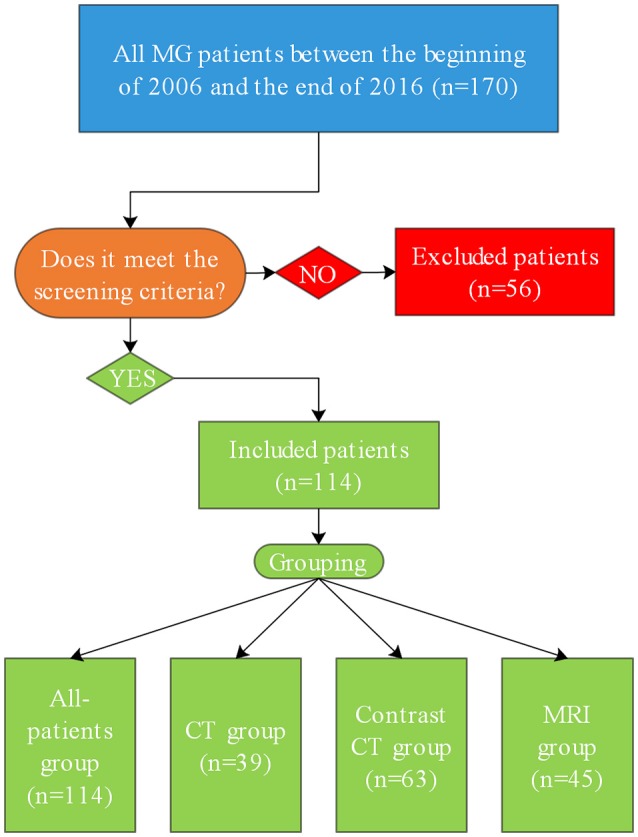
The ability to distinguish between a normal thymus, thymic hyperplasia, and thymoma should aid in clinical management and decision making for patients with myasthenia gravis (MG). We sought to determine the accuracy of routine radiological examinations in predicting thymic pathology. We retrospectively analyzed the records of patients with MG who had undergone thymectomy from the Second Affiliated Hospital of Zhengzhou University. Each patient received at least one initial radiological diagnosis and one histological diagnosis, and the patients were classified into the all-patient, CT, contrast CT, and MRI groups. The sensitivity, accuracy and specificity of each group were calculated for different histological types. This study included 114 patients. All sensitivity, specificity and accuracy values except for sensitivity to hyperplasia in each group for different histological types were satisfactory. MRI had higher sensitivity (68.4, 95% CI: 43.5-87.4%) to histological hyperplasia than did CT (14.3, 95% CI: 0.4-57.9%) and contrast CT (26.7, 95% CI: 7.8-55.1%). Contrast CT had higher specificity (97.9, 95% CI: 88.9-99.95%) for histological hyperplasia than did MRI (88.5, 95% CI: 69.9-97.6%). For patients with MG, CT, contrast CT, and MRI examinations can effectively identify thymoma. Additionally, compared with CT or contrast CT, MRI may have a stronger ability to distinguish thymoma and detect hyperplasia.
区分正常胸腺、胸腺增生和胸腺瘤的能力有助于重症肌无力(MG)患者的临床管理和决策。我们试图确定常规放射学检查在预测胸腺病理方面的准确性。我们回顾性分析了郑州大学第二附属医院接受胸腺切除术的MG患者的记录。每位患者至少接受一次初始放射学诊断和一次组织学诊断,并将患者分为全患者组、CT组、增强CT组和MRI组。计算每组针对不同组织学类型的敏感性、准确性和特异性。本研究纳入了114例患者。除了每组针对不同组织学类型对增生的敏感性外,所有敏感性、特异性和准确性值均令人满意。MRI对组织学增生的敏感性(68.4,95%CI:43.5-87.4%)高于CT(14.3,95%CI:0.4-57.9%)和增强CT(26.7,95%CI:7.8-55.1%)。增强CT对组织学增生的特异性(97.9,95%CI:88.9-99.95%)高于MRI(88.5,95%CI:69.9-97.6%)。对于MG患者,CT、增强CT和MRI检查可有效识别胸腺瘤。此外,与CT或增强CT相比,MRI区分胸腺瘤和检测增生的能力可能更强。