Kurtoğllu Ayşegül Uğur, Koçtekin Belkıs, Kurtoğlu Erdal, Yildiz Mustafa
Department of Biochemistry, Antalya Education and Research Hospital, Antalya, Turkey.
Department of Blood Center, Antalya Education and Research Hospital, Antalya, Turkey.
Arch Med Sci. 2019 Jan;15(1):191-195. doi: 10.5114/aoms.2018.81036. Epub 2018 Dec 30.
Hemolysis due to ineffective erythropoiesis is a serious problem β-thalassemia major (β-TM) patients. The role of complement system in the etiopathogenesis of hemolysis observed in β-TM were released. Hemolysis induced by activation of complement system is prevented by complement regulatory proteins. Decay accelerating factor (CD55), membrane inhibitor of reactive lysis (CD59), and complement reception 1 (CR1, CD35) are among these proteins. The absence of these proteins thus accounts for the increased susceptibility of erythrocytes to complement lysis. Splenomegaly and hypersplenism are common complications among thalassemia major patients necessitating splenectomy.
In this study we investigated how splenectomy effects complement regulatory system in erythrocytes. We analysed CD35, CD55, and CD59 levels on erythrocytes in β-TM by flow cytometry.
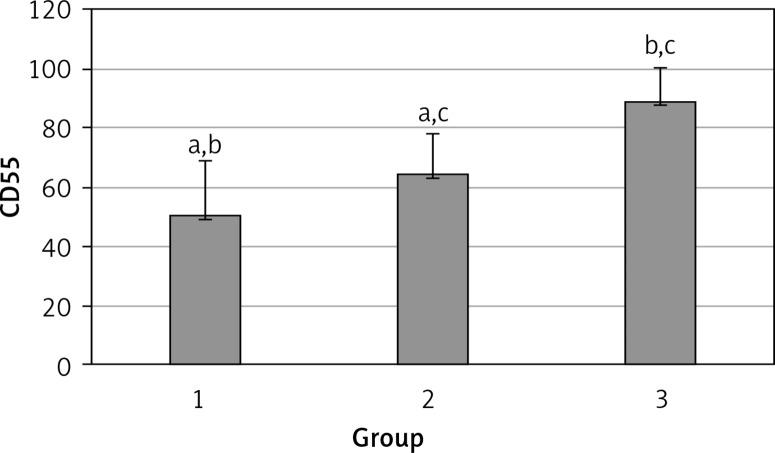
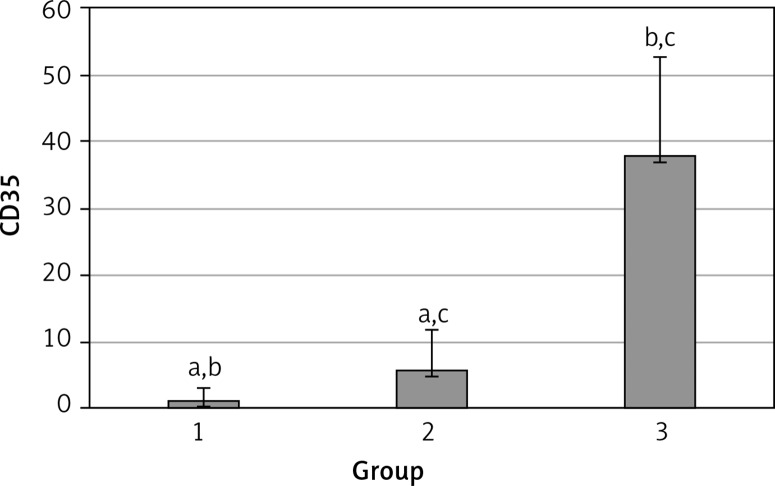
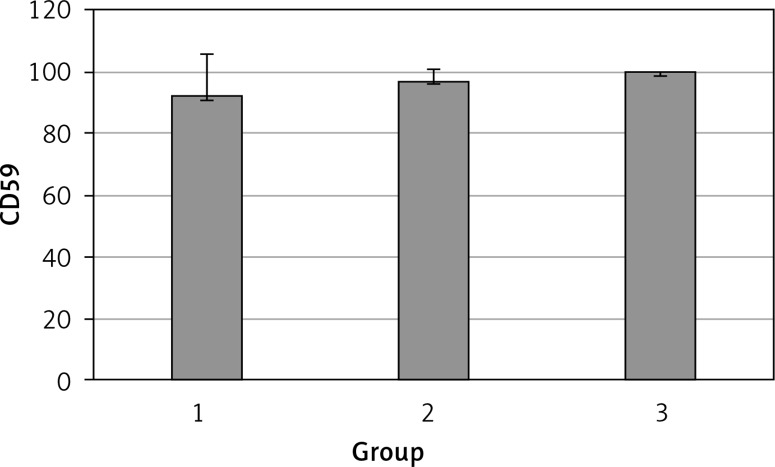
The overall mean percentage of CD55 and CD35 positive RBCs of group 1 (22 β-TM with splenectomy) was significantly lower than group 2 (23 β-TM without splenectomy) and group 3 (healthy controls) ( < 0.05). The overall mean percentage CD59 positive RBCs of patients was no significantly different in all groups. The levels of CD35 and CD55 expression on the erythrocytes of splenectomized patients was significantly lower than non-splenectomized patients ( < 0.05).
Increased erythrocyte destruction and iron deposition in organs due to deficiency of these regulatory proteins may be the underlying mechanism of organ damage developing in β-TM patients.
无效红细胞生成所致的溶血是重型β地中海贫血(β-TM)患者面临的一个严重问题。补体系统在β-TM患者溶血的发病机制中的作用已被揭示。补体调节蛋白可阻止补体系统激活所诱导的溶血。衰变加速因子(CD55)、反应性溶解膜抑制剂(CD59)和补体受体1(CR1,CD35)均属于此类蛋白。因此,这些蛋白的缺失导致红细胞对补体溶解的易感性增加。脾肿大和脾功能亢进是重型地中海贫血患者常见的并发症,常需进行脾切除术。
在本研究中,我们调查了脾切除术对红细胞补体调节系统的影响。我们通过流式细胞术分析了β-TM患者红细胞上的CD35、CD55和CD59水平。
第1组(22例接受脾切除术的β-TM患者)CD55和CD35阳性红细胞的总体平均百分比显著低于第2组(23例未接受脾切除术的β-TM患者)和第3组(健康对照)(P<0.05)。患者CD59阳性红细胞的总体平均百分比在所有组中无显著差异。接受脾切除术患者红细胞上CD35和CD55的表达水平显著低于未接受脾切除术的患者(P<0.05)。
由于这些调节蛋白缺乏导致红细胞破坏增加和器官中铁沉积,可能是β-TM患者发生器官损伤的潜在机制。