Commodore A, Mukherjee N, Chung D, Svendsen E, Vena J, Pearce J, Roberts J, Arshad S H, Karmaus W
Department of Public Health Sciences, Medical University of South Carolina, Charleston, SC, USA.
Division of Epidemiology, Biostatistics, and Environmental Health, University of Memphis, Memphis, TN 38152, USA.
Environ Epigenet. 2019 Jan 23;4(4):dvy028. doi: 10.1093/eep/dvy028. eCollection 2018 Oct.
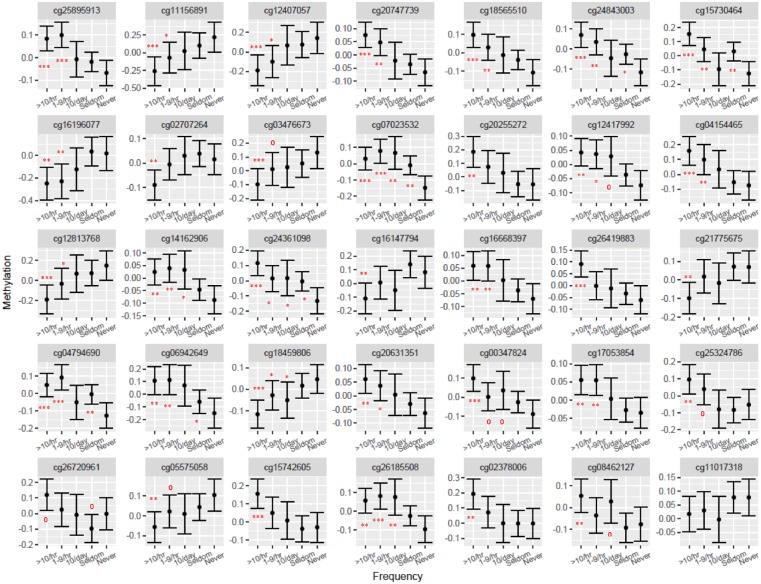
Assessment of changes in DNA methylation (DNA-m) has the potential to identify adverse environmental exposures. To examine DNA-m among a subset of participants ( = 369) in the Isle of Wight birth cohort who reported variable near resident traffic frequencies. We used self-reported frequencies of heavy vehicles passing by the homes of study subjects as a proxy measure for TRAP, which were: never, seldom, 10 per day, 1-9 per hour and >10 per hour. Methylation of cytosine-phosphate-guanine (CpG) dinucleotide sequences in the DNA was assessed from blood samples collected at age 18 years ( = 369) in the F1 generation. We conducted an epigenome wide association study to examine CpGs related to the frequency of heavy vehicles passing by subjects' homes, and employed multiple linear regression models to assess potential associations. We repeated some of these analysis in the F2 generation ( = 140). Thirty-five CpG sites were associated with heavy vehicular traffic. After adjusting for confounders, we found 23 CpGs that were more methylated, and 11 CpGs that were less methylated with increasing heavy vehicular traffic frequency among all subjects. In the F2 generation, 2 of 31 CpGs were associated with traffic frequencies and the direction of the effect was the same as in the F1 subset while differential methylation of 7 of 31 CpG sites correlated with gene expression. Our findings reveal differences in DNA-m in participants who reported higher heavy vehicular traffic frequencies when compared to participants who reported lower frequencies.
评估DNA甲基化(DNA-m)的变化有可能识别不良环境暴露情况。为了研究怀特岛出生队列中一部分报告了不同的附近居民交通频率的参与者(n = 369)的DNA-m情况。我们使用研究对象家中重型车辆经过的自我报告频率作为交通相关空气污染颗粒(TRAP)的替代指标,这些频率分别为:从不、很少、每天10次、每小时1 - 9次以及每小时超过10次。从F1代18岁时采集的血样(n = 369)中评估DNA中胞嘧啶 - 磷酸 - 鸟嘌呤(CpG)二核苷酸序列的甲基化情况。我们进行了全表观基因组关联研究以检查与重型车辆经过受试者家的频率相关的CpG,并用多元线性回归模型评估潜在关联。我们在F2代(n = 140)中重复了其中一些分析。35个CpG位点与重型车辆交通相关。在调整混杂因素后,我们发现所有受试者中随着重型车辆交通频率增加,有23个CpG甲基化程度更高,11个CpG甲基化程度更低。在F2代中,31个CpG中有2个与交通频率相关,效应方向与F1亚组相同,同时31个CpG位点中有7个的差异甲基化与基因表达相关。我们的研究结果揭示了报告重型车辆交通频率较高的参与者与报告较低频率的参与者在DNA-m方面存在差异。