Institute of Crop Sciences, Chinese Academy of Agricultural Sciences/National Engineering Laboratory for Crop Molecular Breeding, National Center of Space Mutagenesis for Crop Improvement, Beijing, China.
College of Agriculture, Ludong University, Yantai, China.
PLoS One. 2019 Jan 30;14(1):e0211492. doi: 10.1371/journal.pone.0211492. eCollection 2019.
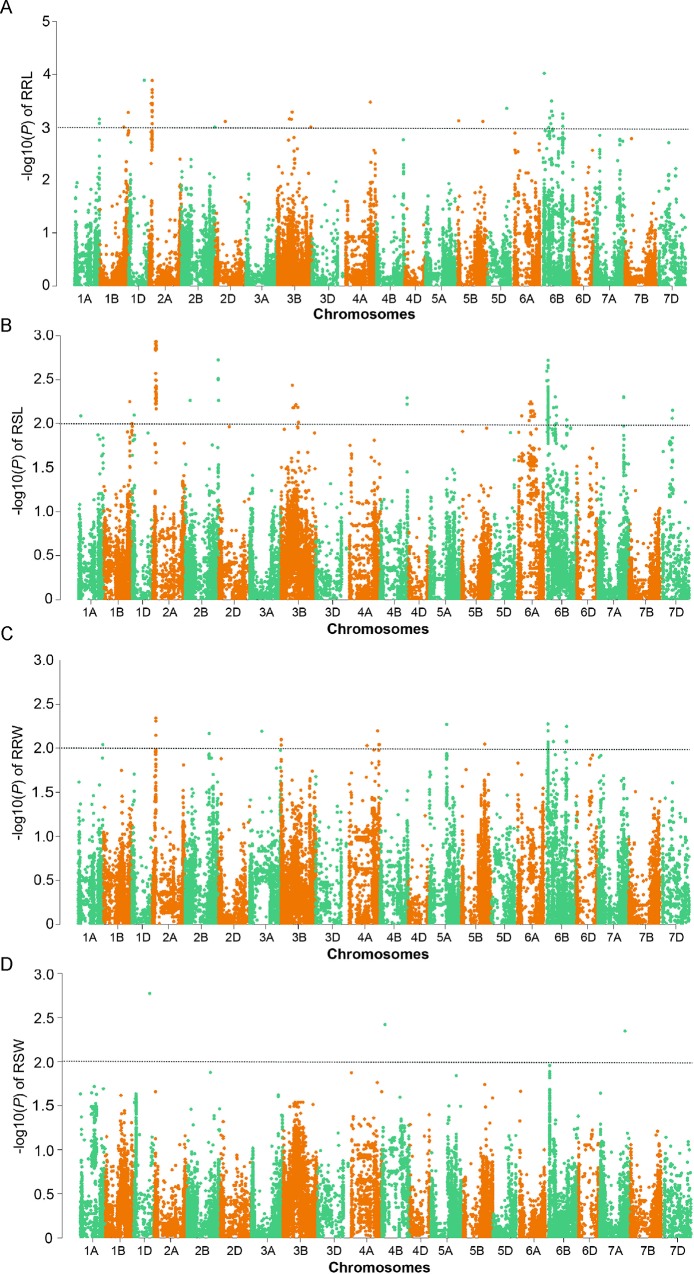
Crop productivity is highly dependent on the application of N fertilizers, but ever-increasing N application is causing serious environmental impacts. To facilitate the development of new wheat cultivars that can thrive in low N growth conditions, key loci and genes associated with wheat responses to low N must be identified. In this GWAS and t-test study of 190 M6 mutant wheat lines (Jing 411-derived) based on genotype data from the wheat 660k SNP array, we identified a total of 221 significant SNPs associated four seedling phenotypic traits that have been implicated in resistance to low N: relative root length, relative shoot length, relative root weight, and relative shoot weight. Notably, we detected large numbers of significantly associated SNP in what appear to be genomic 'hotspots' for resistance to low N on chromosomes 2A and 6B, strongly suggesting that these regions are functionally related to the resistance phenotypes that we observed in some of the mutant lines. Moreover, the candidate genes, including genes encoding high-affinity nitrate transporter 2.1, gibberellin responsive protein, were identified for resistance to low N. This study raises plausible mechanistic hypotheses that can be evaluated in future applied or basic efforts by breeders or plant biologists seeking to develop new high-NUE wheat cultivars.
作物生产力高度依赖于氮肥的施用,但氮肥的施用不断增加正在造成严重的环境影响。为了促进能够在低氮生长条件下茁壮成长的新型小麦品种的发展,必须确定与小麦对低氮的反应相关的关键基因座和基因。在这项基于小麦 660k SNP 阵列基因型数据的 190 个 M6 突变体小麦系(源自 Jing 411)的 GWAS 和 t 检验研究中,我们总共鉴定出了 221 个与四个幼苗表型性状相关的显著 SNP,这些性状与耐低氮有关:相对根长、相对茎长、相对根重和相对茎重。值得注意的是,我们在染色体 2A 和 6B 上的耐低氮“热点”区域检测到大量数量显著相关的 SNP,这强烈表明这些区域与我们在一些突变体系中观察到的耐低氮表型具有功能相关性。此外,还鉴定到了耐低氮的候选基因,包括编码高亲和力硝酸盐转运蛋白 2.1、赤霉素反应蛋白的基因。这项研究提出了合理的机制假说,可以在未来由育种者或植物生物学家进行的应用或基础努力中进行评估,以开发新的高氮利用效率小麦品种。