Department of Human Ecology, University of California, Davis, CA, USA.
Department of Psychological and Brain Sciences, University of Massachusetts, Amherst, MA, USA.
Child Maltreat. 2019 Nov;24(4):340-352. doi: 10.1177/1077559519826295. Epub 2019 Jan 30.
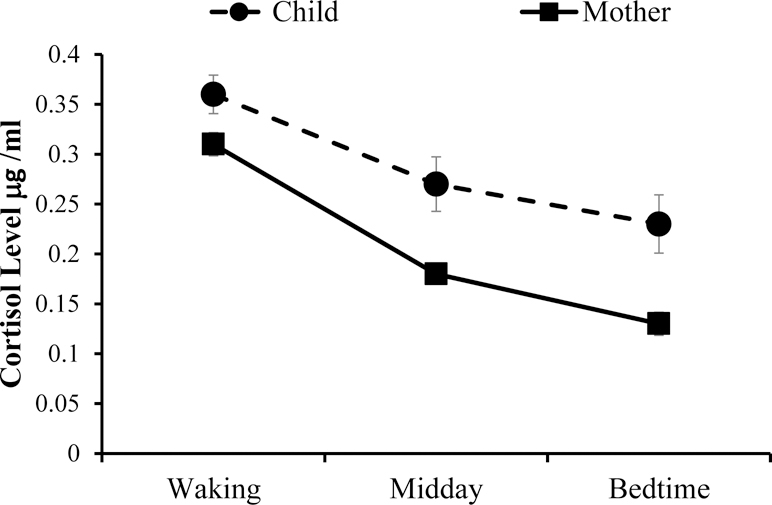
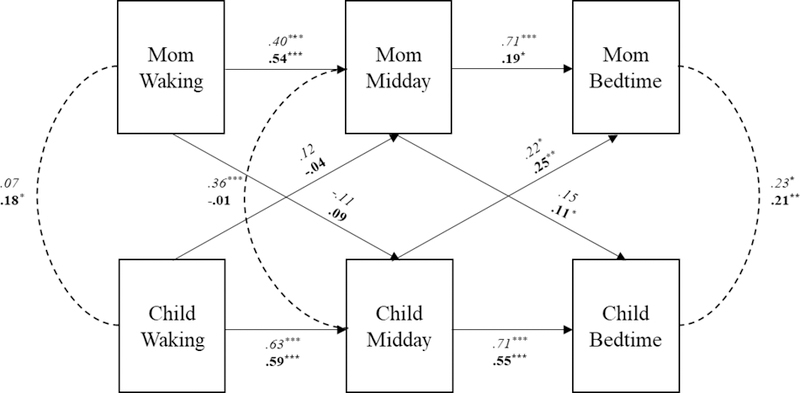
In the current study, we examined the attunement and transmission of mother-child diurnal cortisol among maltreating ( = 165) and nonmaltreating ( = 83) mothers and their preschool-aged children. Over half of the families had a substantiated child maltreatment case with the mother as the perpetrator. Mothers collected three saliva samples (waking, midday, and bedtime) on themselves and their child on two consecutive days, which were later assayed for cortisol. This design allows for the examination of concurrent attunement, as well as cross-lagged transmission, across the day. Results from actor-partner interdependence models revealed significant differences in mother-child cortisol attunement and transmission between the maltreating and nonmaltreating groups. Specifically, only maltreating mothers transmitted cortisol to their children and were attuned at first waking; only nonmaltreating dyads were attuned at midday. Implications of these results for sociocultural models of stress physiology and for our understanding of how child maltreatment affects diurnal cortisol regulation are discussed.
在本研究中,我们研究了受虐(= 165)和非受虐(= 83)母亲及其学龄前儿童的母子日间皮质醇同步和传递。超过一半的家庭有经证实的儿童虐待案件,母亲是施虐者。母亲在两天内为自己和孩子收集了三个唾液样本(醒来时、中午和睡前),随后对皮质醇进行了检测。这种设计允许检查日间的同步以及交叉滞后的传递。演员-伙伴相互依存模型的结果显示,受虐和非受虐组之间的母子皮质醇同步和传递存在显著差异。具体来说,只有受虐母亲向孩子传递皮质醇,并在第一次醒来时同步;只有非受虐对子在中午同步。这些结果对社会文化应激生理学模型以及我们对儿童虐待如何影响日间皮质醇调节的理解具有重要意义。