Department of Neuroscience, Unit of Pharmacology, Science for Life Laboratory, Uppsala University, Box 593, SE-751 24, Uppsala, Sweden.
BMC Evol Biol. 2019 Jan 30;19(1):38. doi: 10.1186/s12862-018-1341-8.
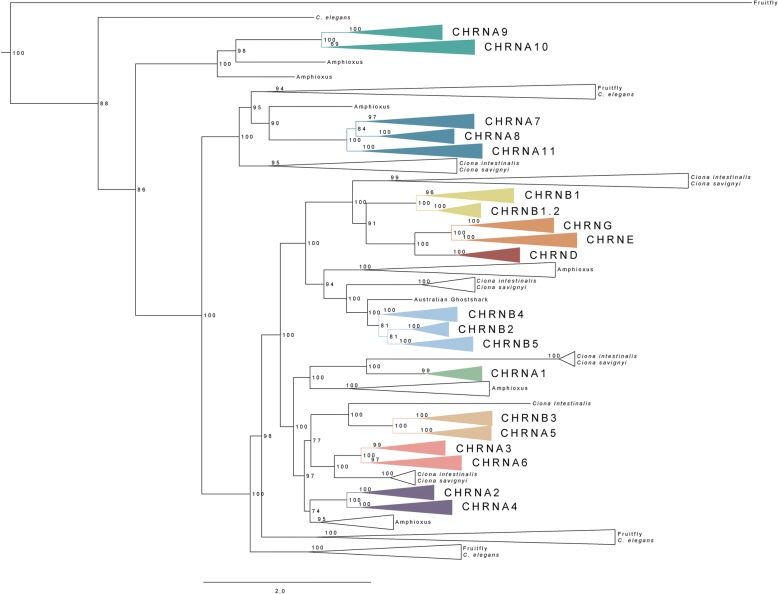
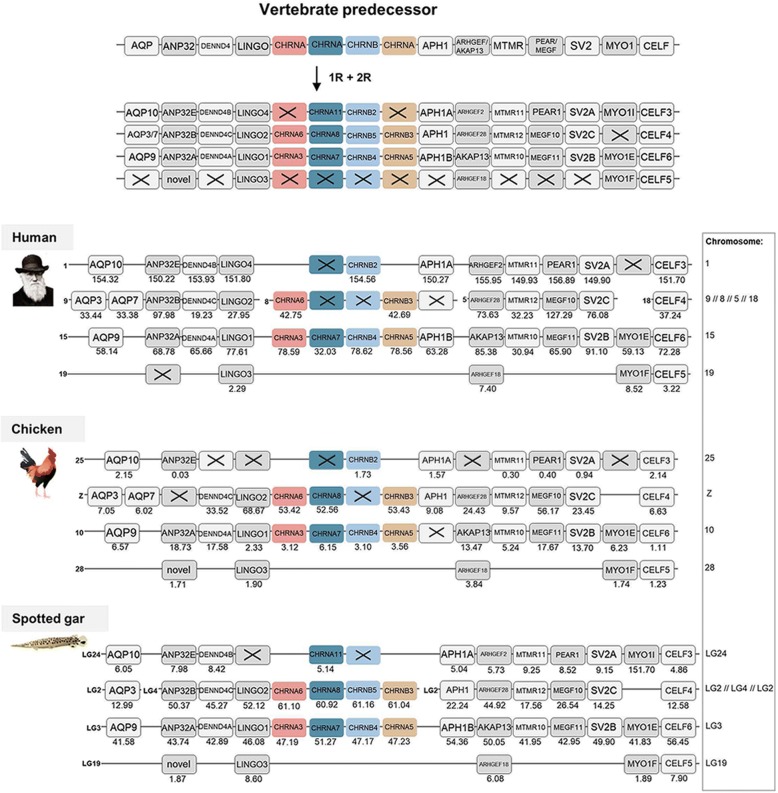
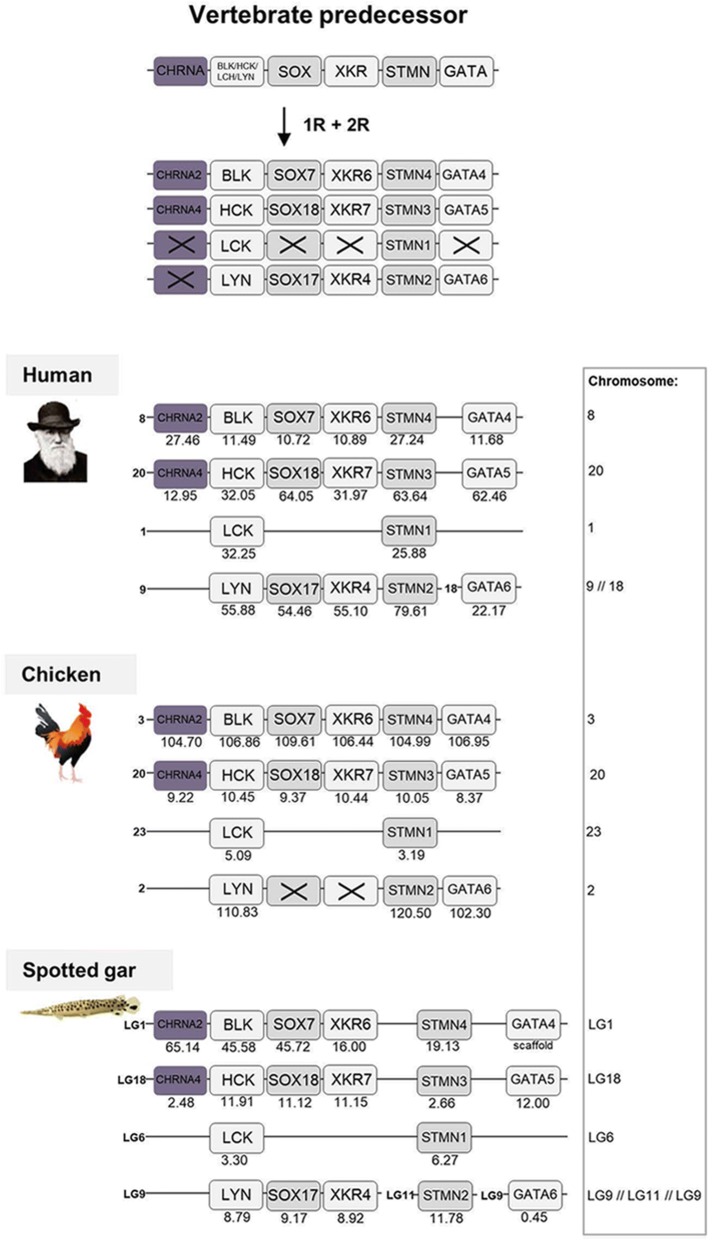
Many physiological processes are influenced by nicotinic acetylcholine receptors (nAChR), ranging from neuromuscular and parasympathetic signaling to modulation of the reward system and long-term memory. Due to the complexity of the nAChR family and variable evolutionary rates among its members, their evolution in vertebrates has been difficult to resolve. In order to understand how and when the nAChR genes arose, we have used a broad approach of analyses combining sequence-based phylogeny, chromosomal synteny and intron positions.
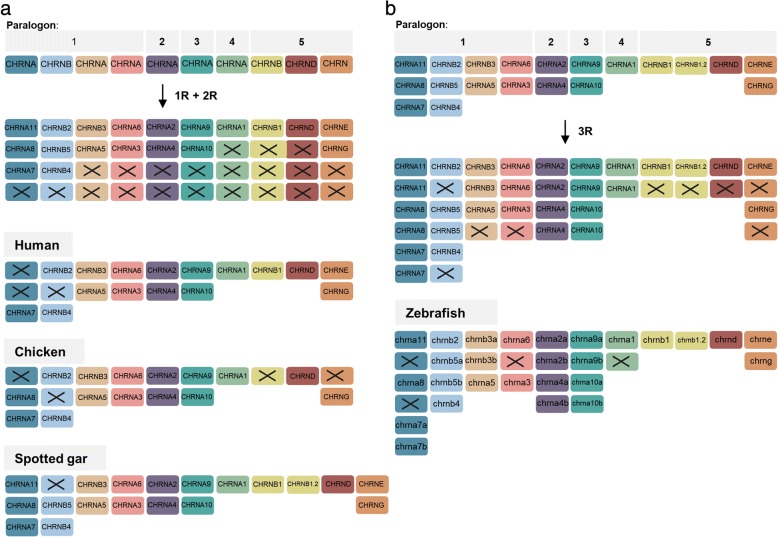
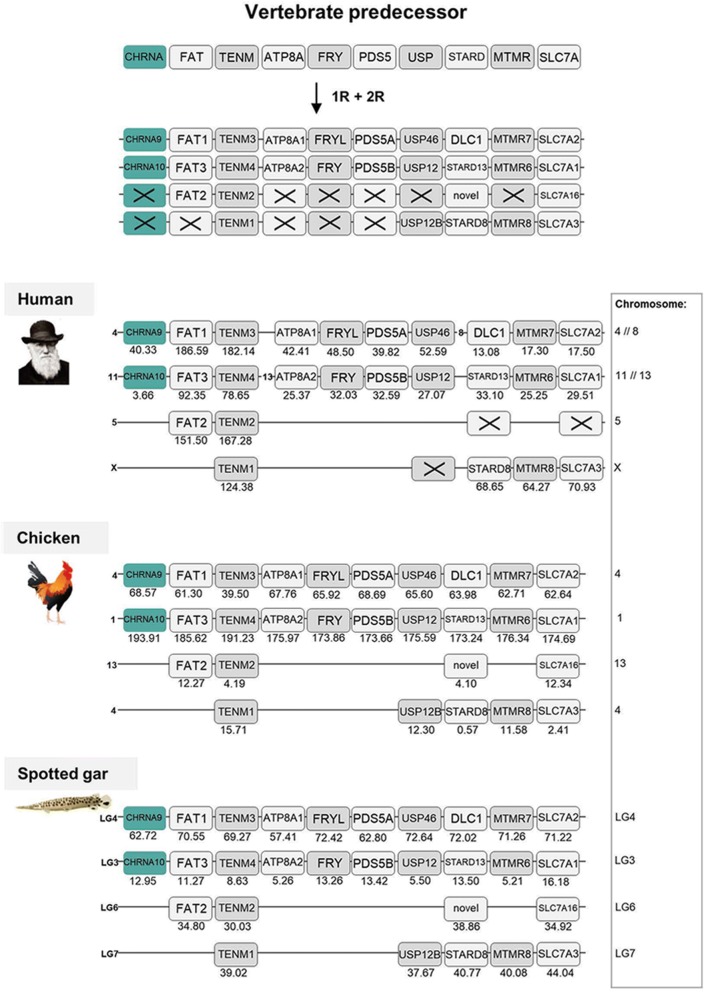
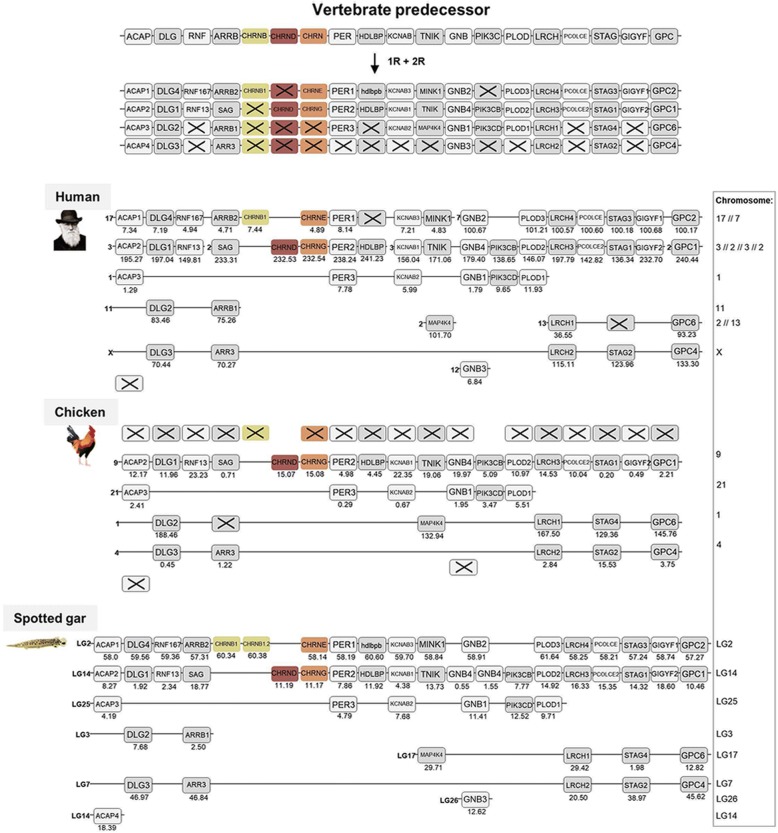
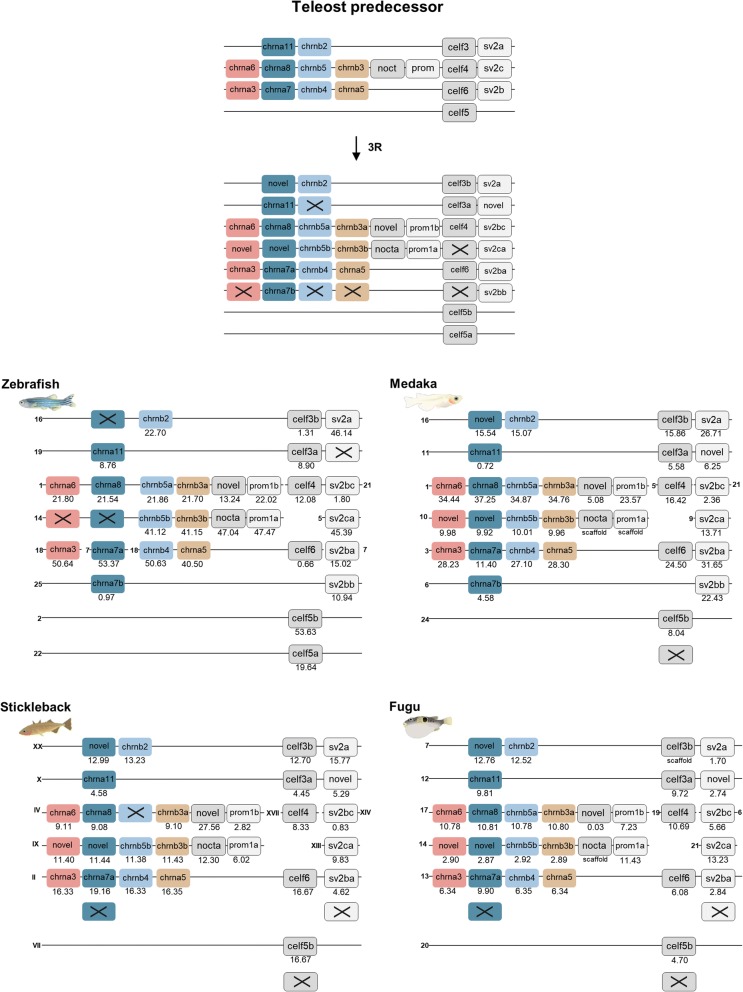
Our analyses suggest that there were ten subunit genes present in the vertebrate predecessor. The two basal vertebrate tetraploidizations (1R and 2R) then expanded this set to 19 genes. Three of these have been lost in mammals, resulting in 16 members today. None of the ten ancestral genes have kept all four copies after 2R. Following 2R, two of the ancestral genes became triplicates, five of them became pairs, and three seem to have remained single genes. One triplet consists of CHRNA7, CHRNA8 and the previously undescribed CHRNA11, of which the two latter have been lost in mammals but are still present in lizards and ray-finned fishes. The other triplet consists of CHRNB2, CHRNB4 and CHRNB5, the latter of which has also been lost in mammals. In ray-finned fish the neuromuscular subunit gene CHRNB1 underwent a local gene duplication generating CHRNB1.2. The third tetraploidization in the predecessor of teleosts (3R) expanded the repertoire to a total of 31 genes, of which 27 remain in zebrafish. These evolutionary relationships are supported by the exon-intron organization of the genes.
The tetraploidizations explain all gene duplication events in vertebrates except two. This indicates that the genome doublings have had a substantial impact on the complexity of this gene family leading to a very large number of members that have existed for hundreds of millions of years.
许多生理过程受到烟碱型乙酰胆碱受体(nAChR)的影响,范围从神经肌肉和副交感神经信号传递到奖励系统和长期记忆的调节。由于 nAChR 家族的复杂性和其成员之间的可变进化率,它们在脊椎动物中的进化一直难以解决。为了了解 nAChR 基因是如何以及何时产生的,我们使用了一种广泛的分析方法,结合基于序列的系统发育、染色体同线性和内含子位置。
我们的分析表明,在脊椎动物的前身中存在十个亚基基因。随后,两次基础的脊椎动物四倍体化(1R 和 2R)将这个集合扩展到 19 个基因。其中三个在哺乳动物中丢失了,导致今天有 16 个成员。在 2R 之后,没有一个祖先进化基因保留了所有四个拷贝。2R 之后,两个祖先进化基因变成了三倍体,五个变成了双拷贝,三个似乎仍然是单基因。一个三倍体由 CHRNA7、CHRNA8 和以前未描述的 CHRNA11 组成,其中后两个在哺乳动物中丢失了,但仍存在于蜥蜴和射线鳍鱼类中。另一个三倍体由 CHRNB2、CHRNB4 和 CHRNB5 组成,后者在哺乳动物中也丢失了。在射线鳍鱼类中,神经肌肉亚基基因 CHRNB1 经历了局部基因复制,产生了 CHRNB1.2。硬骨鱼祖先中的第三次四倍体化(3R)将基因库扩展到总共 31 个基因,其中 27 个仍存在于斑马鱼中。这些进化关系得到了基因外显子-内含子组织的支持。
除了两个基因外,四倍体化解释了脊椎动物中的所有基因复制事件。这表明基因组加倍对这个基因家族的复杂性产生了重大影响,导致了大量存在了数亿年的成员。