Department of Medicine and.
Division of Comparative Medicine, Washington University School of Medicine, St. Louis, MO.
Blood. 2019 Apr 25;133(17):1899-1908. doi: 10.1182/blood-2018-11-886275. Epub 2019 Jan 30.
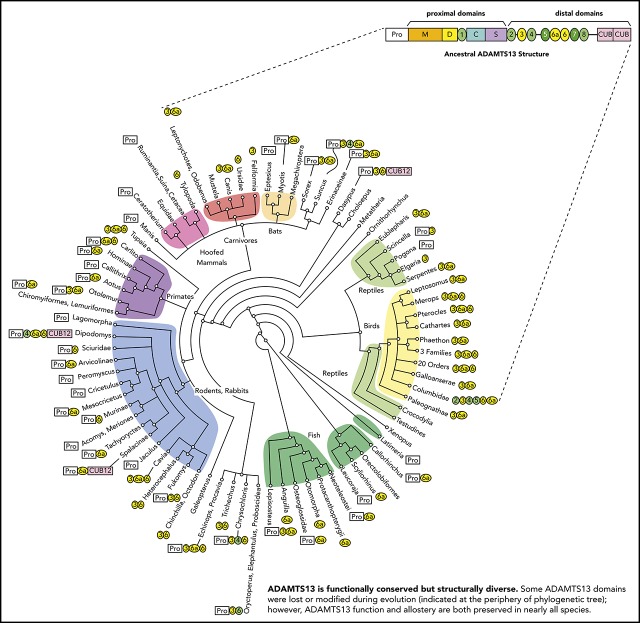
The metalloprotease ADAMTS13 (a disintegrin and metalloprotease with thrombospondin type 1 repeats member 13) prevents microvascular thrombosis by cleaving von Willebrand factor (VWF) within platelet-rich thrombi, and cleavage depends on allosteric activation of ADAMTS13 by the substrate VWF. Human ADAMTS13 has a short propeptide, metalloprotease (M), disintegrin-like (D), thrombospondin-1 (T), Cys-rich (C), and spacer (S) domains (proximal domains), followed by 7 T and 2 CUB (complement components C1r and C1s, sea urchin protein Uegf, and bone morphogenetic protein-1) domains (distal domains). Distal domains inhibit the catalytic proximal domains; binding of distal T8-CUB domains to the VWF D4 domain relieves autoinhibition and promotes cleavage of the nearby VWF A2 domain. However, the role of specific ADAMTS13 distal domains in this allosteric mechanism is not established. Assays of plasma ADAMTS13 from 20 placental mammals, birds, and amphibians show that allosteric regulation is broadly conserved, and phylogenetic analysis of 264 vertebrates shows the long propeptide, T3, T4, T6, and T6a domains have been deleted several times in placental mammals, birds, and fish. Notably, pigeon ADAMTS13 has only 3 distal T domains but was activated normally by human VWF D4 and cleaved VWF multimers, preferentially under fluid shear stress. Human ADAMTS13 constructed to resemble pigeon ADAMTS13 retained normal allosteric regulation and shear-dependent cleavage of VWF. Thus, the T3-T6 domains of human ADAMTS13 are dispensable. Conversely, deletion of T7 or T8 abolished allosteric activation. For most species, some sequence changes in the VWF substrate can markedly increase the rate of cleavage, suggesting that ADAMTS13 and VWF have not evolved to be optimal enzyme-substrate pairs. These properties may reflect evolutionary pressure to balance the risk for VWF-dependent bleeding and thrombosis.
金属蛋白酶 ADAMTS13(解整合素和金属蛋白酶与血小板反应素 1 型重复成员 13)通过在富含血小板的血栓中切割血管性血友病因子(VWF)来防止微血管血栓形成,并且切割取决于 ADAMTS13 对底物 VWF 的变构激活。人类 ADAMTS13 具有短的前肽、金属蛋白酶(M)、解整合素样(D)、血小板反应素-1(T)、富含半胱氨酸(C)和间隔区(S)结构域(近端结构域),随后是 7 个 T 和 2 个 CUB(补体成分 C1r 和 C1s、海胆蛋白 Uegf 和骨形态发生蛋白-1)结构域(远端结构域)。远端结构域抑制催化性近端结构域;远端 T8-CUB 结构域与 VWF D4 结构域的结合解除了自动抑制,并促进了附近的 VWF A2 结构域的切割。然而,特定的 ADAMTS13 远端结构域在这种变构机制中的作用尚未确定。对来自 20 种胎盘哺乳动物、鸟类和两栖动物的血浆 ADAMTS13 的测定表明,变构调节广泛保守,对 264 种脊椎动物的系统发育分析表明,长前肽、T3、T4、T6 和 T6a 结构域在胎盘哺乳动物、鸟类和鱼类中已多次缺失。值得注意的是,鸽子 ADAMTS13 只有 3 个远端 T 结构域,但被人 VWF D4 正常激活,并优先在流体剪切应力下切割 VWF 多聚体。与人 ADAMTS13 相似的构建的人类 ADAMTS13 保留了正常的变构调节和 VWF 的剪切依赖性切割。因此,人类 ADAMTS13 的 T3-T6 结构域是可有可无的。相反,T7 或 T8 的缺失会消除变构激活。对于大多数物种,VWF 底物中的一些序列变化可以显著增加切割速度,这表明 ADAMTS13 和 VWF 尚未进化为最佳的酶-底物对。这些特性可能反映了平衡 VWF 依赖性出血和血栓形成风险的进化压力。