From the ‡Institut de Pharmacologie et de Biologie Structurale (IPBS), Université de Toulouse, CNRS UMR 5089, UPS, Toulouse, France;; §STROMALab, Université de Toulouse, INSERM U1031, EFS, INP-ENVT, UPS, Toulouse, France.
From the ‡Institut de Pharmacologie et de Biologie Structurale (IPBS), Université de Toulouse, CNRS UMR 5089, UPS, Toulouse, France.
Mol Cell Proteomics. 2019 Apr;18(4):744-759. doi: 10.1074/mcp.RA118.000958. Epub 2019 Jan 30.
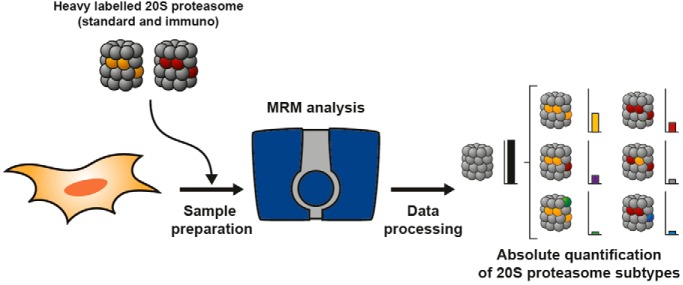
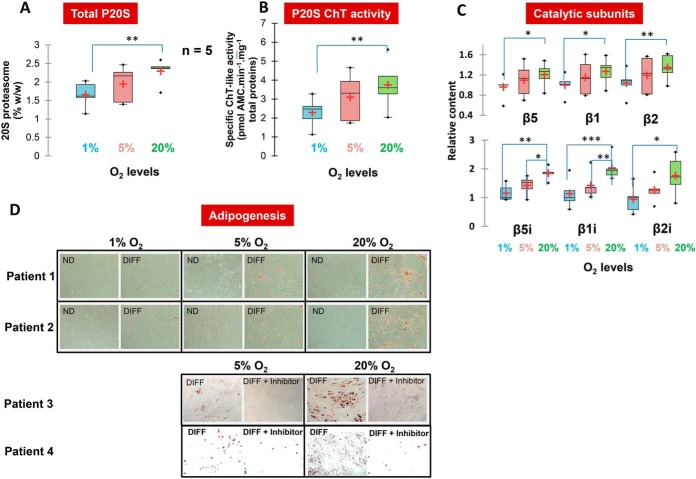
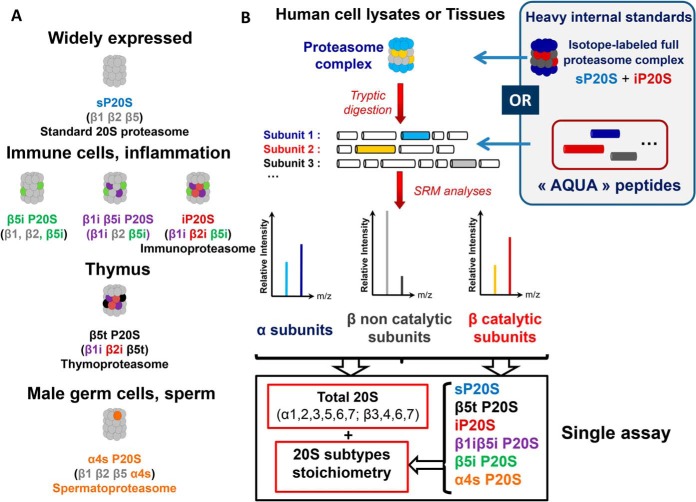
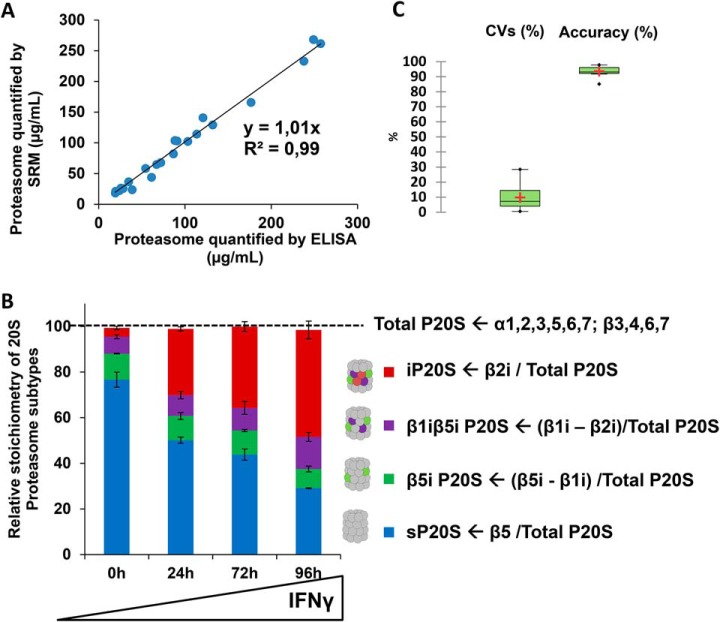
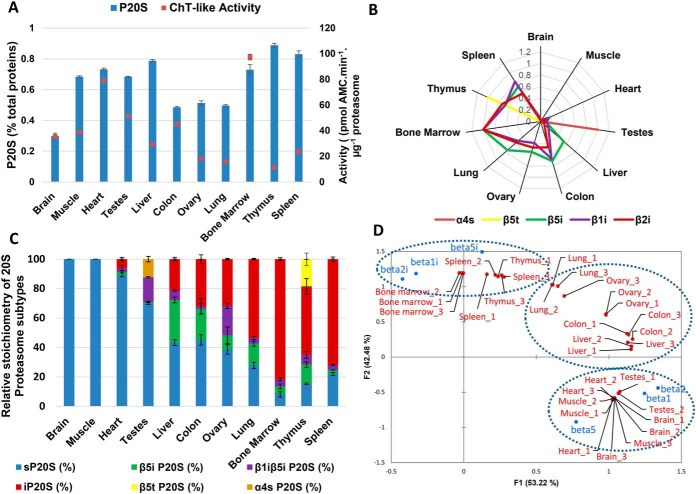
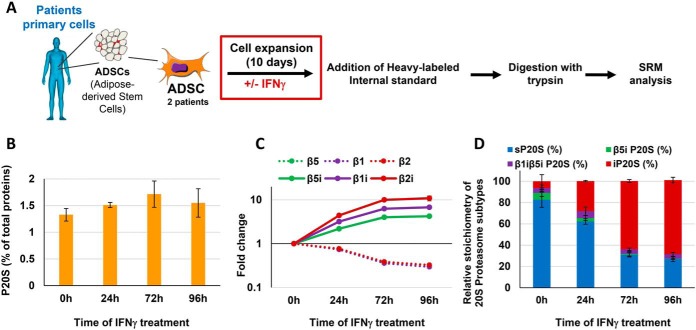
The proteasome controls a multitude of cellular processes through protein degradation and has been identified as a therapeutic target in oncology. However, our understanding of its function and the development of specific modulators are hampered by the lack of a straightforward method to determine the overall proteasome status in biological samples. Here, we present a method to determine the absolute quantity and stoichiometry of ubiquitous and tissue-specific human 20S proteasome subtypes based on a robust, absolute SILAC-based multiplexed LC-Selected Reaction Monitoring (SRM) quantitative mass spectrometry assay with high precision, accuracy, and sensitivity. The method was initially optimized and validated by comparison with a reference ELISA assay and by analyzing the dynamics of catalytic subunits in HeLa cells following IFNγ-treatment and in range of human tissues. It was then successfully applied to reveal IFNγ- and O-dependent variations of proteasome status during primary culture of Adipose-derived-mesenchymal Stromal/Stem Cells (ADSCs). The results show the critical importance of controlling the culture conditions during cell expansion for future therapeutic use in humans. We hypothesize that a shift from the standard proteasome to the immunoproteasome could serve as a predictor of immunosuppressive and differentiation capacities of ADSCs and, consequently, that quality control should include proteasomal quantification in addition to examining other essential cell parameters. The method presented also provides a new powerful tool to conduct more individualized protocols in cancer or inflammatory diseases where selective inhibition of the immunoproteasome has been shown to reduce side effects.
蛋白酶体通过蛋白质降解控制着众多细胞过程,已被确定为肿瘤学的治疗靶点。然而,由于缺乏一种直接的方法来确定生物样本中蛋白酶体的总体状态,我们对其功能的理解和特异性调节剂的开发受到了阻碍。在这里,我们提出了一种基于可靠的、基于绝对 SILAC 的多重 LC-选择反应监测(SRM)定量质谱分析的方法,用于确定普遍存在和组织特异性的人 20S 蛋白酶体亚型的绝对数量和化学计量比,该方法具有高精度、准确性和灵敏度。该方法最初通过与参考 ELISA 测定的比较和分析 IFNγ 处理后 HeLa 细胞和多种人类组织中催化亚基的动力学进行了优化和验证。然后成功地应用于揭示 IFNγ 和 O 依赖性在原代培养脂肪来源间充质基质/干细胞(ADSCs)过程中蛋白酶体状态的变化。结果表明,在细胞扩增过程中控制培养条件对于未来人类治疗的重要性。我们假设从标准蛋白酶体向免疫蛋白酶体的转变可以作为 ADSCs 免疫抑制和分化能力的预测因子,因此,质量控制除了检查其他基本细胞参数外,还应包括蛋白酶体定量。所提出的方法还提供了一种新的强大工具,可用于癌症或炎症性疾病的个体化方案,其中已证明选择性抑制免疫蛋白酶体可减少副作用。