Institut de Pharmacologie et de Biologie Structurale, CNRS, Université Paul Sabatier (UPS), Université de Toulouse, Toulouse, 31000 France.
Institut de Recherche en Santé, Environnement et Travail, INSERM, École des Hautes Études en Santé Publique (EHESP), Université de Rennes, UMR_S 1085, Rennes, 35042 France.
Proc Natl Acad Sci U S A. 2022 Apr 12;119(15):e2116826119. doi: 10.1073/pnas.2116826119. Epub 2022 Apr 4.
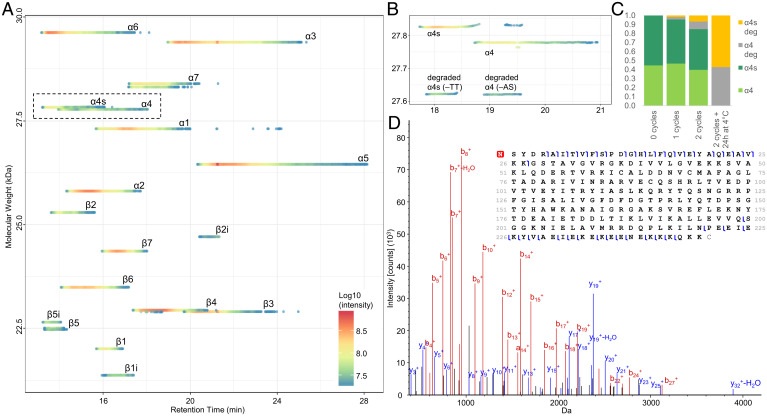
During spermatogenesis, spermatogonia undergo a series of mitotic and meiotic divisions on their path to spermatozoa. To achieve this, a succession of processes requiring high proteolytic activity are in part orchestrated by the proteasome. The spermatoproteasome (s20S) is specific to the developing gametes, in which the gamete-specific α4s subunit replaces the α4 isoform found in the constitutive proteasome (c20S). Although the s20S is conserved across species and was shown to be crucial for germ cell development, its mechanism, function, and structure remain incompletely characterized. Here, we used advanced mass spectrometry (MS) methods to map the composition of proteasome complexes and their interactomes throughout spermatogenesis. We observed that the s20S becomes highly activated as germ cells enter meiosis, mainly through a particularly extensive 19S activation and, to a lesser extent, PA200 binding. Additionally, the proteasome population shifts from c20S (98%) to s20S (>82 to 92%) during differentiation, presumably due to the shift from α4 to α4s expression. We demonstrated that s20S, but not c20S, interacts with components of the meiotic synaptonemal complex, where it may localize via association with the PI31 adaptor protein. In vitro, s20S preferentially binds to 19S and displays higher trypsin- and chymotrypsin-like activities, both with and without PA200 activation. Moreover, using MS methods to monitor protein dynamics, we identified significant differences in domain flexibility between α4 and α4s. We propose that these differences induced by α4s incorporation result in significant changes in the way the s20S interacts with its partners and dictate its role in germ cell differentiation.
在精子发生过程中,精原细胞在向精子分化的过程中经历一系列有丝分裂和减数分裂。为了实现这一目标,一系列需要高蛋白水解活性的过程部分由蛋白酶体协调。精子蛋白酶体(s20S)是发育配子所特有的,其中配子特异性的α4s 亚基取代了在组成型蛋白酶体(c20S)中发现的α4 同工型。尽管 s20S 在物种间是保守的,并且被证明对生殖细胞发育至关重要,但它的机制、功能和结构仍不完全清楚。在这里,我们使用先进的质谱(MS)方法来绘制整个精子发生过程中蛋白酶体复合物及其相互作用组的组成。我们观察到,随着生殖细胞进入减数分裂,s20S 变得高度激活,主要是通过特别广泛的 19S 激活,以及在较小程度上通过 PA200 结合。此外,蛋白酶体群体在分化过程中从 c20S(98%)转移到 s20S(>82 到 92%),这可能是由于从α4 到α4s 的表达转变。我们证明 s20S 与减数分裂联会复合体的成分相互作用,但 c20S 不与该成分相互作用,它可能通过与 PI31 衔接蛋白的关联而在该复合体中定位。在体外,s20S 优先与 19S 结合,并显示出更高的胰蛋白酶和糜蛋白酶样活性,无论是否有 PA200 激活。此外,我们使用 MS 方法监测蛋白质动力学,发现α4 和α4s 之间在结构域灵活性方面存在显著差异。我们提出,这些由α4s 掺入引起的差异导致 s20S 与其伴侣相互作用的方式发生重大变化,并决定其在生殖细胞分化中的作用。