Department of Psychiatry, University of Iowa Carver College of Medicine, Iowa City, IA, 52246, USA.
Interdisciplinary Graduate Program in Genetics, University of Iowa, Iowa City, IA, 52246, USA.
Transl Psychiatry. 2019 Jan 31;9(1):47. doi: 10.1038/s41398-019-0376-y.
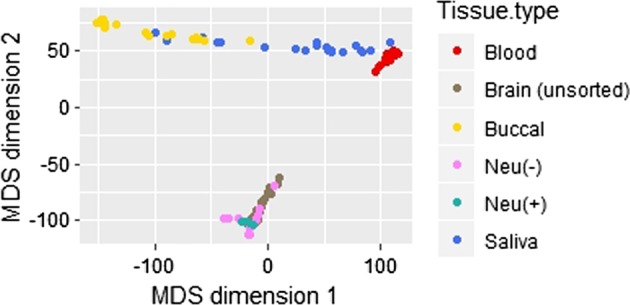
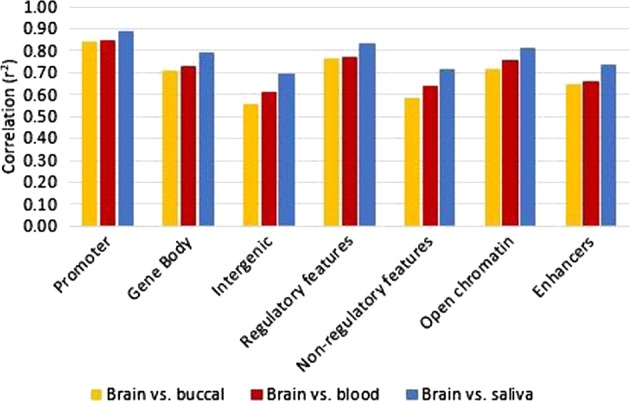
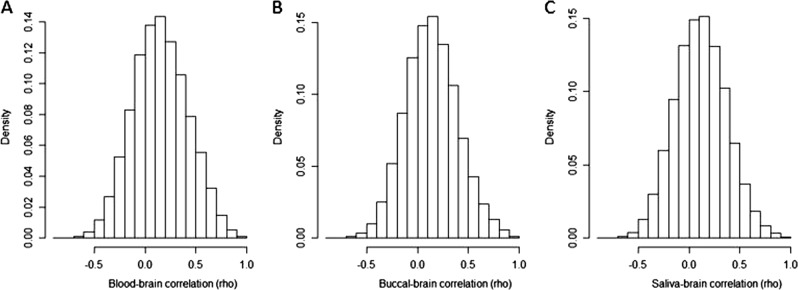
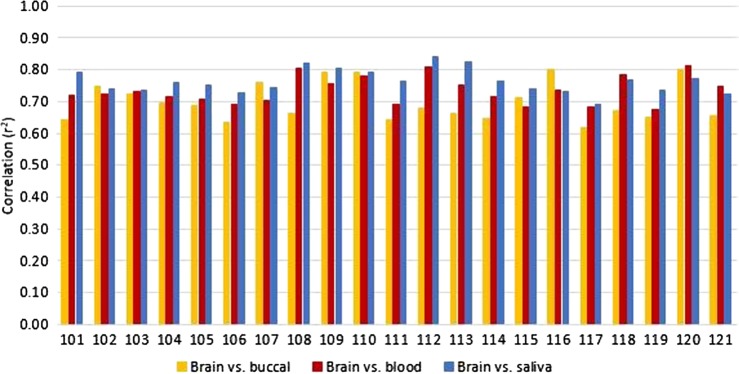
Differential DNA methylation in the brain is associated with many psychiatric diseases, but access to brain tissues is essentially limited to postmortem samples. The use of surrogate tissues has become common in identifying methylation changes associated with psychiatric disease. In this study, we determined the extent to which peripheral tissues can be used as surrogates for DNA methylation in the brain. Blood, saliva, buccal, and live brain tissue samples from 27 patients with medically intractable epilepsy undergoing brain resection were collected (age range 5-61 years). Genome-wide methylation was assessed with the Infinium HumanMethylation450 (n = 12) and HumanMethylationEPIC BeadChip arrays (n = 21). For the EPIC methylation data averaged for each CpG across subjects, the saliva-brain correlation (r = 0.90) was higher than that for blood-brain (r = 0.86) and buccal-brain (r = 0.85) comparisons. However, within individual CpGs, blood had the highest proportion of CpGs correlated to brain at nominally significant levels (20.8%), as compared to buccal tissue (17.4%) and saliva (15.1%). For each CpG and each gene, levels of brain-peripheral tissue correlation varied widely. This indicates that to determine the most useful surrogate tissue for representing brain DNA methylation, the patterns specific to the genomic region of interest must be considered. To assist in that objective, we have developed a website, IMAGE-CpG, that allows researchers to interrogate DNA methylation levels and degree of cross-tissue correlation in user-defined locations across the genome.
大脑中的差异 DNA 甲基化与许多精神疾病有关,但获取大脑组织基本上仅限于死后样本。因此,使用替代组织来识别与精神疾病相关的甲基化变化已变得很常见。在这项研究中,我们确定了外周组织在多大程度上可以作为大脑 DNA 甲基化的替代物。我们收集了 27 名患有药物难治性癫痫症并接受脑部切除术的患者的血液、唾液、口腔和活体脑组织样本(年龄范围为 5-61 岁)。使用 Infinium HumanMethylation450(n=12)和 HumanMethylationEPIC BeadChip 阵列(n=21)评估全基因组甲基化。对于每个 CpG 在受试者之间平均的 EPIC 甲基化数据,唾液与大脑的相关性(r=0.90)高于血液与大脑(r=0.86)和口腔与大脑(r=0.85)的相关性。然而,在单个 CpG 中,血液与大脑相关的 CpG 比例最高(名义上显著水平为 20.8%),而口腔组织为 17.4%,唾液为 15.1%。对于每个 CpG 和每个基因,脑-外周组织相关性的水平差异很大。这表明,为了确定最有用的代表大脑 DNA 甲基化的替代组织,必须考虑到与感兴趣的基因组区域特定的模式。为了协助实现这一目标,我们开发了一个名为 IMAGE-CpG 的网站,该网站允许研究人员在基因组上的用户定义位置查询 DNA 甲基化水平和跨组织相关性的程度。