Department of Health and Human Physiology, College of Liberal Arts and Sciences, University of Iowa, Iowa City, IA, USA.
Department of Epidemiology, College of Public Health, University of Iowa, Iowa City, IA, USA.
Int J Obes (Lond). 2019 Sep;43(9):1701-1711. doi: 10.1038/s41366-018-0284-x. Epub 2019 Jan 31.
Timing of dietary intake may play a role in obesity. However, previous studies produced mixed findings possibly due to inconsistent approaches to characterize meal timing and not taking into account chronotype and macronutrients. To address the aforementioned limitations, we have defined meal timing relative to sleep/wake timing, investigated the relationship between meal timing and body mass index (BMI) dependent on chronotype, and examined the associations.
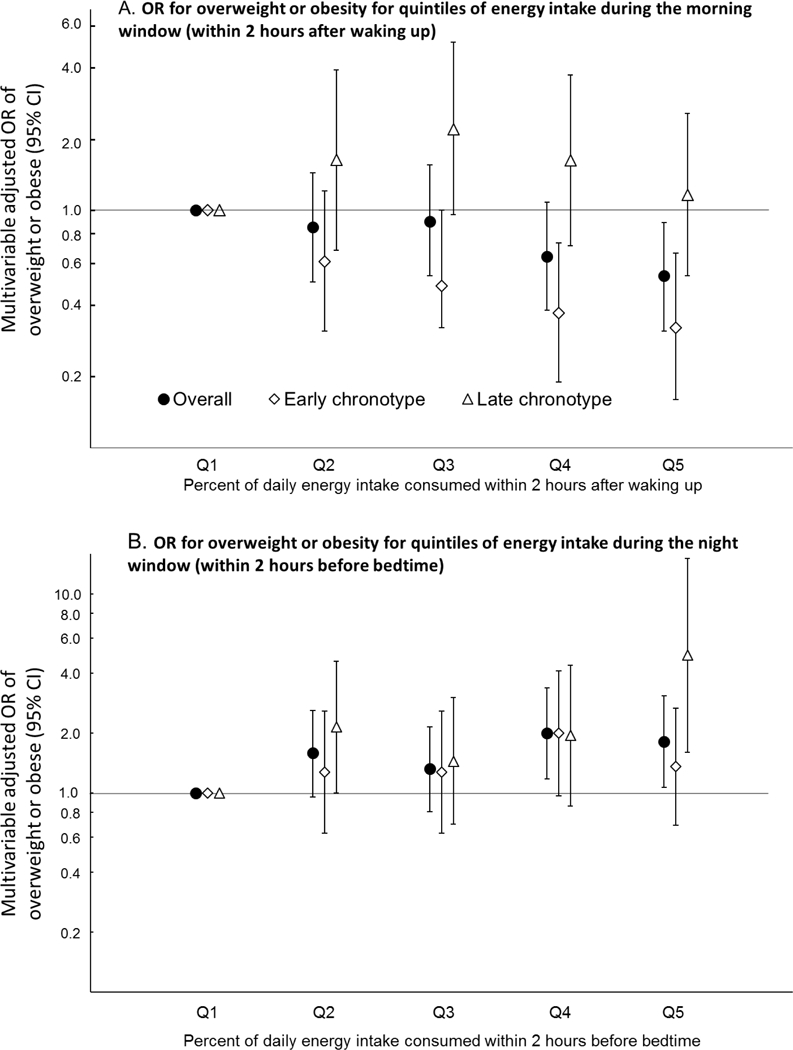
BMI, chronotype, and dietary intakes were measured in 872 middle-to-older-aged adults by six 24-h dietary recalls in 1 year. We defined four time windows of intake relative to sleep timing: morning (within 2 h after getting out of bed), night (within 2 h before bedtime), and two midday periods in between (split by the midpoint of the waking period).
A higher percent of total daily energy intake consumed during the morning window was associated with lower odds of being overweight or obese (odds ratio (95% confidence intervals), 0.53 (0.31, 0.89)). This association was stronger in people with an earlier chronotype (0.32 (0.16, 0.66)). A higher percent of total daily energy intake consumed during the night window was associated with higher odds of being overweight or obese (1.82 (1.07, 3.08)), particularly in people with a later chronotype (4.94 (1.61, 15.14)). These associations were stronger for the intakes of carbohydrates and protein than for fat intake.
Our study suggests that higher dietary consumption after waking up and lower consumption close to bedtime associate with lower BMI, but the relationship differs by chronotype. Furthermore, the data demonstrate a clear relationship between the timing of carbohydrate and protein intake and obesity. Our findings highlight the importance of considering timing of intake relative to sleep timing when studying the associations of meal timing with obesity and metabolic health.
饮食摄入的时间可能与肥胖有关。然而,之前的研究结果存在差异,可能是由于在描述用餐时间时方法不一致,并且没有考虑到昼夜类型和宏量营养素。为了解决上述限制,我们根据睡眠/醒来时间定义了用餐时间,研究了用餐时间与昼夜类型相关的 BMI 之间的关系,并检查了相关性。
通过 1 年内的 6 次 24 小时膳食回忆,对 872 名中老年成年人进行了 BMI、昼夜类型和膳食摄入量的测量。我们根据睡眠时间定义了四个摄入时间窗口:早上(起床后 2 小时内)、晚上(睡前 2 小时内)和中间的两个中午时段(由清醒时段的中点分开)。
早上窗口消耗的总日能量摄入的比例越高,超重或肥胖的可能性越低(比值比(95%置信区间),0.53(0.31,0.89))。这种关联在昼夜类型较早的人群中更强(0.32(0.16,0.66))。晚上窗口消耗的总日能量摄入的比例越高,超重或肥胖的可能性越高(1.82(1.07,3.08)),尤其是在昼夜类型较晚的人群中(4.94(1.61,15.14))。这些关联对于碳水化合物和蛋白质的摄入量比脂肪摄入量更强。
我们的研究表明,醒来后较高的膳食摄入和接近睡眠时间较低的摄入与较低的 BMI 相关,但这种关系因昼夜类型而异。此外,数据表明碳水化合物和蛋白质摄入时间与肥胖之间存在明确的关系。我们的研究结果强调了在研究用餐时间与肥胖和代谢健康之间的关系时,相对于睡眠时间考虑摄入时间的重要性。