Hunsberger Monica, Mehlig Kirsten, Börnhorst Claudia, Hebestreit Antje, Moreno Luis, Veidebaum Toomas, Kourides Yiannis, Siani Alfonso, Molnar Dénes, Sioen Isabelle, Lissner Lauren
Section for Epidemiology and Social Medicine, University of Gothenburg, P.O. Box 453, 40530 Gothenburg, Sweden.
Leibniz Institute for Prevention Research and Epidemiology-BIPS GmbH, Achterstrasse 30, D-28359 Bremen, Germany.
Nutrients. 2015 Dec 8;7(12):10223-36. doi: 10.3390/nu7125529.
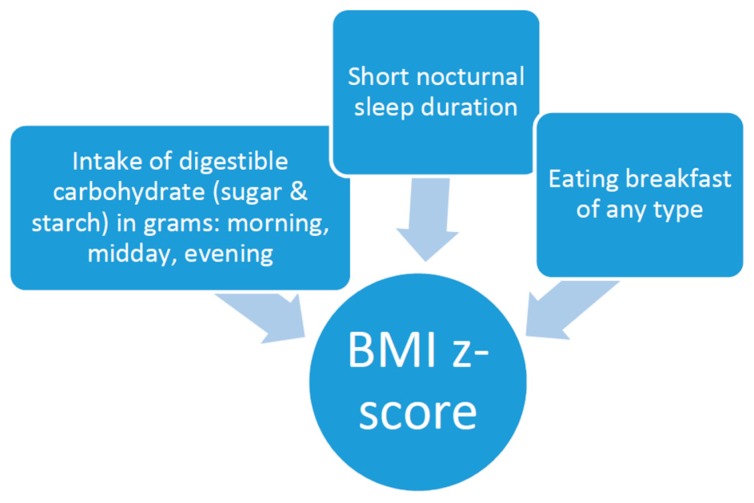
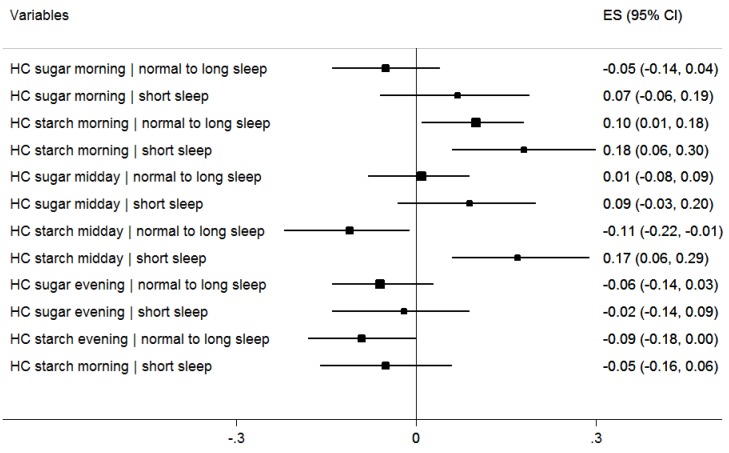
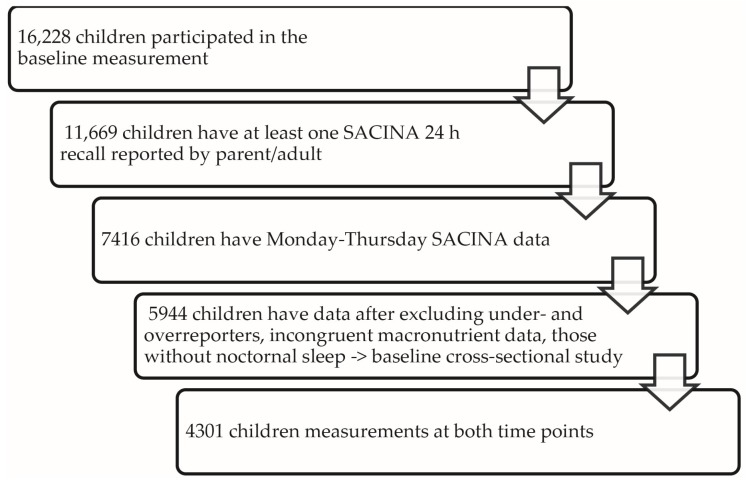
Previous research has found an association between being overweight and short sleep duration. We hypothesized that this association could be modified by a high carbohydrate (HC) diet and that the timing and type (starch or sugar) of intake may be an important factor in this context. Participants in the prospective, eight-country European study IDEFICS were recruited from September 2007 to June 2008, when they were aged two to nine years. Data on lifestyle, dietary intake and anthropometry were collected on two occasions. This study included 5944 children at baseline and 4301 at two-year follow-up. For each meal occasion (morning, midday, and evening), starch in grams and sugar in grams were divided by total energy intake (EI), and quartiles calculated. HC-starch and HC-sugar intake categories were defined as the highest quartile for each meal occasion. In a mutually adjusted linear regression model, short sleep duration as well as HC-starch in the morning were positively associated with body mass index (BMI) z-scores at baseline. HC-starch at midday was positively associated with body mass index (BMI) z-scores in children with short sleep duration, and negatively associated with BMI z-scores in those with normal sleep. After adjustment for baseline BMI z-scores, associations between total HC from starch or sugar and high BMI z-scores at two-year follow-up did not persist. Our observations offer a perspective on optimal timing for macronutrient consumption, which is known to be influenced by circadian rhythms. Reduced carbohydrate intake, especially during morning and midday meals, and following nocturnal sleep duration recommendations are two modifiable factors that may protect children from being overweight in the future.
先前的研究发现超重与短睡眠时间之间存在关联。我们假设这种关联可能会受到高碳水化合物(HC)饮食的影响,并且在此背景下,摄入的时间和类型(淀粉或糖)可能是一个重要因素。前瞻性八国欧洲研究IDEFICS的参与者于2007年9月至2008年6月招募,当时他们的年龄在2至9岁之间。在两个时间点收集了生活方式、饮食摄入和人体测量数据。本研究在基线时有5944名儿童,两年随访时有4301名儿童。对于每餐(早餐、午餐和晚餐),将淀粉克数和糖克数除以总能量摄入(EI),并计算四分位数。HC-淀粉和HC-糖摄入类别被定义为每餐的最高四分位数。在相互调整的线性回归模型中,短睡眠时间以及早餐时的HC-淀粉与基线时的体重指数(BMI)z评分呈正相关。午餐时的HC-淀粉与短睡眠时间儿童的体重指数(BMI)z评分呈正相关,而与睡眠正常儿童的BMI z评分呈负相关。在调整基线BMI z评分后,两年随访时来自淀粉或糖的总HC与高BMI z评分之间的关联不再持续。我们的观察结果为常量营养素消费的最佳时间提供了一个视角,已知这会受到昼夜节律的影响。减少碳水化合物的摄入,尤其是在早餐和午餐时,并遵循夜间睡眠时间建议,是两个可改变的因素,可能会保护儿童未来不超重。