de Gier Camilla, Granland Caitlyn M, Pickering Janessa L, Walls Tony, Bhuiyan Mejbah, Mills Nikki, Richmond Peter C, Best Emma J, Thornton Ruth B, Kirkham Lea-Ann S
School of Medicine, University of Western Australia, Perth 6009, Australia.
Wesfarmers Centre of Vaccines and Infectious Disease, Telethon Kids Institute, Perth 6009, Australia.
Vaccines (Basel). 2019 Jan 31;7(1):14. doi: 10.3390/vaccines7010014.
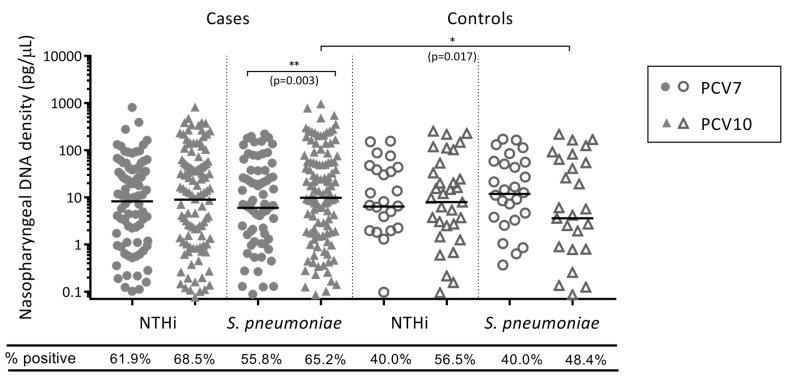
Otitis media (OM) is a major reason for antibiotic consumption and surgery in children. Nasopharyngeal carriage of otopathogens, and nontypeable (NTHi), is a prerequisite for development of OM, and increased nasopharyngeal otopathogen density correlates with disease onset. Vaccines can reduce or eliminate otopathogen carriage, as demonstrated for pneumococcal serotypes included in pneumococcal conjugate vaccines (PCV). The 10-valent PCV (PCV10) includes an NTHi carrier protein, and in 2011 superseded 7-valent PCV on the New Zealand Immunisation Program. Data are conflicting on whether PCV10 provides protection against NTHi carriage or disease. Assessing this in otitis-prone cohorts is important for OM prevention. We compared otopathogen density in the nasopharynx and middle ear of New Zealand PCV7-vaccinated and PCV10-vaccinated otitis-prone and non-otitis-prone children to determine PCV10 impact on NTHi and carriage. We applied qPCR to specimens collected from 217 PCV7-vaccinated children (147 otitis-prone and 70 non-otitis-prone) and 240 PCV10-vaccinated children (178 otitis-prone and 62 non-otitis-prone). After correcting for age and day-care attendance, no difference was observed between NTHi density in the nasopharynx of PCV7-vaccinated versus PCV10-vaccinated otitis-prone ( = 0.563) or non-otitis-prone ( = 0.513) children. In contrast, pneumococcal nasopharyngeal density was higher in PCV10-vaccinated otitis-prone children than PCV7-vaccinated otitis-prone children ( = 0.003). There was no difference in otopathogen density in middle ear effusion from PCV7-vaccinated versus PCV10-vaccinated otitis-prone children (NTHi = 0.918; = 0.415). When pneumococcal carriage was assessed by vaccine serotypes (VT) and non-vaccine serotypes (NVT), there was no difference in VT density ( = 0.546) or NVT density ( = 0.315) between all PCV7-vaccinated versus all PCV10-vaccinated children. In summary, PCV10 did not reduce NTHi density in the nasopharynx or middle ear, and was associated with increased pneumococcal nasopharyngeal density in otitis-prone children in New Zealand. Development of therapies that prevent or reduce otopathogen colonisation density in the nasopharynx are warranted to reduce the burden of OM.
中耳炎(OM)是儿童使用抗生素和进行手术的主要原因。耳病原体在鼻咽部的携带,尤其是不可分型流感嗜血杆菌(NTHi),是中耳炎发病的先决条件,鼻咽部耳病原体密度增加与疾病发作相关。疫苗可以减少或消除耳病原体携带,如肺炎球菌结合疫苗(PCV)中包含的肺炎球菌血清型所证明的那样。10价PCV(PCV10)包含一种NTHi载体蛋白,并于2011年在新西兰免疫规划中取代了7价PCV。关于PCV10是否能预防NTHi携带或疾病的数据存在矛盾。在易患中耳炎的队列中评估这一点对于预防中耳炎很重要。我们比较了新西兰接种PCV7和PCV10的易患中耳炎和不易患中耳炎儿童的鼻咽部和中耳的耳病原体密度,以确定PCV10对NTHi携带的影响。我们对从217名接种PCV7的儿童(147名易患中耳炎和70名不易患中耳炎)和240名接种PCV10的儿童(178名易患中耳炎和62名不易患中耳炎)收集的标本进行了定量聚合酶链反应(qPCR)。在校正年龄和日托出勤情况后,接种PCV7和接种PCV10的易患中耳炎儿童(P = 0.563)或不易患中耳炎儿童(P = 0.513)的鼻咽部NTHi密度之间没有差异。相比之下,接种PCV10的易患中耳炎儿童的肺炎球菌鼻咽部密度高于接种PCV7的易患中耳炎儿童(P = 0.003)。接种PCV7和接种PCV10的易患中耳炎儿童的中耳积液中的耳病原体密度没有差异(NTHi:P = 0.918;肺炎球菌:P = 0.415)。当按疫苗血清型(VT)和非疫苗血清型(NVT)评估肺炎球菌携带情况时,所有接种PCV7的儿童与所有接种PCV10的儿童之间的VT密度(P = 0.546)或NVT密度(P = 0.315)没有差异。总之,PCV10没有降低鼻咽部或中耳的NTHi密度,并且与新西兰易患中耳炎儿童的肺炎球菌鼻咽部密度增加有关。有必要开发预防或降低鼻咽部耳病原体定植密度的疗法,以减轻中耳炎的负担。