Department of Microbiology and Immunology, University of Rochester School of Medicine and Dentistry, Rochester, NY 14642, United States.
Department of Microbiology and Immunology, University of Rochester School of Medicine and Dentistry, Rochester, NY 14642, United States.
Curr Opin Microbiol. 2019 Feb;47:66-73. doi: 10.1016/j.mib.2018.12.001. Epub 2019 Jan 31.
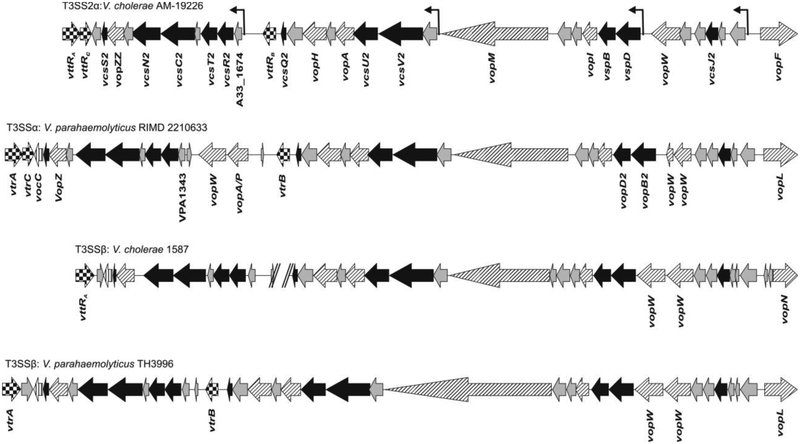
Mounting evidence suggests that Type 3 Secretion Systems (T3SS) are widespread among Vibrio species, and are present in strains isolated from diverse sources such as human clinical infections, environmental reservoirs, and diseased marine life. Experiments evaluating Vibrio parahaemolyticus and Vibrio cholerae T3SS mediated virulence suggest that Vibrio T3SS pathogenicity islands have a tripartite composition. A conserved 'core' region encodes functions essential for colonization and disease in vivo, including modulation of innate immune signaling pathways and actin dynamics, whereas regions flanking core sequences are variable among strains and encode effector proteins performing a diverse array of activities. Characterizing novel functions associated with Vibrio-specific effectors is, therefore, essential for understanding how vibrios employ T3SS mechanisms to cause disease in a broad range of hosts and how T3SS island composition potentially defines species-specific disease.
越来越多的证据表明,III 型分泌系统(T3SS)在弧菌属中广泛存在,并且存在于从人类临床感染、环境储层和患病海洋生物等各种来源分离的菌株中。评估副溶血性弧菌和霍乱弧菌 T3SS 介导的毒力的实验表明,弧菌 T3SS 致病岛具有三分体组成。一个保守的“核心”区域编码对体内定植和疾病至关重要的功能,包括调节先天免疫信号通路和肌动蛋白动力学,而核心序列侧翼的区域在菌株间具有变异性,并且编码执行各种活性的效应蛋白。因此,鉴定与弧菌特异性效应物相关的新功能对于理解弧菌如何利用 T3SS 机制在广泛的宿主中引起疾病以及 T3SS 岛组成如何潜在地定义物种特异性疾病至关重要。