Center for Personalized Therapeutics, The University of Chicago, Chicago, IL, USA.
Department of Health Sciences, The University of Chicago, Chicago, IL, USA.
Pharmacogenomics J. 2019 Dec;19(6):528-537. doi: 10.1038/s41397-019-0076-2. Epub 2019 Feb 4.
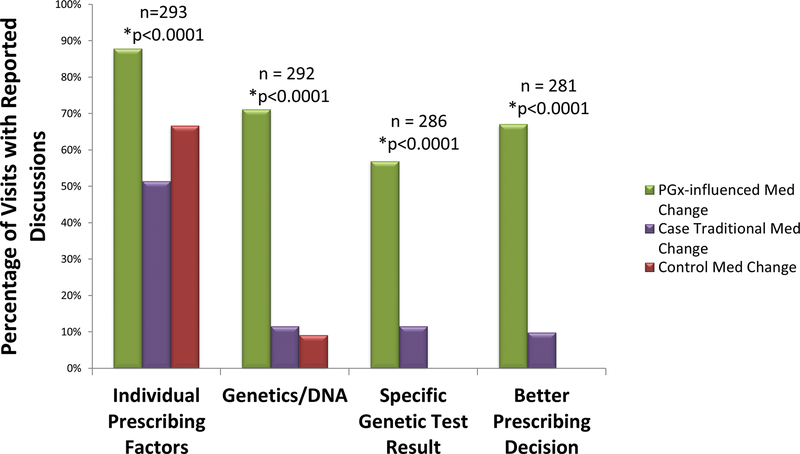
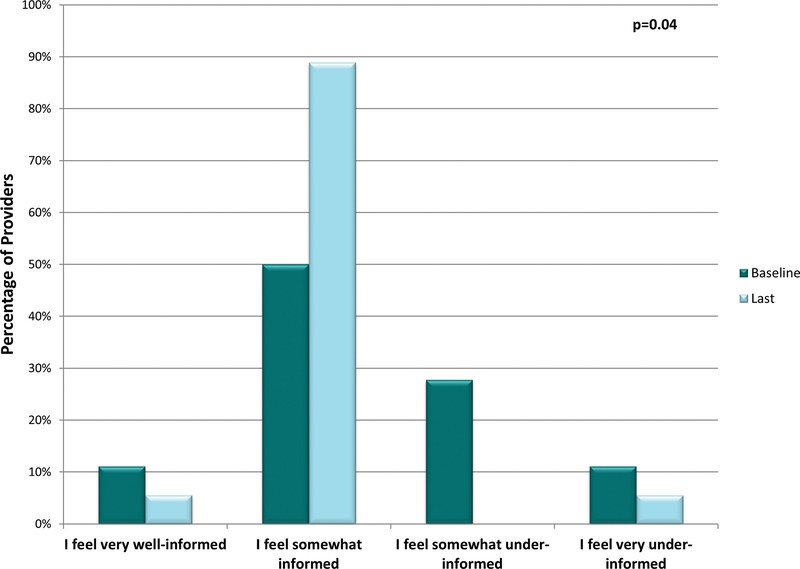
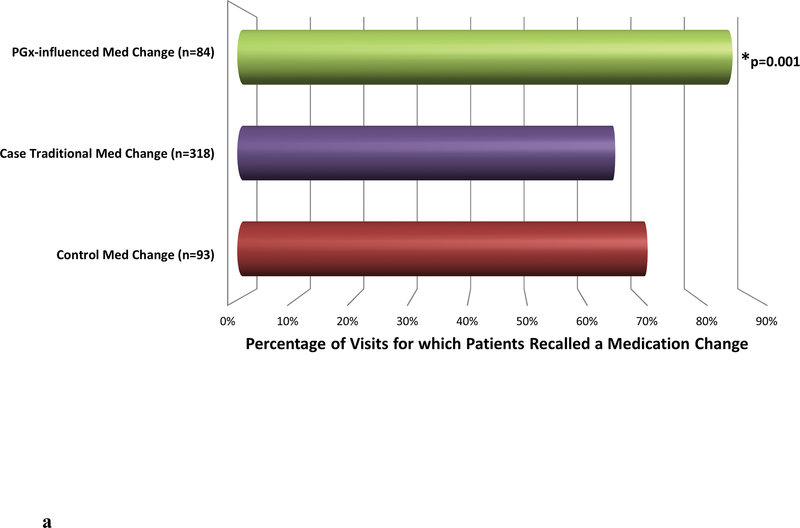
Effective doctor-patient communication is critical for disease management, especially when considering genetic information. We studied patient-provider communications after implementing a point-of-care pharmacogenomic results delivery system to understand whether pharmacogenomic results are discussed and whether medication recall is impacted. Outpatients undergoing preemptive pharmacogenomic testing (cases), non-genotyped controls, and study providers were surveyed from October 2012-May 2017. Patient responses were compared between visits where pharmacogenomic results guided prescribing versus visits where pharmacogenomics did not guide prescribing. Provider knowledge of pharmacogenomics, before and during study participation, was also analyzed. Both providers and case patients frequently reported discussions of genetic results after visits where pharmacogenomic information guided prescribing. Importantly, medication changes from visits where pharmacogenomics influenced prescribing were more often recalled than non-pharmacogenomic guided medication changes (OR = 3.3 [1.6-6.7], p = 0.001). Case patients who had separate visits where pharmacogenomics did and did not, respectively, influence prescribing more often remembered medication changes from visits where genomic-based guidance was used (OR = 3.4 [1.2-9.3], p = 0.02). Providers also displayed dramatic increases in personal genomic understanding through program participation (94% felt at least somewhat informed about pharmacogenomics post-participation, compared to 61% at baseline, p = 0.04). Using genomic information during prescribing increases patient-provider communications, patient medication recall, and provider understanding of genomics, important ancillary benefits to clinical use of pharmacogenomics.
有效的医患沟通对于疾病管理至关重要,尤其是在考虑遗传信息时。我们研究了实施床边药物基因组学结果传递系统后的医患沟通,以了解是否讨论了药物基因组学结果以及是否影响药物召回。从 2012 年 10 月至 2017 年 5 月,对接受预防性药物基因组学检测的门诊患者(病例)、未进行基因分型的对照患者和研究提供者进行了调查。比较了药物基因组学指导处方的就诊与未指导处方的就诊时患者的反应。还分析了研究参与前后提供者对药物基因组学的了解。提供者和病例患者经常报告在药物基因组学信息指导处方的就诊后讨论遗传结果。重要的是,与非药物基因组学指导的药物变化相比,药物基因组学指导处方的就诊时药物变化的记忆更频繁(OR=3.3[1.6-6.7],p=0.001)。分别有一次就诊时药物基因组学分别影响和不影响处方的病例患者,更经常记得使用基于基因组的指导的就诊时的药物变化(OR=3.4[1.2-9.3],p=0.02)。通过计划参与,提供者对个人基因组学的理解也有了显著提高(与基线时的 61%相比,94%的人在参与后至少对药物基因组学有一定了解,p=0.04)。在处方中使用基因组信息会增加医患沟通、患者药物记忆和提供者对基因组学的理解,这是药物基因组学临床应用的重要辅助益处。