Chaumard Noël, Defouilloy Céline, Kita Noriko T
WiscSIMS, Department of Geoscience, University of Wisconsin-Madison, 1215 W. Dayton Street, Madison, WI 53706-1692, USA.
Geochim Cosmochim Acta. 2018 May 1;228:220-242. doi: 10.1016/j.gca.2018.02.040. Epub 2018 Mar 5.
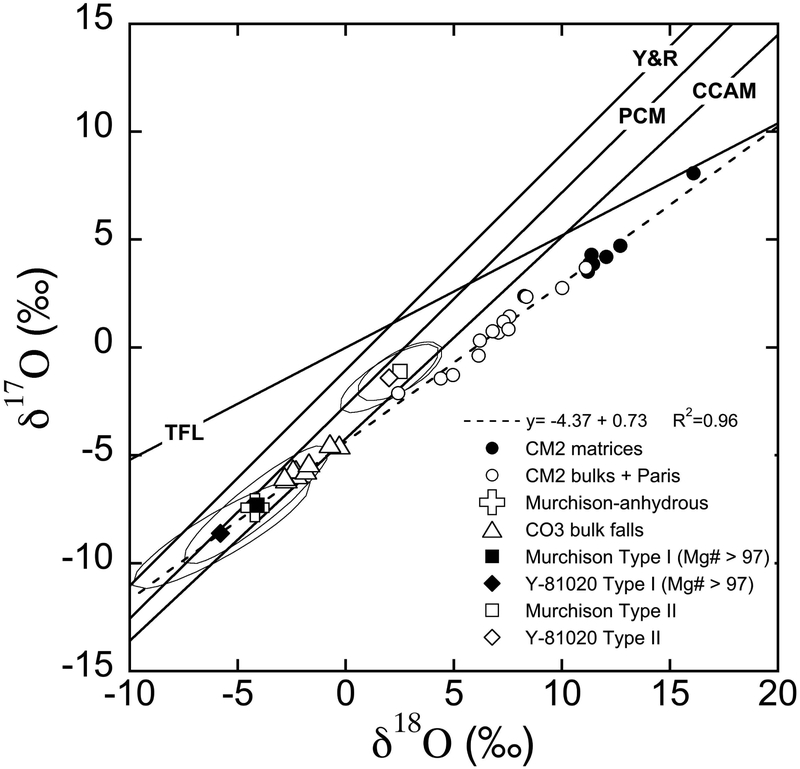
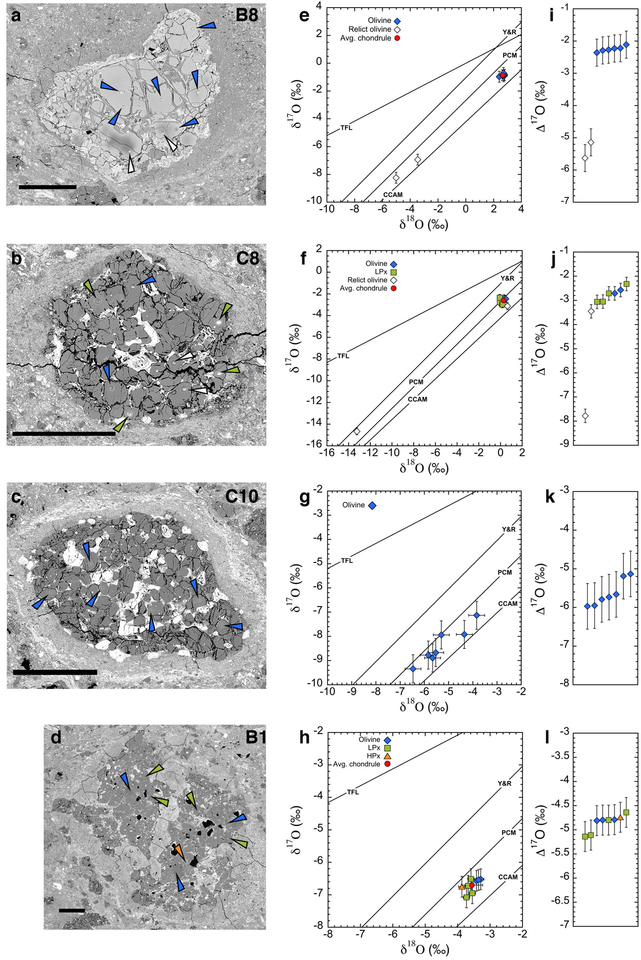
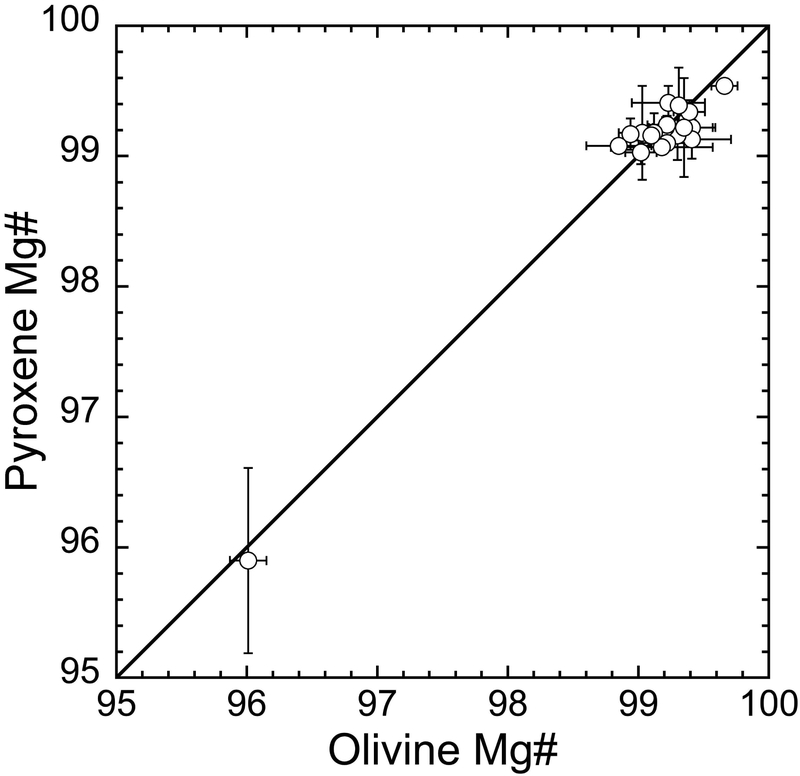
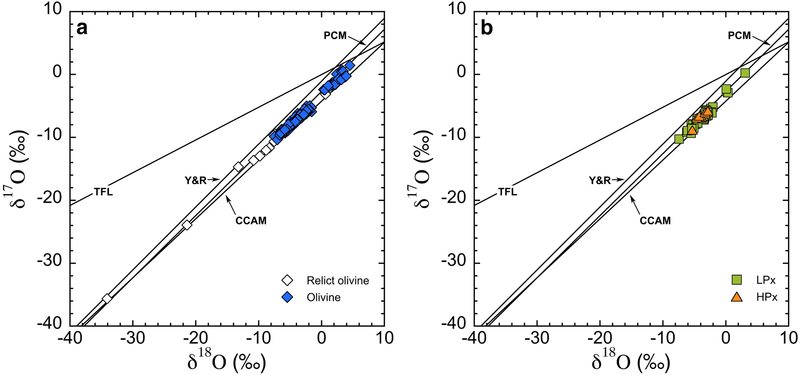
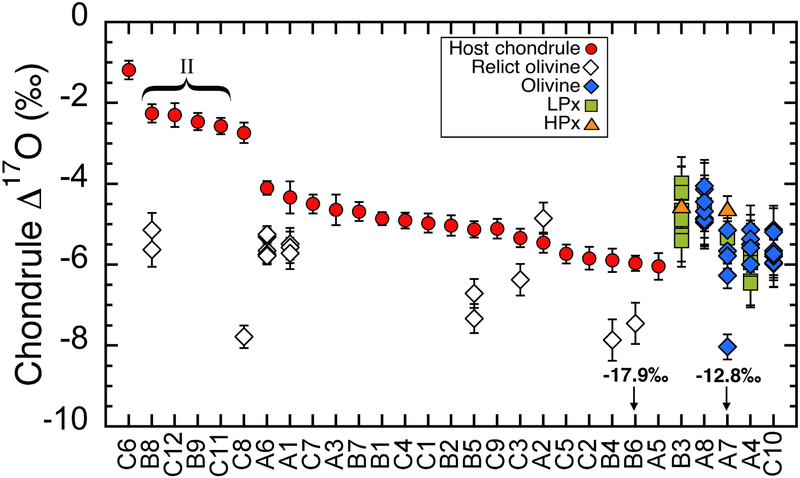
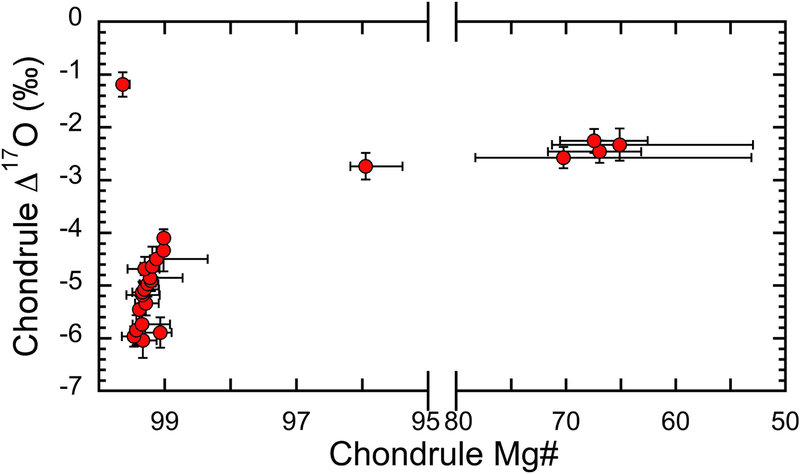
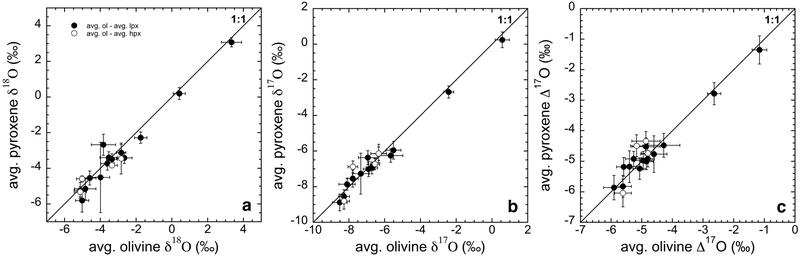
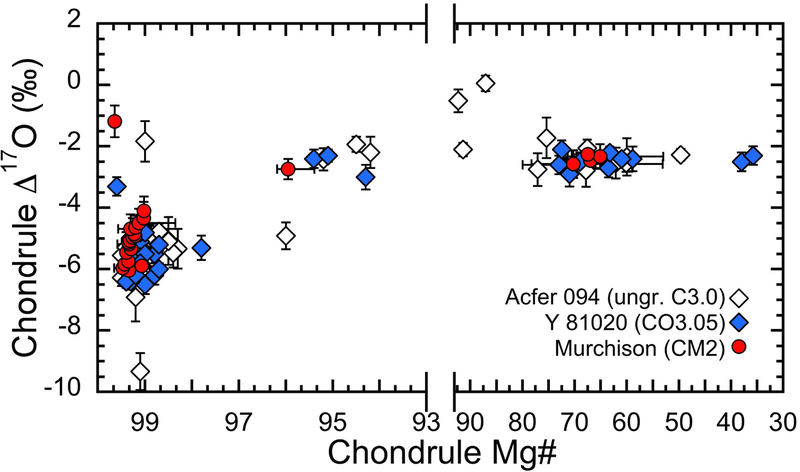
High-precision oxygen three-isotope measurements of olivine and pyroxene were performed on 29 chondrules in the Murchison CM2 chondrite by secondary ion mass spectrometry (SIMS). The oxygen isotope ratios of analyzed chondrules all plot very close to the primitive chondrule minerals (PCM) line. In each of 24 chondrules, the olivine and/or pyroxene grains analyzed show indistinguishable oxygen isotope ratios. Exceptions are minor occurrences of isotopically distinguished relict olivine grains, which were found in nine chondrules. The isotope homogeneity of these phenocrysts is consistent with a co-magmatic crystallization of olivine and pyroxene from the final chondrule melts and a significant oxygen isotope exchange between the ambient gas and the melts. Homogeneous type I chondrules with Mg#'s of 98.9-99.5 have host chondrule ΔO values ranging from -6.0‰ to -4.1‰, with one exception (ΔO: -1.2‰; Mg#: 99.6). Homogeneous chondrules with Mg#'s <96, including four type II chondrules (Mg# 65-70), have ΔO values of around -2.5%. Five type I chondrules (Mg# ≥99) have internally heterogeneous oxygen isotope ratios with ΔO values ranging from -6.5% to -4.0%, similar to those of host chondrule values. These heterogeneous chondrules have granular or porphyritic textures, convoluted outlines, and contain numerous metal grains dispersed within fine-grained silicates. This is consistent with a low degree of melting of the chondrule precursors, possibly because of a low temperature of the melting event and/or a shorter duration of melting. The ΔO values of relict olivine grains in nine chondrules range from -17.9% to -3.4%, while most of them overlap the range of the host chondrule values. Similar to those reported from multiple carbonaceous chondrites (Acfer 094, Y-82094, CO, CR, and CV), the ΔO ~-5% and high Mg# (≥99) chondrules, which might derive from a reduced reservoir with limited dust enrichments (50× Solar System), dominate the population of chondrules in Murchison. Other chondrules in Murchison formed in more oxidizing environment (Mg#<96) with higher ΔO values of -2.5%, in agreement with the low Mg# chondrules in Acfer 094 and CO chondrites and some chondrules in CV and CR chondrites. They might form in environments containing the same anhydrous precursors as for the ΔO -5% and Mg# ~99 chondrules, but enriched in O-poor H2O ice (0.3-0.4× the CI dust; Δ0>0%) and at dust enrichments of ~300-2000×. Regarding the Mg# and oxygen isotope ratios, the chondrule populations sampled by CM and CO chondrites are similar and indistinguishable. The similarity of these O-rich components in CO and CM chondrites is also supported by the common Fe/Mn ratio of olivine in type II chondrules. Although they accreted similar high-temperature silicates, CO chondrites are anhydrous compared to CM chondrites, suggesting they derived from different parent bodies formed inside and outside the snow line, respectively. If chondrules in CO and CM chondrites formed at the same disk locations but the CM parent body accreted later than the CO parent body, the snow line might have crossed the the common chondrule-forming region towards the Sun between the time of the CO and CM parent bodies accretion.
利用二次离子质谱仪(SIMS)对默奇森CM2球粒陨石中的29个球粒进行了橄榄石和辉石的高精度氧三同位素测量。分析的球粒的氧同位素比值都非常接近原始球粒矿物(PCM)线。在24个球粒中的每一个中,分析的橄榄石和/或辉石颗粒显示出无法区分的氧同位素比值。例外情况是在9个球粒中发现了少量同位素可区分的残余橄榄石颗粒。这些斑晶的同位素均匀性与橄榄石和辉石从最终球粒熔体中共岩浆结晶以及环境气体与熔体之间显著的氧同位素交换相一致。Mg#为98.9 - 99.5的均匀I型球粒的球粒主体ΔO值范围为 - 6.0‰至 - 4.1‰,有一个例外(ΔO: - 1.2‰;Mg#:99.6)。Mg# <96的均匀球粒,包括4个II型球粒(Mg#约为65 - 70),其ΔO值约为 - 2.5%。5个I型球粒(Mg#≥99)具有内部不均匀的氧同位素比值,ΔO值范围为 - 6.5%至 - 4.0%,与球粒主体值相似。这些不均匀球粒具有粒状或斑状结构、曲折的轮廓,并且在细粒硅酸盐中含有许多分散的金属颗粒。这与球粒前体的低程度熔融一致,可能是由于熔融事件的低温和/或较短的熔融持续时间。9个球粒中残余橄榄石颗粒的ΔO值范围为 - 17.9%至 - 3.4%,而它们中的大多数与球粒主体值范围重叠。与多个碳质球粒陨石(Acfer 094、Y - 82094、CO、CR和CV)报道的情况类似,ΔO约为 - 5%且Mg#(≥99)的球粒可能源自一个尘埃富集有限(约50倍太阳系)的还原储库,在默奇森球粒中占主导地位。默奇森中的其他球粒在更氧化的环境(Mg#<96)中形成,ΔO值较高,为 - 2.5%,这与Acfer 094和CO球粒陨石中的低Mg#球粒以及CV和CR球粒陨石中的一些球粒一致。它们可能在与ΔO约为 - 5%且Mg#约为99的球粒相同的无水前体环境中形成,但富含贫氧的H2O冰(约0.3 - )。